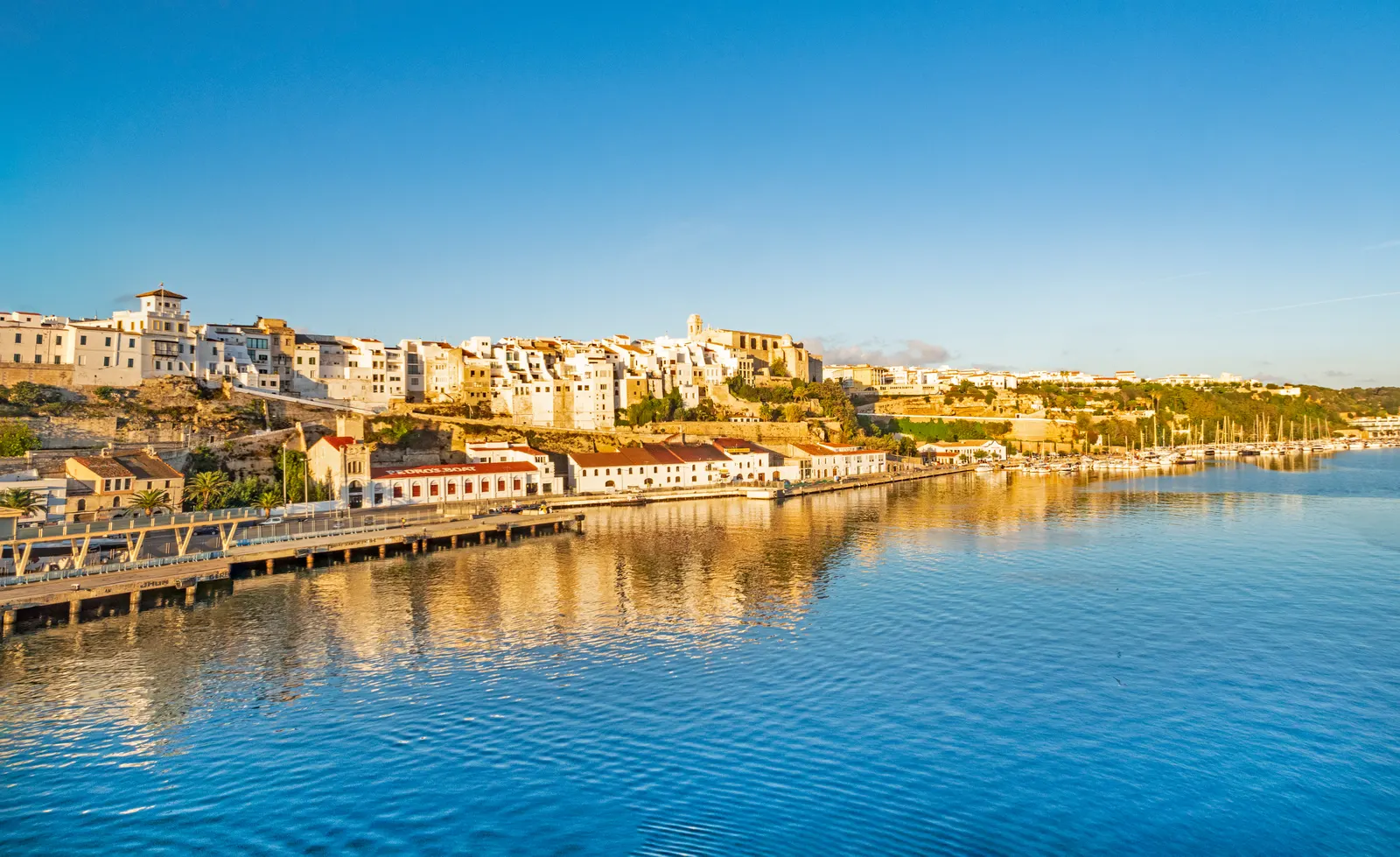
Some cities show themselves off; others simply breathe. Maó —Mahón in its Spanish form— belongs to the second kind. The capital of Menorca does not try to dazzle you all at once: it gives itself slowly, to anyone who walks down to the water, lifts their gaze towards the houses on both shores and understands that the protagonist here is not a monument but a harbour. One of the largest and deepest natural harbours in the Mediterranean, a long tongue of sea that reaches several kilometres inland and that, for centuries, made this island a prize coveted by the great powers.
That rivalry left its mark, and the mark is precisely what makes Maó a different sort of capital. The British governed Menorca for much of the eighteenth century and brought with them their architecture, their customs and even their gin. That is why, strolling through the upper town, you come across sash windows, façades with a Georgian air and an elegant restraint unlike that of any other Spanish city. Maó does not shout its history: it lets you glimpse it, the way one shares a secret.
This is our guide to discovering Maó with the eye of quiet luxury: not the hurried version of someone crossing it on the way to the beach, but the unhurried one, which understands that the real luxury here is time. Time to watch the water, to climb up to a distillery, to cross by boat to an island where a hospital has become art. Time, in short, to let the serene capital of Menorca teach you its rhythm.
The essentials
- What it is: the capital of Menorca, at the eastern tip of the island, looking out over a great natural harbour.
- Who it’s for: anyone seeking history, walking, food and still water rather than a city beach.
- Recommended time: half a day for the essentials; a full day to savour it.
- Must-sees: the harbour, the upper town, the Mercat des Claustre, the gin distillery and the Illa del Rei.
- Best time of day: early morning and sunset down by the water.
- How to enjoy it: slowly, alternating between the upper town and the harbour shore, with no rigid agenda.
A harbour that explains the whole city
To understand Maó you have to understand its harbour. It is no ordinary port: it is a sea inlet almost six kilometres long, narrow and deep, sheltered from the swell and the winds. That exceptional geography explains why the British, French and Spanish fought over the island during the eighteenth century, and why Maó grew up facing the water rather than turning its back on it.
Today that same harbour is the city’s serene heart. The upper part, with its streets, squares and churches, looks down from the top of the cliff; below, at the water’s edge, runs a shore of old warehouses, fishing boats and terraces. Between the two there are ramps and stairways —such as the famous costa de ses Voltes— that turn the simple act of walking down to the harbour into a little stroll with a view. Walking that transition, from the noble stone above to the reflection of the water below, is already half the visit.
The British legacy: why Maó looks like nowhere else
Almost a century of British presence left Maó with a stamp that is still alive. The first thing that betrays that heritage are the sash windows, those panes that slide up and down vertically, so un-Mediterranean and so typical of the English architecture of the period. They appear on discreet façades in the upper town, almost like a game for the attentive traveller.
To that legacy you can add a Georgian air in some houses and public buildings: sober proportions, symmetry and a restrained elegance. To enjoy it you don’t need a fixed itinerary; it is enough to walk unhurriedly through the old town, look up and let the details surprise you. It is a silent luxury, that of uncovering a history that is not paraded on great signs but hidden in the frame of a window.
The gin of Maó: from harbour to glass
If the British brought one custom that took root, it was that of gin. Menorca adopted it, made it its own, and today still distils it beside the harbour, at the historic Xoriguer distillery, right at the water’s edge. Visiting its shop and looking in on the process is a wonderful way to bring together history, craft and flavour in a single stop.
The most Menorcan way to try it is the pomada: gin with lemonade, cool and easy-going, the drink that accompanies the island’s festivals and its summer sunsets. Sip it slowly, on a terrace by the harbour, like a quiet toast to the fading afternoon. If you’d rather get to know the gin in its pure state, ask at the distillery itself and check current opening hours before you go, as they may vary with the season.
The Illa del Rei: art on an old hospital
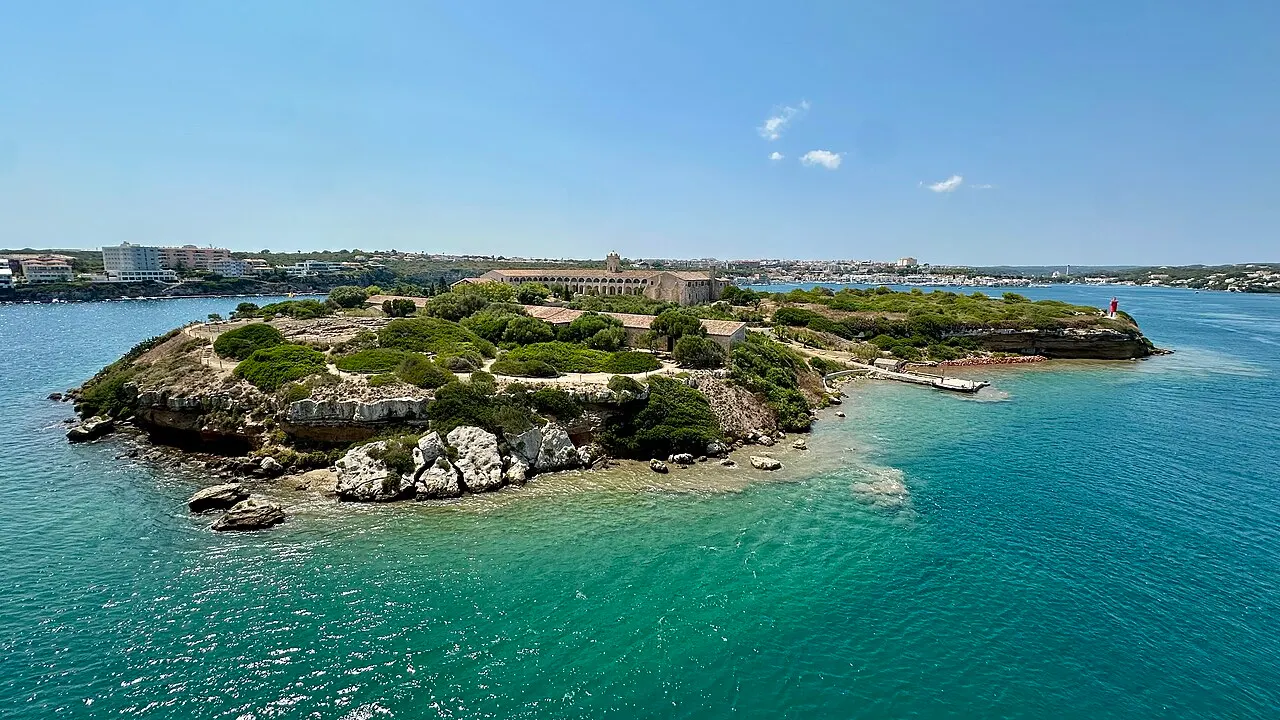
In the middle of the harbour stands a small island with an enormous history: the Illa del Rei, which for centuries housed a quarantine station and a naval hospital, built in the British era to care for sailors. After decades of neglect, a group of volunteers rescued it from oblivion, and since 2021 it has also been home to Hauser & Wirth Menorca, a branch of the prestigious international gallery, set among gardens.
Visiting it is an experience of absolute calm. You reach it by boat from the harbour of Maó, in a short crossing that is worth the trip in itself: the still water, the shores drawing away, the city seen from within its own harbour. Once on the island, time slows down amid historic architecture, contemporary art and Mediterranean greenery. It is wise to check opening hours and the season of operation, as well as the boat timetable, before planning the excursion.
The Mercat des Claustre and life in the upper town
The upper town has its own pulse, and few places concentrate it like the Mercat des Claustre, a former cloister turned into a market and meeting place. Among its arches you’ll find stalls of local produce, small shops and cafés where you can sit and watch the morning go by. It is the perfect place for an unscripted pause: a coffee, a conversation, the discovery of a cheese or an island pastry.
All around, the streets of the centre invite you to walk slowly. Quiet squares, churches, lifelong shops and viewpoints that suddenly hand you back the image of the harbour down below. There is no need to see it all or tick boxes: the charm of Maó’s upper town lies in letting yourself drift and allowing one street to lead you to the next.
Golden Farm and the harbour views
Among the houses dotted along the harbour, one stands out for its history and its colour: the so-called Golden Farm, an estate with a reddish façade looking onto the water from the northern shore. Local legend links it to Admiral Nelson, though its real interest today is scenic: it forms part of that line of buildings that give the harbour of Maó its unmistakable silhouette.
It is not a monument you visit from the inside, but a feature of the landscape worth knowing how to read. From different points of the harbour, and especially from the water if you take the boat crossing, you can better appreciate how the houses, the old barracks and the fortifications are spread across the two shores, together telling the city’s military and seafaring story.
How to experience Maó calmly
Maó rewards the unhurried traveller. Our first recommendation is to rise early: the first hours of the morning, with the upper town cool and almost empty, are the best moment to walk without crowds and discover the details —the sash windows, the viewpoints, the silence of the squares— that fade into the bustle later in the day.
By midday, head down to the harbour without watching the clock. Walk the shore, look in on the distillery, sit down to eat facing the water. And save the sunset for the end: the light turns golden over the two shores and the harbour grows still. In high season there are more people and more heat, so avoid the central hours and let dawn and dusk set the rhythm. Respect the surroundings —the harbour is a living, fragile space— lower your voice, and let the city pass on its calm to you.
When to go
Maó can be enjoyed all year round. Spring and autumn are, for us, its finest version: mild temperatures, clear light, quiet streets and unhurried terraces. Summer fills the city with atmosphere and stretches out the evenings, but it also brings heat and bigger crowds; if you travel in those months, take refuge in the gentler hours of the day. Winter reveals the most authentic and serene face of the capital, that of an island living behind its own doors.
Whatever the season, the harbour is always there, serene, reminding you that in Maó luxury is measured in time and in silence.
Our take
Maó is not a city of quick postcards, and that is exactly where its worth lies. It is a capital of layers —military, British, seafaring, contemporary— that reveal themselves to whoever walks it calmly. Our advice is to split the visit in two: an early morning for the upper town and its details, and an afternoon by the harbour that ends with a pomada at sunset or, better still, with the boat crossing to the Illa del Rei.
If we had to keep just one idea, it would be this: don’t cross Maó on your way somewhere else. Go down to the water, sit, look. The serene capital of Menorca is not conquered; it is accompanied. And in that unhurried company —the island’s true quiet luxury— lies everything worth remembering.