Menorca ends at its lighthouses. Raised where the land surrenders to the sea, they are the island’s most honest viewpoints: no terraces, no background music, no queue for a photo. Just wind, rock and a horizon that seems never to end. To visit them is to understand the real Menorca — the one that exists 365 days a year, not the one that fits on an August postcard.
They are also a serene way to travel the island by its extremes. Each lighthouse faces a different point of the compass, guards a stretch of coast with its own character, and holds stories of shipwrecks, keepers and centuries of sleepless nights before the Mediterranean. You needn’t be a sailor to feel it: it is enough to reach the end of the road, where the tarmac gives up and the blue begins.
In this guide we cover the lighthouses with local judgement: what they are like, when each one is worth the trip, how to get there without surprises, and what to expect from the light — that raw material which in Menorca is almost a character in its own right.
Key facts
- How many: the island has several landmark lighthouses; the essential ones are Favàritx, Cap de Cavalleria, Punta Nati, Cap d’Artrutx and Illa de l’Aire.
- When to go: at dawn or dusk, when the low light turns the rock to gold and the midday heat eases off.
- Access: you drive to nearby car parks; the final stretch is usually on foot. The towers cannot be entered (they are working maritime signalling installations).
- What to bring: closed shoes, water, a windbreaker and, in summer, a cap. In the north, the tramontana wind can be fierce.
- Time to allow: between 45 minutes and a couple of hours per lighthouse if you stay for sunset, which is how they should be experienced.
Why Menorca has so many lighthouses
Menorca has been a Biosphere Reserve since 1993, an island of a long, wild coastline, almost entirely traced by the Camí de Cavalls (GR-223), the historic path of some 185 kilometres that loops around the island. That coast, especially in the north, is dark, low and treacherous rock: for centuries it was a trap for ships entering and leaving the western Mediterranean.
The lighthouses were born of that need. Through the nineteenth and twentieth centuries, towers rose on the most exposed capes to guide navigation and reduce wrecks. They remain in service today —now automated— but have gained a second life as natural viewpoints and as the island’s quiet symbols. Each is a different full stop on the map.
Favàritx: the lunar lighthouse of the northeast
If you could see only one, make it Favàritx. It stands on a cape in the northeast, within the s’Albufera des Grau Natural Park, over a landscape of black, folded slate that looks like another planet. There is no green here; there is metallic rock, salt pools and a sea that, on windy days, breaks with a hypnotic violence.
The tower, white with dark bands, contrasts with that dark ground in an almost theatrical way. It is Menorca’s most dramatic lighthouse and a photographers’ favourite: it works under clear skies and equally with low cloud and a rough sea, when everything turns lead and silver.
- When to go: at dusk, or on a tramontana day if you want the wild side.
- Access: road from Maó towards the cape; car park near the tower. In high season traffic may be regulated, so it is best to go early.
- A word of caution: wet rocks are slippery; don’t approach the edge when the sea is up.
Cap de Cavalleria: the northern tip
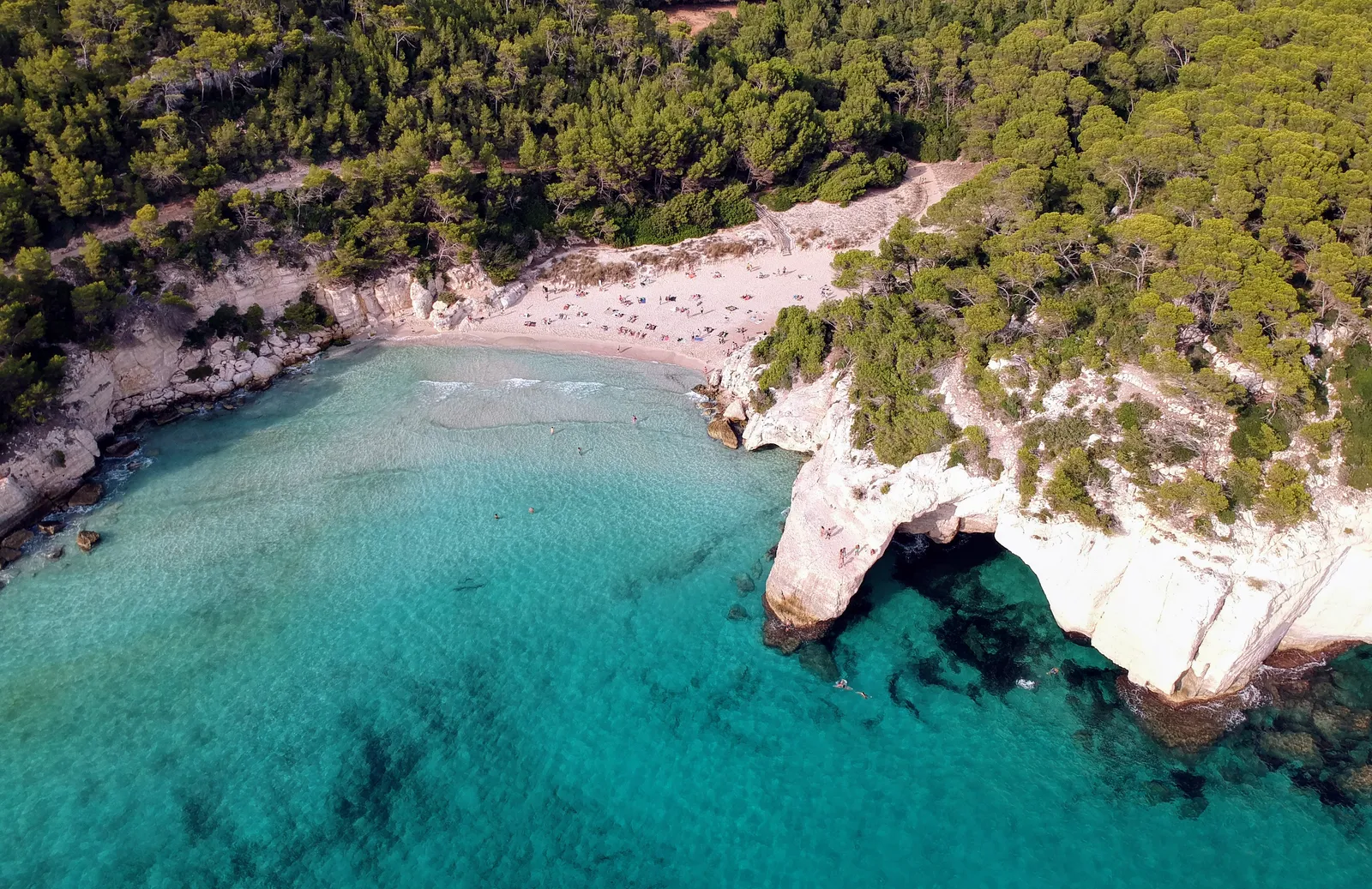
Cap de Cavalleria is the northernmost point of Menorca: the place where the island leans fully into the open sea. Here the reddish cliffs, the deep blue and the sheer vastness dominate everything. It is a lighthouse of long views, of a gentle end-of-the-world feeling.
The area offers far more than the tower: there are coves of reddish sand, archaeological remains and the trace of the old Roman town of Sanitja. It makes a fine half-day plan, combining a walk, nature and history.
- When to go: a bright morning for the colour of the sea, or dusk for the calm.
- Access: road to a car park; the final stretch on foot. In summer there may be access control or a shuttle at peak times: check up-to-date local information before you go.
- Extra: pair it with a swim in the nearby coves if the wind allows.
Punta Nati: bare stone near Ciutadella
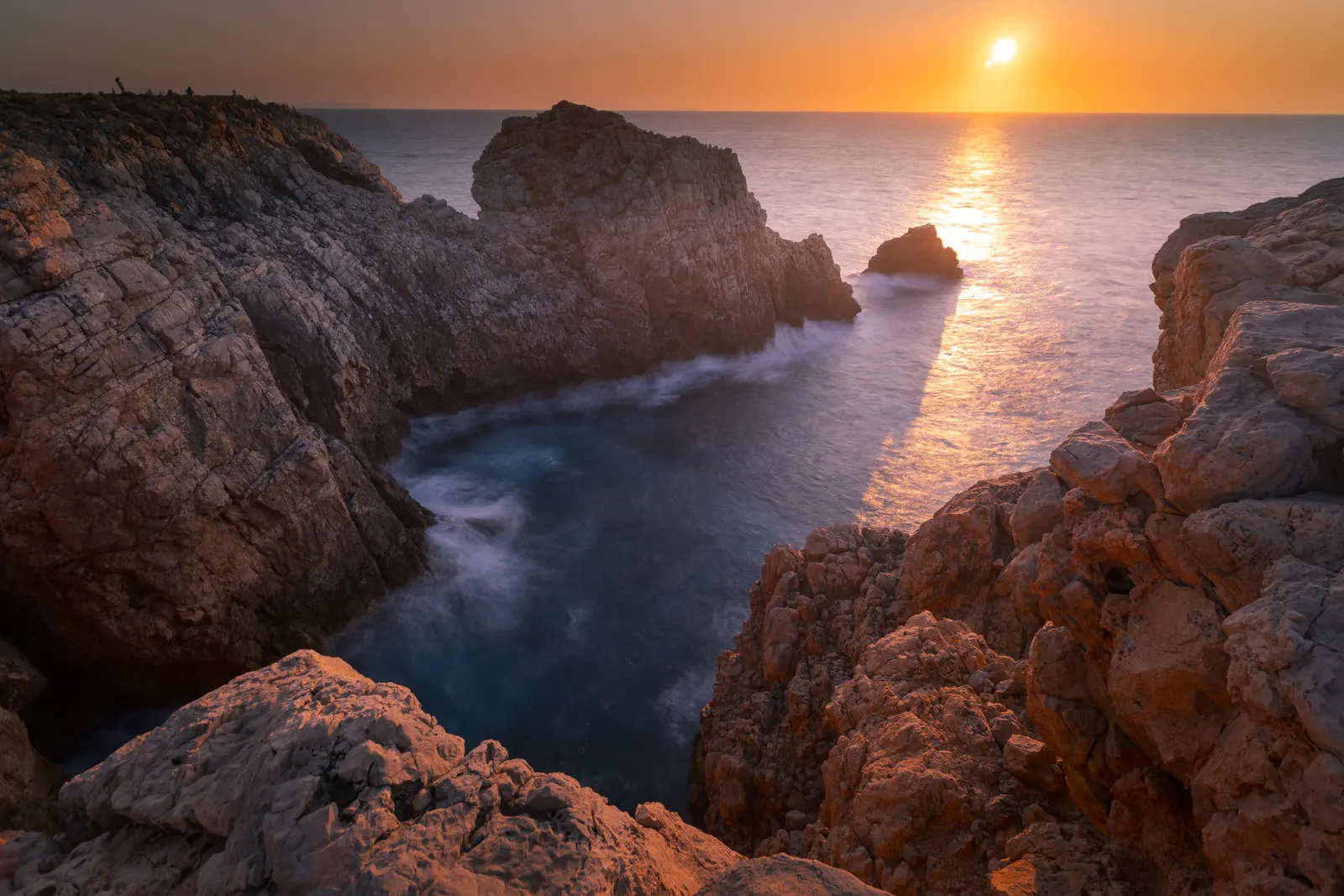
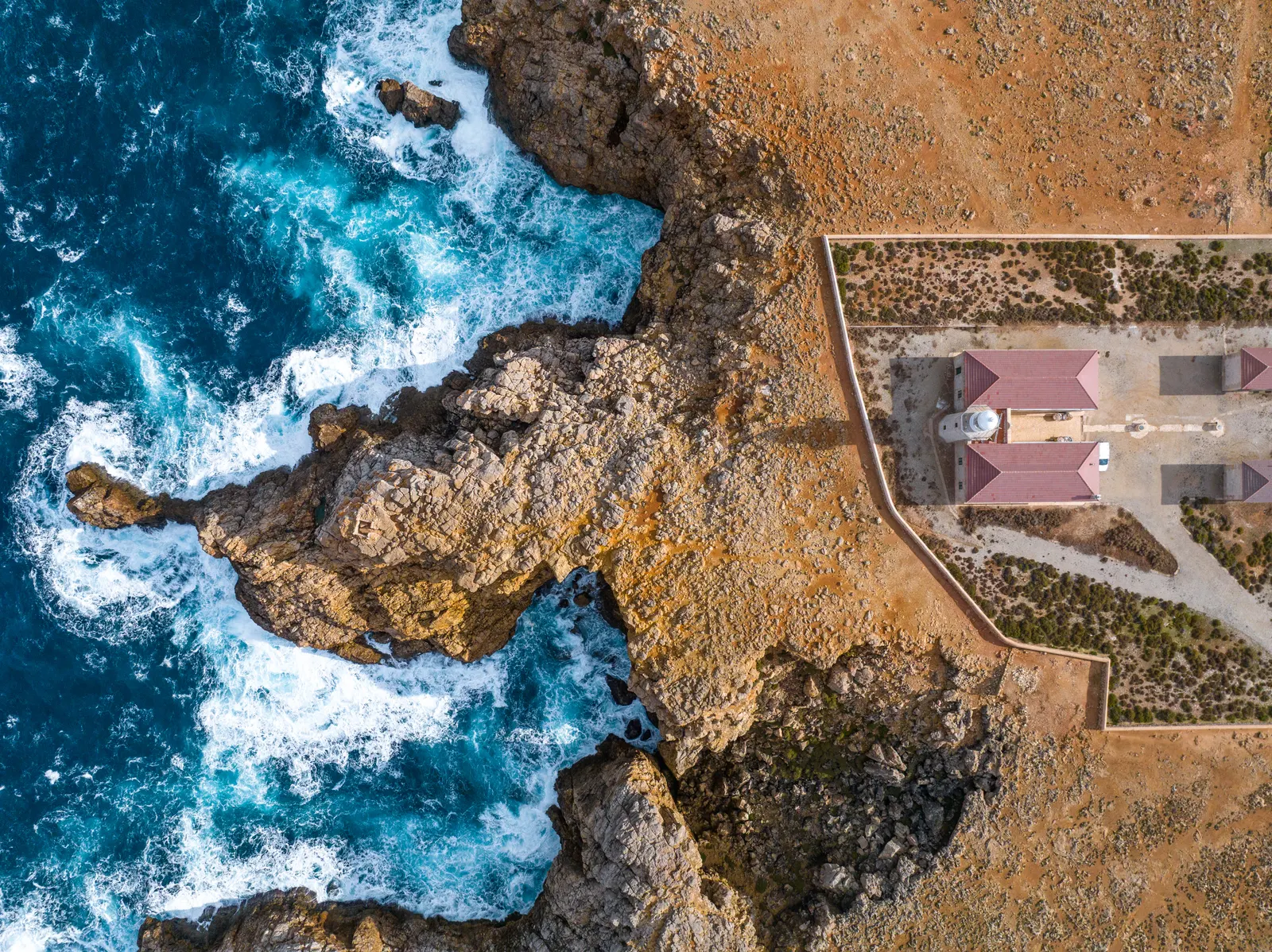
To the northwest, very close to Ciutadella, Punta Nati is the lighthouse of mineral solitude. The landscape is pure stone: dry-stone walls, ground stripped bare by the wind, and the curious shepherds’ huts (barraques) of dry stone — those traditional stepped structures that dot the Menorcan countryside.
There is no possible distraction here. It is austere, almost arid, and that is why its sunset hits so hard: the sun drops into the sea and the stone catches fire. For its closeness to Ciutadella, it is the perfect finish to an afternoon in the west of the island.
- When to go: sunset, without question. Arrive with time to find a spot in peace.
- Access: a short road from Ciutadella; the end of the track is stony.
- Tip: bring an extra layer even in the heat; once the sun sets, the wind cools quickly.
Cap d’Artrutx: sunset over the water in the southwest
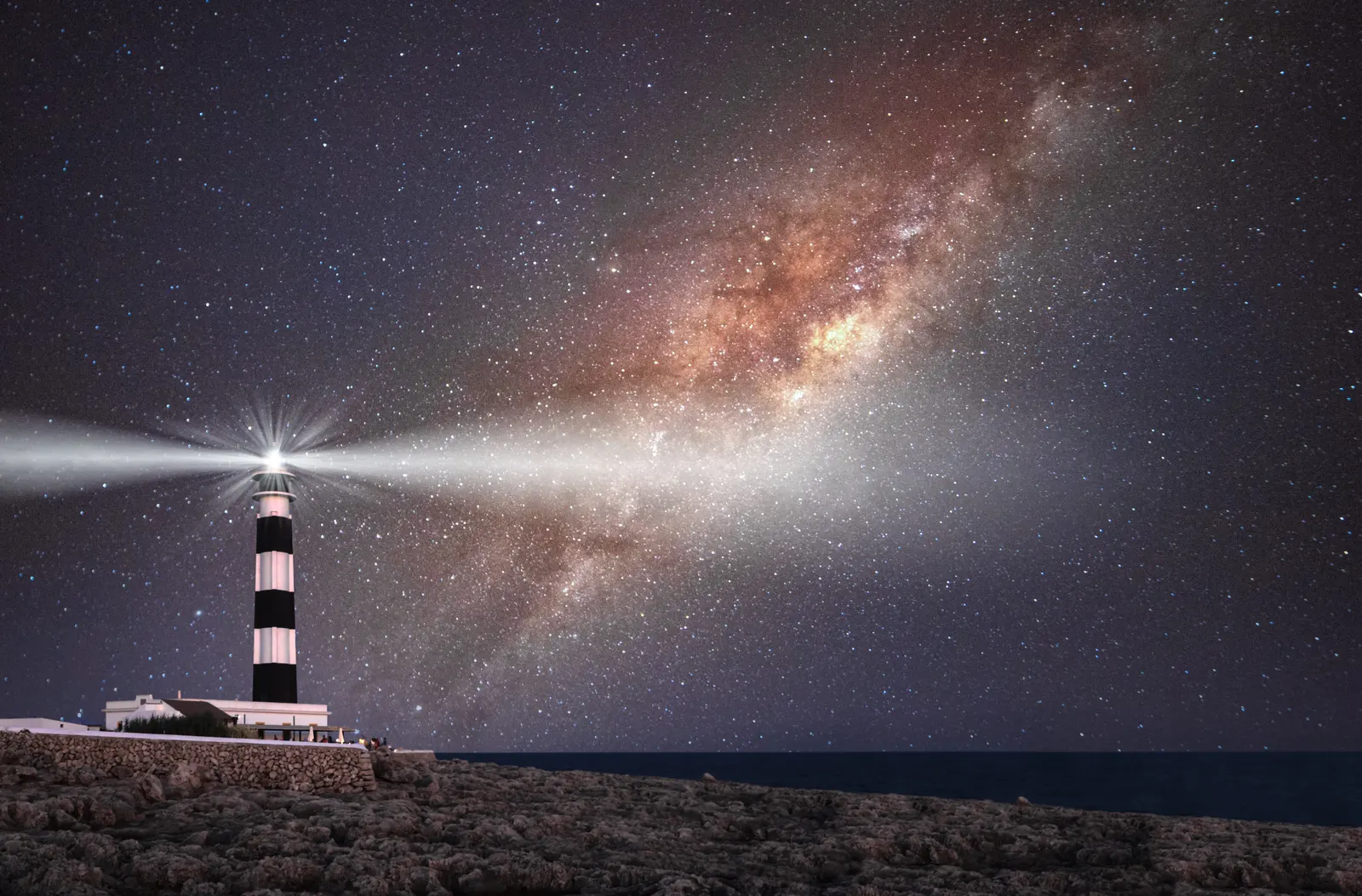
In the southwest, beside the Cala en Bosc area, the black-and-white striped tower of Cap d’Artrutx is one of the island’s most recognisable images. Its great virtue is orientation: here the sun falls directly onto the water, with no land in between, which makes it an unbeatable lookout for sunset.
It is the most accessible and family-friendly of the five, with services and places to eat nearby, which makes it an easy first encounter. By night, far from light pollution, its striped silhouette under the stars is pure poetry.
- When to go: sunset for the sun over the sea; a clear night for the sky.
- Access: easy by car, with parking close by.
- Ideal for: anyone seeking beauty without a demanding walk.
Illa de l’Aire: the islet lighthouse, the tallest of all
Off Punta Prima, in the south, the Illa de l’Aire lighthouse rises on an islet and is the tallest in Menorca. You can’t reach it on foot like the others —it stands on a separate island— but it is magnificently seen from the Punta Prima shore, especially at the end of the day.
The islet is famous for its black lizards (the endemic subspecies Podarcis lilfordi), of a singular dark colour. It is a lighthouse to admire from afar, with respect: a reminder that in Menorca the most beautiful thing is sometimes what stays on the other side of the water.
- When to go: at dusk from the Punta Prima promenade.
- Access: observed from the coast; the islet is a protected space.
Lighthouses and the night sky
Menorca is proud of its clear skies, and the lighthouses are its finest balcony for looking upward. Far from the towns, light pollution drops sharply and, on moonless nights, the Milky Way is visible to the naked eye with a clarity that surprises anyone arriving from a city. Cap d’Artrutx and Favàritx, with their recognisable silhouettes, are regular settings for night photography.
If you fancy it, come prepared: a red-light torch so you don’t dazzle yourself, warm clothing even in summer and, above all, the patience to let your eyes adjust to the dark. No equipment is needed: sometimes it is enough to lie down, fall silent and let the sky do the rest. It is one of the most serene experiences the island offers out of season.
How to combine them into a route
Don’t try to see them all in one day: they sit at opposite ends of the island and the magic dissolves in a rush. A good formula is to split them by area. Keep the east and north —Favàritx and Cavalleria, setting out from Maó— for one day, and the west and south —Punta Nati, Artrutx and the view of Illa de l’Aire, based in Ciutadella— for another.
Between one lighthouse and the next, leave room for whatever turns up: a quiet cove, a stretch of the Camí de Cavalls, a Mahón-Menorca DOP cheese bought at a market, or a pomada with Gin Xoriguer as the afternoon fades. The lighthouses mark the edges; the good things tend to happen on the way to them.
How to experience the lighthouses with calm
The commonest mistake is going at midday, in a hurry and in the heat. The lighthouses ask for the opposite. Go at dawn or dusk: the raking light transforms the rock, softens the wind and empties the car parks a little. Wear closed shoes —the ground is uneven and slippery when damp—, bring water, a windbreaker and, if you stay for sunset, an extra layer, because the temperature drops fast the moment the sun touches the sea.
Respect the surroundings: keep to the paths, don’t lean over the edges when the sea is up, and leave no trace. The towers are not open inside; they are working maritime signals. And above all, don’t rush: the point of a lighthouse is to stay and look, to let the sea set the pace and to understand why the island places its full stops here.
Our take
If you’re here for only a few days, settle on two: Favàritx on a windy morning or afternoon, for its incomparable landscape, and Cap d’Artrutx or Punta Nati for sunset, depending on whether you’re nearer the east or the west. If you have more time, Cavalleria is worth a full half-day for its mix of sea, coves and Roman history.
The best advice is seasonal: in winter, with the tramontana sweeping the north, the lighthouses offer Menorca’s purest spectacle — the island alone with the sea, with no one around. Always check up-to-date access and opening details in high season, because some points regulate traffic, and plan your outing with the exact sunset time in mind. The light does the rest.