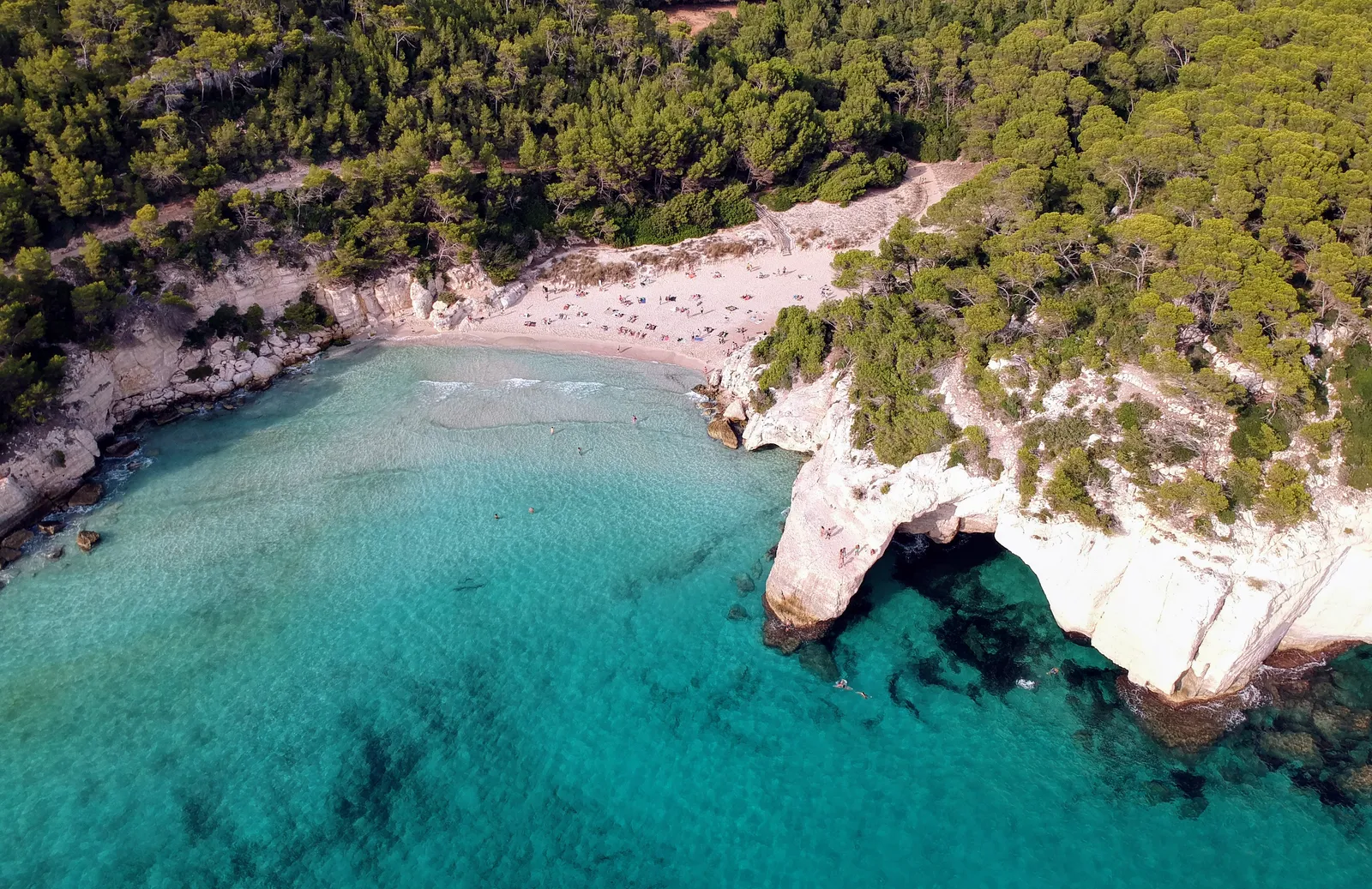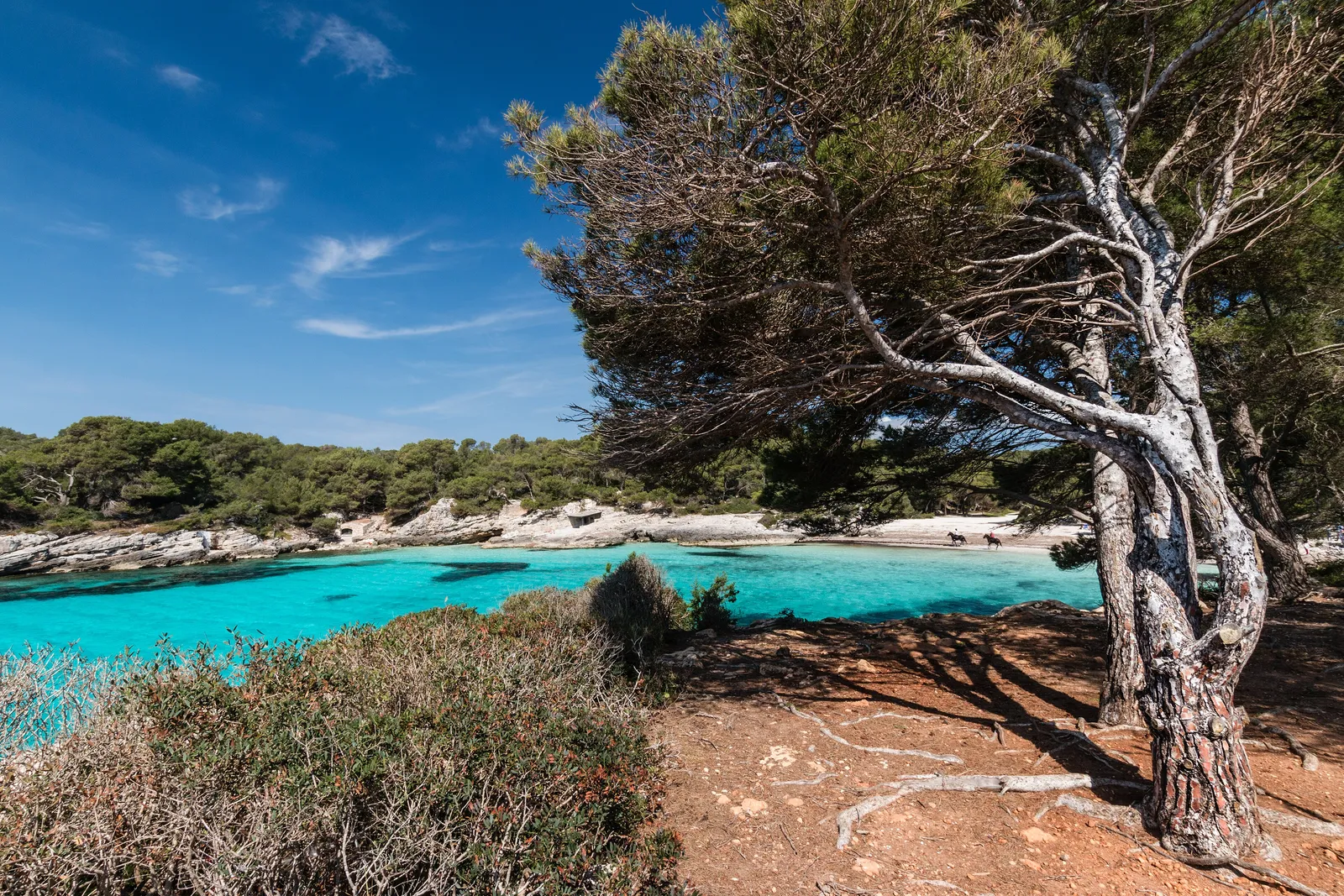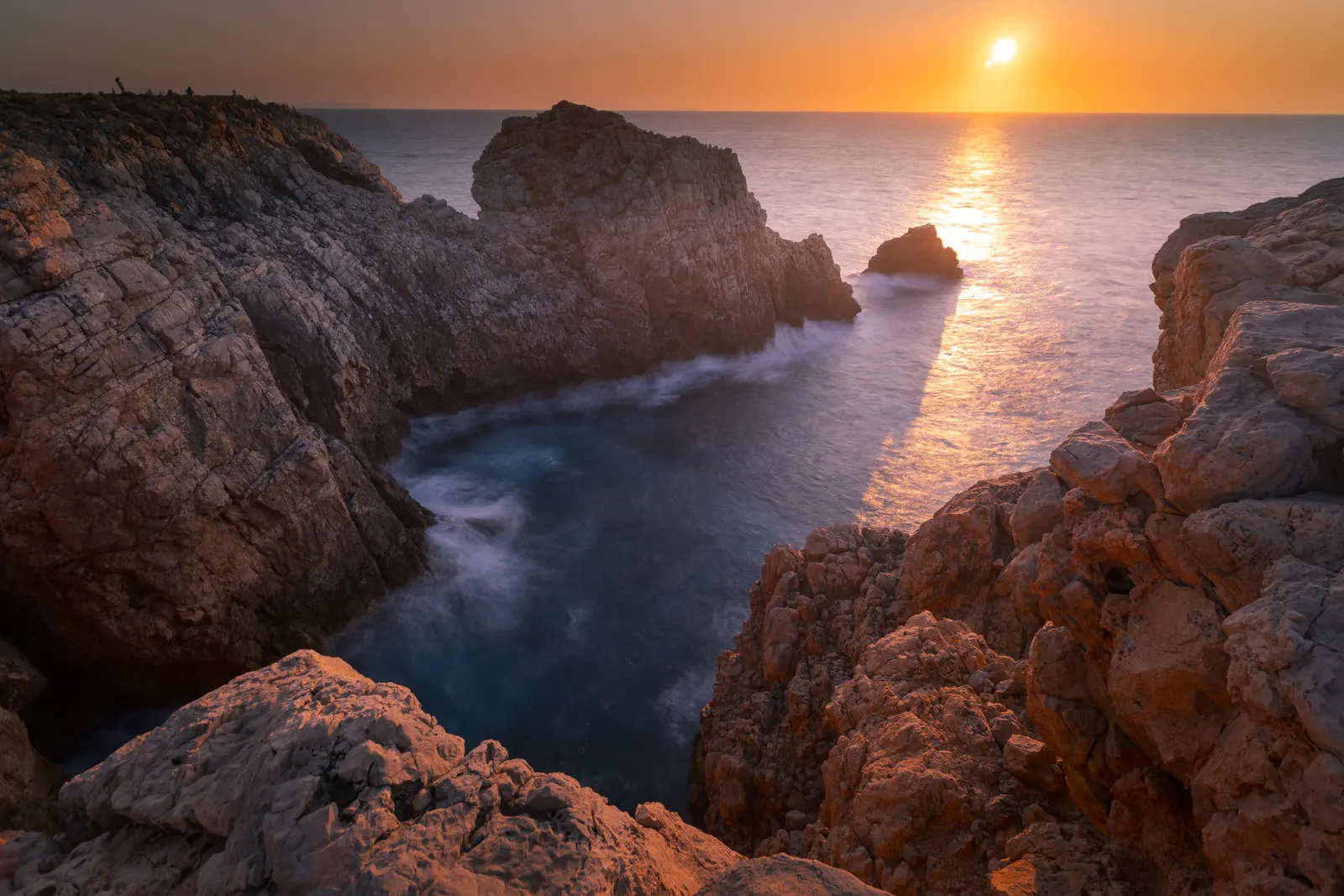
There is a moment, each evening, when Menorca lowers its voice. The wind eases, the light turns liquid, and the sea stops glittering and begins, instead, to burn. This is not something to glance at from the car: it is something to inhabit, to give yourself over to. Watching the sun go down on this island is not about taking a photo and leaving; it is about staying still long enough for the day to fade out in front of you.
At Calma Society we champion a kind of luxury that money cannot buy: the luxury of having the time, the space and the silence for one beautiful thing. And few things are as beautiful, or as free, as a Mediterranean sunset properly lived. The difference between a tourist who “sees the sunset” and a traveller who savours it lies not in the place, but in how they arrive: with room to spare, in no hurry, willing to do nothing at all for an entire hour.
This is a guide for the second kind. We will tell you where the sun looks best in Menorca, when to go, what to bring and, above all, how to turn half an hour of dying light into one of the most serene memories of your trip.
The essentials
- Where: the west coast, around Ciutadella, has the finest sunsets, because the sun drops straight onto the open sea with no land in the way.
- Key spots: Punta Nati, Cap d’Artrutx (lighthouse), Pont d’en Gil and Cala en Blanes. The north —Cap de Cavalleria, Favàritx— offers wilder, more dramatic sunsets.
- La Cova d’en Xoroi: a cave-bar set into the cliff at Cala’n Porter, famous for its sunsets. There is an entry fee or a minimum spend; check current opening times and prices before you go.
- When to arrive: with time to spare, 30 to 45 minutes before the hour of sunset. The good part begins before the sun touches the water and continues afterwards.
- What to bring: something warm (the wind picks up as evening falls), water, closed shoes and little else. The less, the better.
- The real luxury: the Mediterranean light and the calm of the moment. You need buy nothing to have it.
Why the west is the coast of sunsets
It is pure geography. Menorca’s westernmost point sits near Ciutadella, and it is along that face that the sun sinks head-on into the sea, with no islands or coastline in the way. The result is that clean, complete image —the red disc descending until it touches the water and disappears— which other orientations lose behind the land.
The west offers something more subtle, too: a bare, mineral landscape of pale stone and long horizons that does not compete with the sky but frames it. Here the sunset is not a pretty backdrop for a terrace; it is the main event, and the whole place seems built to watch it.
Punta Nati: bare stone and silence
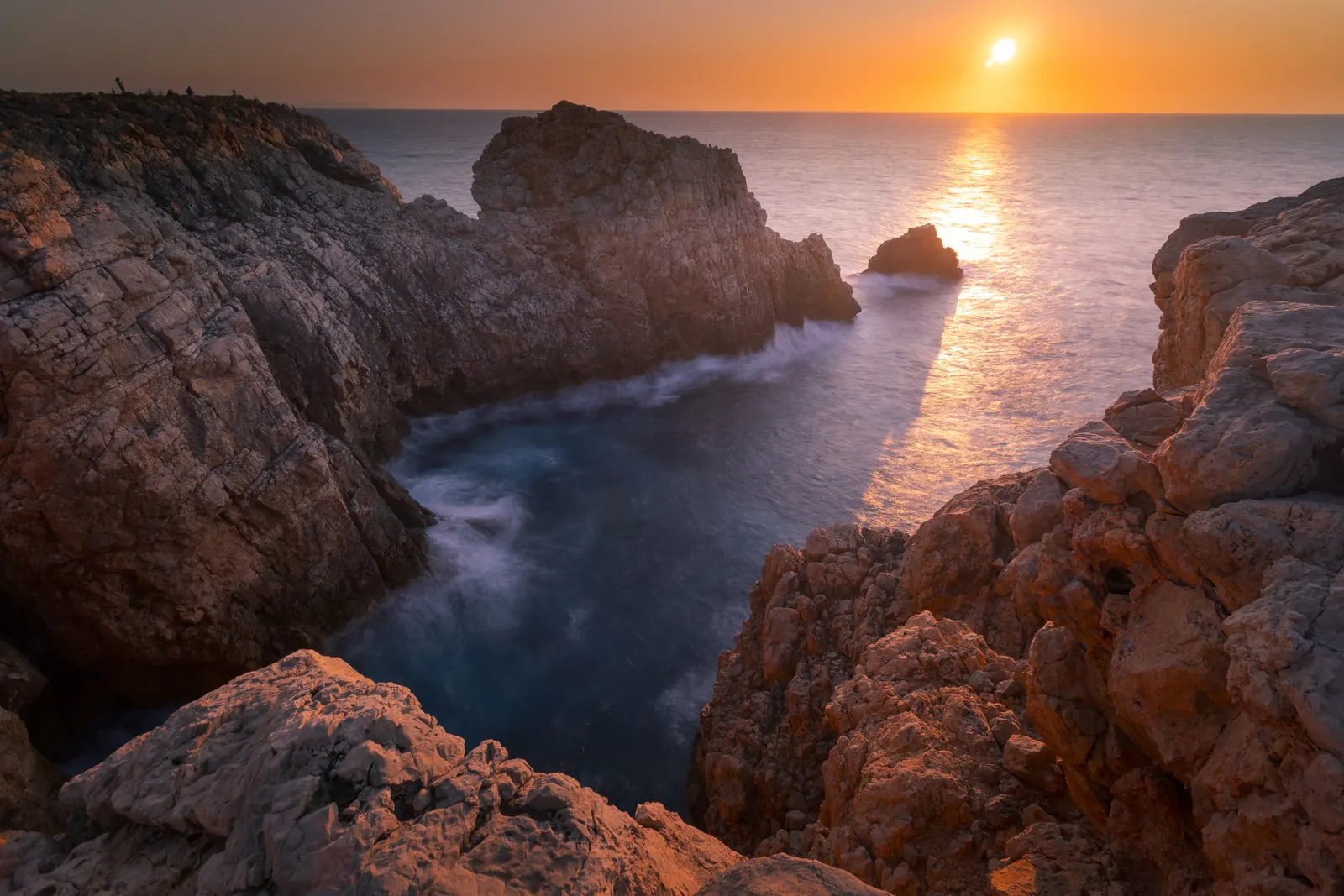
Northwest of Ciutadella, Punta Nati is the sunset in its most austere and most distilled form. The landscape is wind-stripped rock, dry-stone walls and the characteristic shepherds’ huts that dot the countryside. There are no terraces, no music, no possible distraction: only the lighthouse, the stone and the sun falling into the sea.
That is why it hits so hard. As the light drops, all that pale stone catches fire in gold and pink, and the silence becomes part of the spectacle. This is the place for anyone seeking the sunset without intermediaries, alone with the horizon. Arrive early, find a comfortable rock away from the noisiest group, and do not touch your phone until the sun has vanished completely.
Cap d’Artrutx: the sun straight onto the water
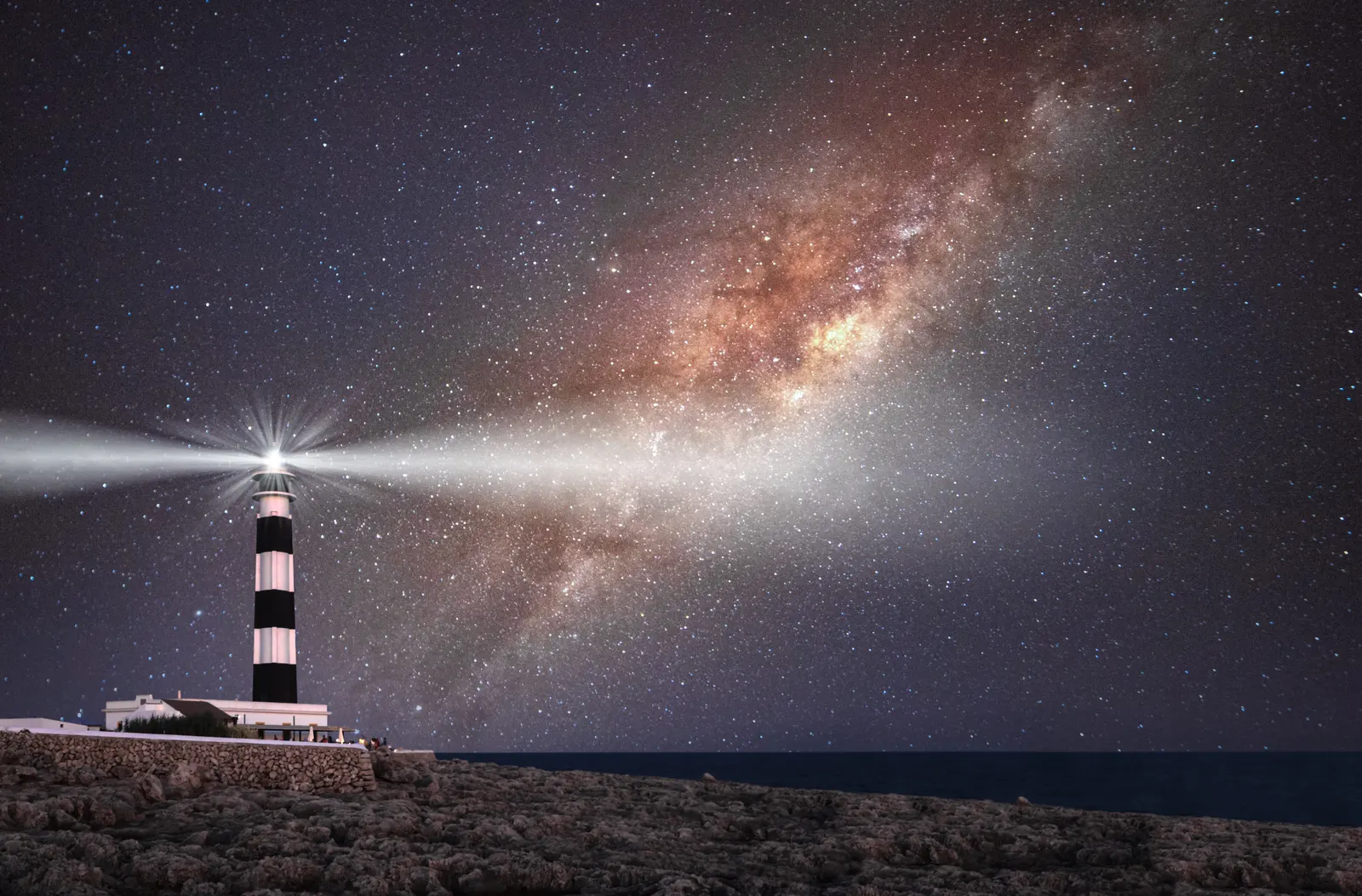
At the far southwest, beside Cala en Bosc, the black-and-white striped lighthouse of Cap d’Artrutx has the perfect orientation: here the sun drops squarely onto the water, with no land in between. It is one of the most accessible and comfortable sunsets on the island, with services nearby, which makes it ideal for a first time or for anyone who would rather not walk.
That comfort comes at a cost: it is also one of the busiest. The trick is the timing. Stay after the sun has set, when most people leave and the sky enters its finest half hour, the one of pinks and violets. That stretch, more often than not, you will have almost to yourself.
Pont d’en Gil and Cala en Blanes: the intimate west
The Pont d’en Gil is a natural rock arch over the sea, northwest of Ciutadella, a quiet viewpoint that few visitors put on their list and that offers a sunset framed by stone. Nearby, Cala en Blanes gives you an easier, more urban option, with the golden light bathing the sand at the end of the day.
These are the places for sunset without ceremony: the one you live as a couple, as a family or alone, simply sitting. Here the plan is not to photograph but to be. Bring a thin blanket, sit down, and let the evening pass.
La Cova d’en Xoroi: sunset with a drink in hand
On the cliff at Cala’n Porter, on the south coast, La Cova d’en Xoroi is a case apart: a natural cave opening onto the sea, turned into a bar and viewpoint, famous for its sunsets. It is the “with service” option for sunset, drink in hand and sheer views over the Mediterranean from terraces carved into the rock.
It runs on an entry fee or a minimum spend, and the hours change with the season, so check current prices and opening times before you go. It is a different experience —more social, more lively— and perfectly compatible with our idea of quiet luxury if you go at a serene hour and choose the right corner. If you are after absolute calm, go early, before the night atmosphere sets in.
The wild north: Cavalleria and Favàritx
If what you want is drama rather than sweetness, look north. Cap de Cavalleria, the island’s northernmost point, and Favàritx, with its lunar landscape of black slate, offer wilder sunsets: wind, cliffs, heavy seas and a rawer light than in the west.
These are not the “perfect” postcard sunsets but something deeper: the island alone with the elements. Here a warm layer is not advice, it is a necessity —the tramontana wind can blow hard even in summer—. In return, you take home an intensity the gentler west cannot give. Save the north for the days when the sky comes loaded with cloud: that is when it offers its very best.
How to live the sunset with calm
Here lies the real art, and it is simpler than it seems. Arrive early, thirty or forty-five minutes before the hour of sunset, because the magic begins long before the sun touches the water, when the light turns golden and everything softens. Arriving in a rush, just in time, means missing the best part.
Do not leave when the sun disappears. The most common mistake is to get up the moment the disc sinks; the ten or fifteen minutes that follow —the so-called “blue hour”— are usually the most beautiful, when the sky fills with pinks, mauves and violets. Stay.
And live the moment with your senses, not with your screen. Take your photo, if you like, in the first minute, then put the phone away. Listen to the sea, feel the air cool, watch the colour shift every thirty seconds. A sunset never repeats: today’s will not be tomorrow’s. That unrepeatability is precisely what makes it precious.
Avoiding the crowds and respecting the place
The most famous spots —Cap d’Artrutx, La Cova d’en Xoroi— fill up in summer. If you want calm, there are two paths: go to lesser-known places such as Pont d’en Gil or Punta Nati, or go to the popular ones but outside the peak months. May, June, September and October offer splendid sunsets with a fraction of the people.
And a reminder that for us is non-negotiable: leave no trace. Take all your rubbish, light no fires, play no music that breaks the silence for others, and keep to the paths. The beauty of these places depends on every visitor treating them as their own. Respect for the surroundings is part of the luxury we defend: a cared-for landscape is one that still deserves the journey.
Our take
If you can choose only one, make it a west-coast sunset: Punta Nati if you are after mineral silence and solitude, Cap d’Artrutx if you prefer comfort and the sun falling clean onto the water. Save the north —Cavalleria, Favàritx— for an evening of restless sky, when the clouds turn the sunset into a wild spectacle. And keep La Cova d’en Xoroi for the day you fancy a drink with a view, bearing in mind it is worth checking current opening times and prices.
But the place matters less than you think. What truly turns a sunset into a memory is the attitude: arriving with time, feeling no rush to leave, and giving the moment your full attention. That —time, calm and presence— is the hardest luxury to find, and the one this island gives away every evening, for free, to anyone who knows how to stay and watch.