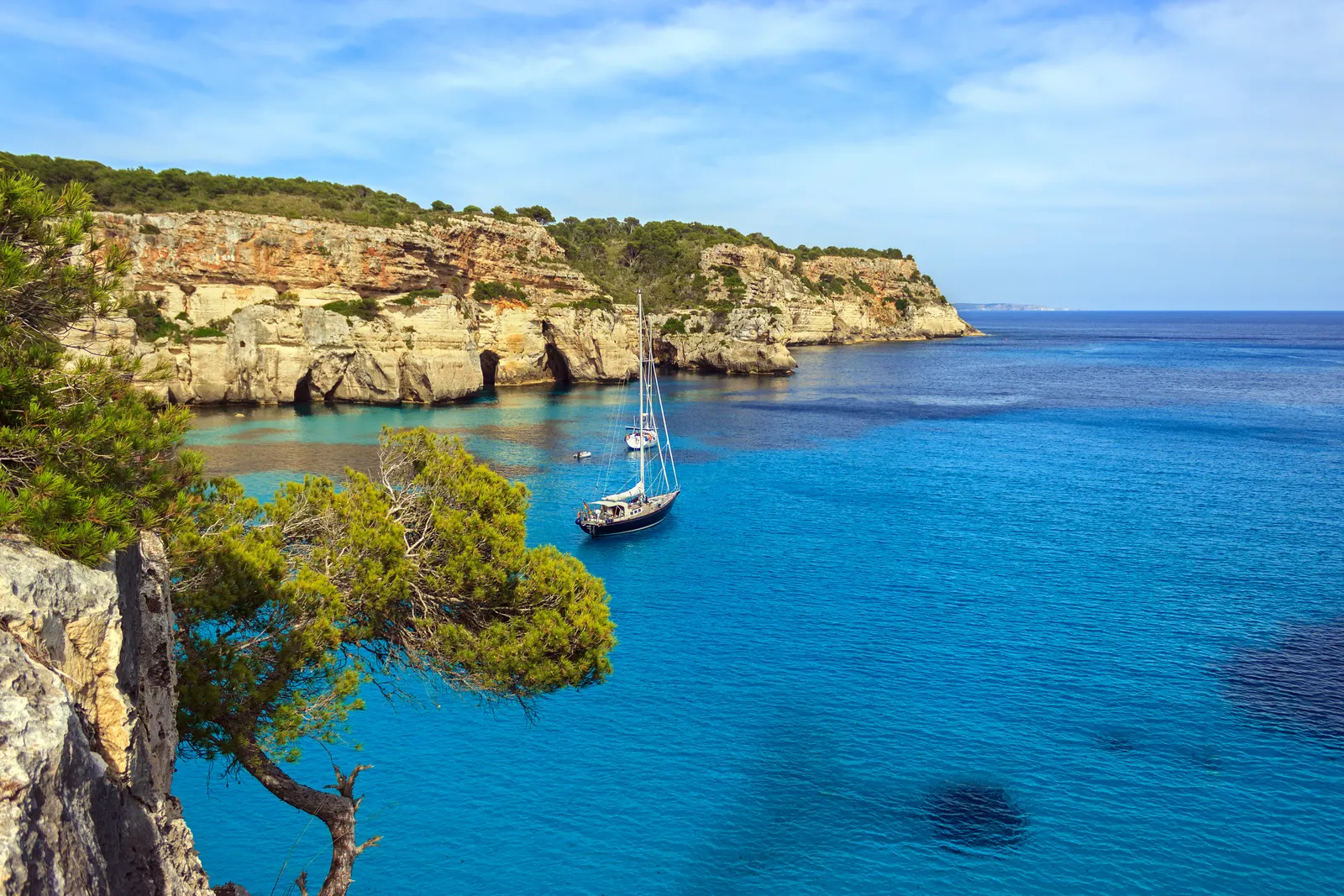
There is a moment, every summer Saturday, when the pontoons of Maó change the guard: one crew steps ashore with weathered skin and bags already undone, and another arrives from the airport with the whole week ahead of them. Check-in day is the hinge of a charter — and, handled well, it is already part of the holiday. Handled badly, it is a house move in a hurry.
This guide puts that first day in Menorca in order: where the bases are, what to expect from check-in, what to pack, where to do a shop worthy of the week and how to move everything — people, kit bags and provisions — from the plane to the boat without anyone breaking a sweat. For the detail of each port (marinas, times from the airport, how far the car can go), there is our guide to getting to your boat in Menorca.
The essentials
- The charter week runs, as a general rule, Saturday to Saturday; out of season there is more flexibility.
- Check-in and check-out times are set by each base — there is no standard published time in Menorca. Ask for them when you book and plan the day around them.
- The main sailing base is the port of Maó (Moll de Llevant and Sa Colàrsega); there are hire bases too in Ciutadella, Fornells, Addaia and Cala en Bosch.
- Soft bags, not suitcases. There is no wardrobe space on board for hard shells.
- The considered shop is done at Maó’s markets (Claustre and Peix) or at sa Plaça in Ciutadella; the bulk larder at a supermarket, before you head down to the quay.
Where your week begins
The greatest concentration of hire bases is in the port of Maó — with local operators between the Moll de Llevant and Sa Colàrsega — which makes boarding in Menorca one of the most comfortable in the Mediterranean: the airport is about ten minutes from the pontoon. Charters and hire boats also set out from Ciutadella and Fornells, from the lake-harbour of Cala en Bosch and from Addaia, on the north-east coast. Each base has its own logistics; the port-by-port guide tells you how long each one takes and where the car should drop you.
Saturday, from the inside
The ritual is simple: the outgoing crew hands the boat back, the base checks and restocks it, and the incoming crew boards with the technical briefing and the paperwork before anyone unpacks. The times of that changeover are not standard in Menorca: each operator announces its own, and that figure — not your flight’s — is the one that orders your day.
Hence the two decisions that do most to pacify an embarkation. First: book the transfer for the hour the base expects you, not for landing time. Second: if your flight arrives much earlier, ask your base whether you can leave the luggage while you wait — and become the only member of the crew who starts the holiday over a long lunch on the Moll de Llevant instead of standing guard over kit bags.
The bags: soft, and fewer
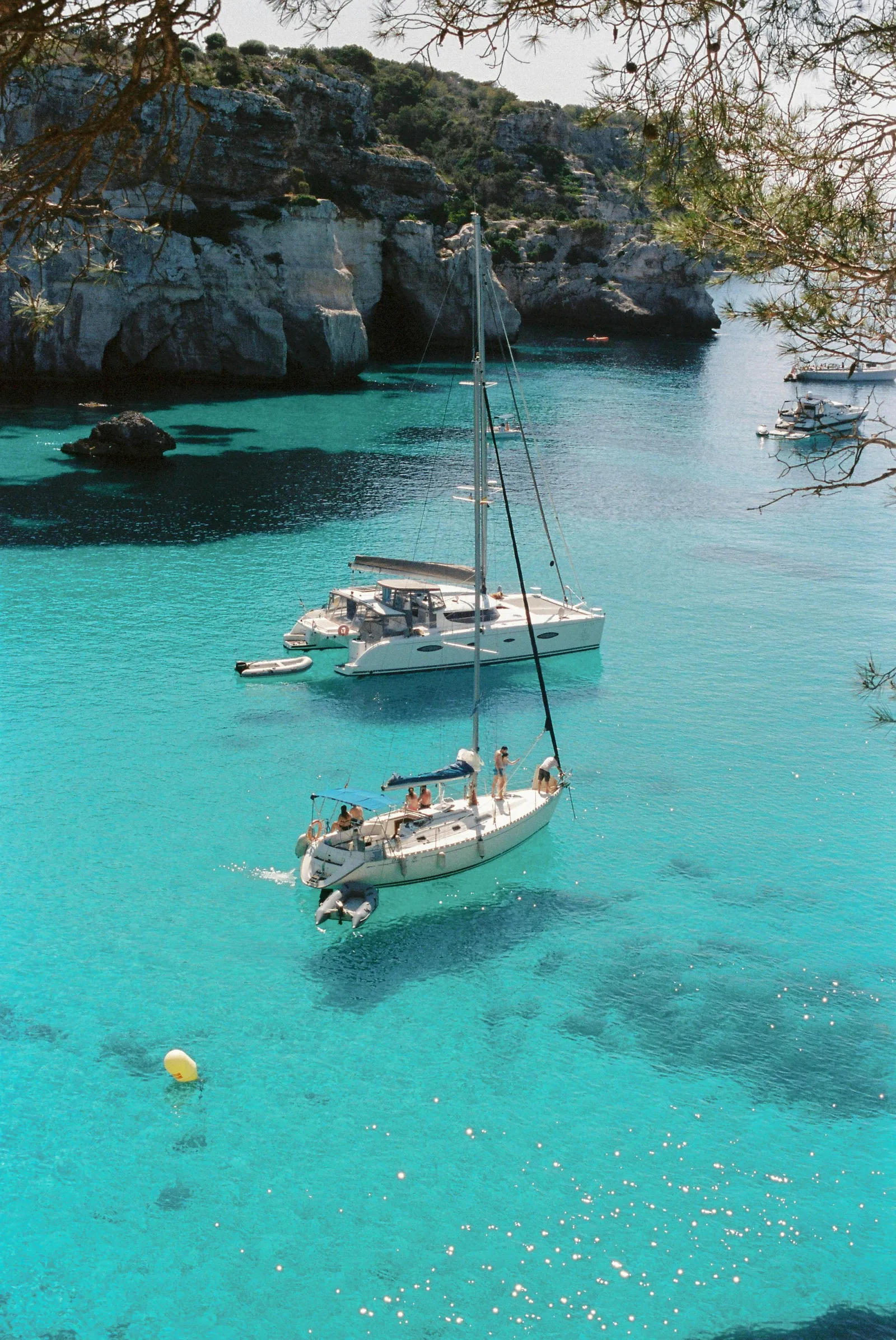
The hard suitcase is the charter’s intimate enemy: it doesn’t fit in the lockers, it gets in the way in the cabins and it ends up occupying someone’s bunk. Kit bags and soft bags, less clothing than you think (‘on a boat you repeat outfits’, as skippers say), a light layer for tramuntana nights, pale-soled shoes for the deck and little more. Even so, it adds up: a crew of eight with their shopping is easily fifteen pieces. It is why the airport transfer is best thought of in terms of boot volume, not just seats.
The shop: markets with soul (and a sensible larder)
Provisioning a boat in Menorca can be a hypermarket errand or the first pleasure of the week. Our recipe combines both. The background larder — water, breakfasts, basics — is settled at the supermarkets of your base town, before you head down to the quay. And the produce with character is sought where it lives: in Maó, the Mercat des Claustre (in the cloister of the Carme, above the harbour) and the Mercat des Peix on Plaça d’Espanya, with the fishmongers in the morning; in Ciutadella, the market on sa Plaça de la Llibertat, five minutes’ walk from the old port, under its nineteenth-century iron structure.
In this house’s basket there is always Mahón-Menorca DOP cheese — the story of the cheese deserves reading with a piece in front of you —, fruit grown on the island and bread for lunches at anchor. Confirm market opening times before you go (Sundays especially) and, if the shop is a big one, take it by car to the closest point to the pontoon rather than making a pilgrimage of it.
The return, decided on the way out
The last day of a charter has a peculiar physics: the boat is handed back at the time your base sets and the flight, often, leaves considerably later. The elegant way to resolve it is to decide everything on the way out: transfer booked both ways, pick-up at the base at check-out time and, if a morning is left orphaned, one last long breakfast by the harbour instead of a wait at the terminal. The margin over your flight time is not up for negotiation; neither is the calm of the last day.
Anchoring well from day one
A single rule makes any crew welcome: the posidonia is not to be touched. The seagrass meadow that keeps Menorca’s water transparent takes centuries to regrow, and the anchor is its worst enemy. You anchor on sand or on a buoy — in Fornells, Ports IB maintains a field of eco-friendly buoys bookable online — and you cut the engine early. The why, the how and the rest of the liturgy of the slow sea are in our guide to sailing Menorca: read it on board on the first day; it is the best letter of introduction to the island.
Our take
The best embarkation we have seen was nothing spectacular: a crew that arrived at the hour they had been given, with soft bags and the shopping done, in a single vehicle that dropped them at the pontoon gate. By seven that evening they had their feet in the water and the fridge full. That is the standard. The sailing week begins on Saturday morning, in how you choose to arrive; let the first memory of the boat be not the transfer, but the first time the harbour slips astern.