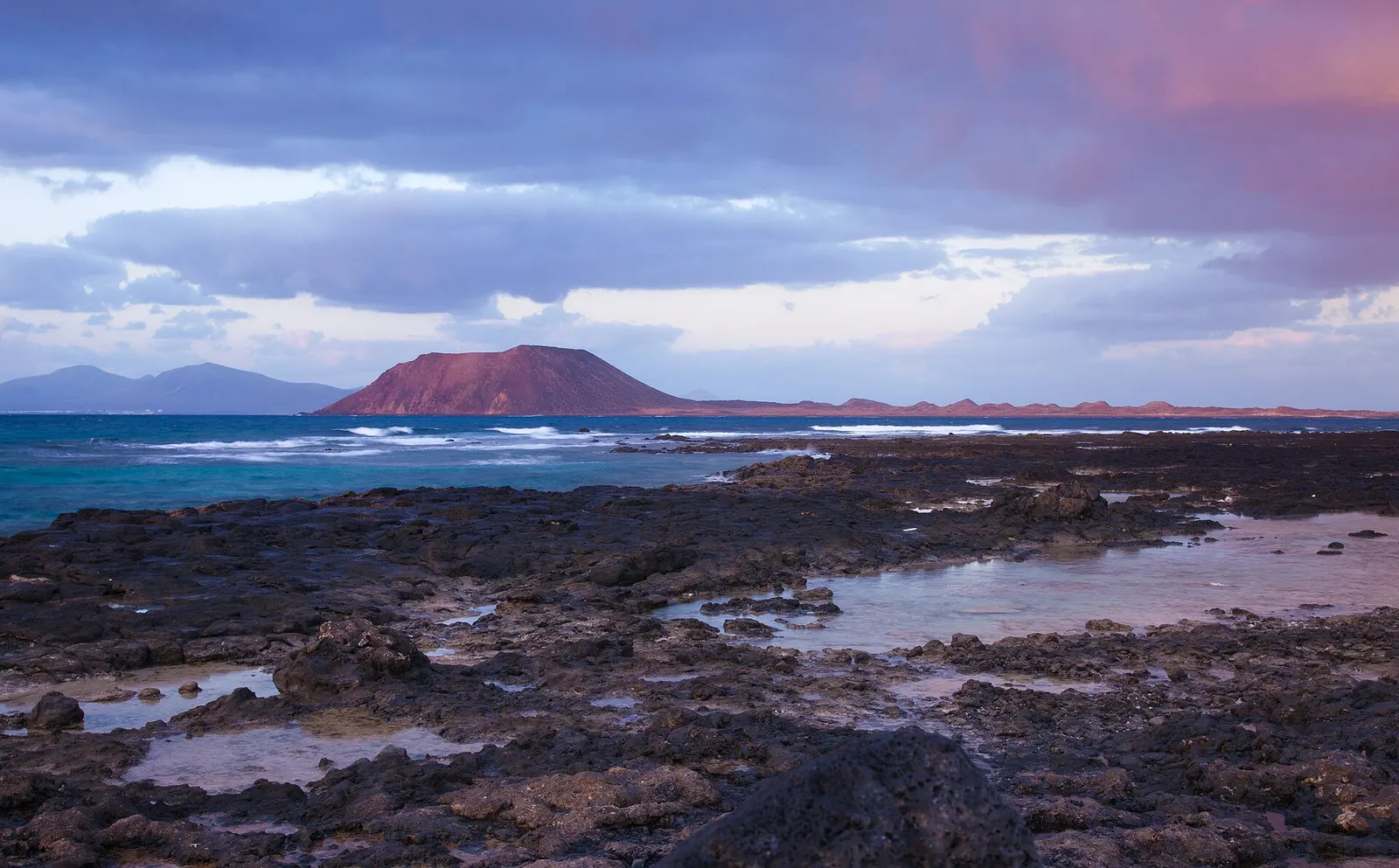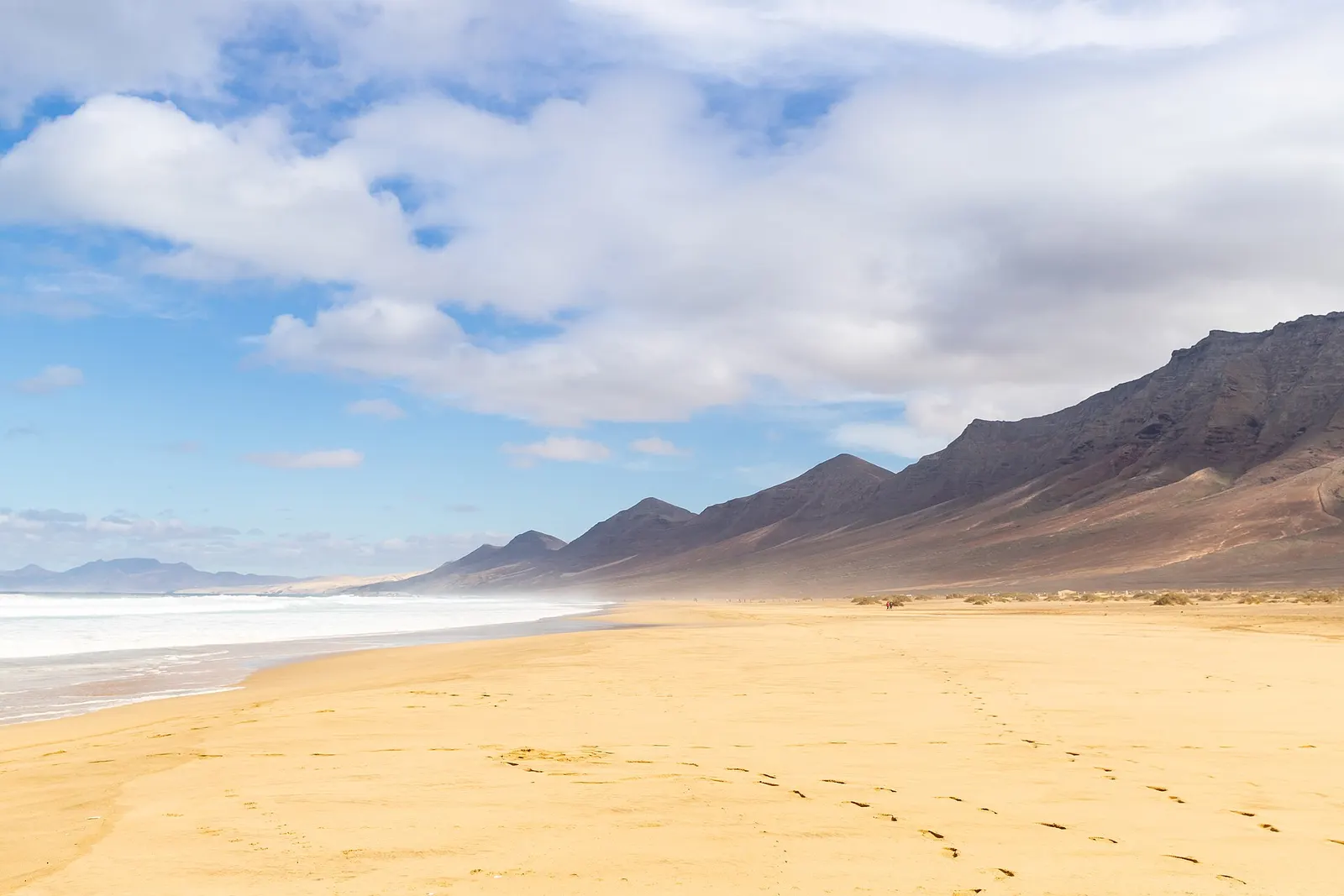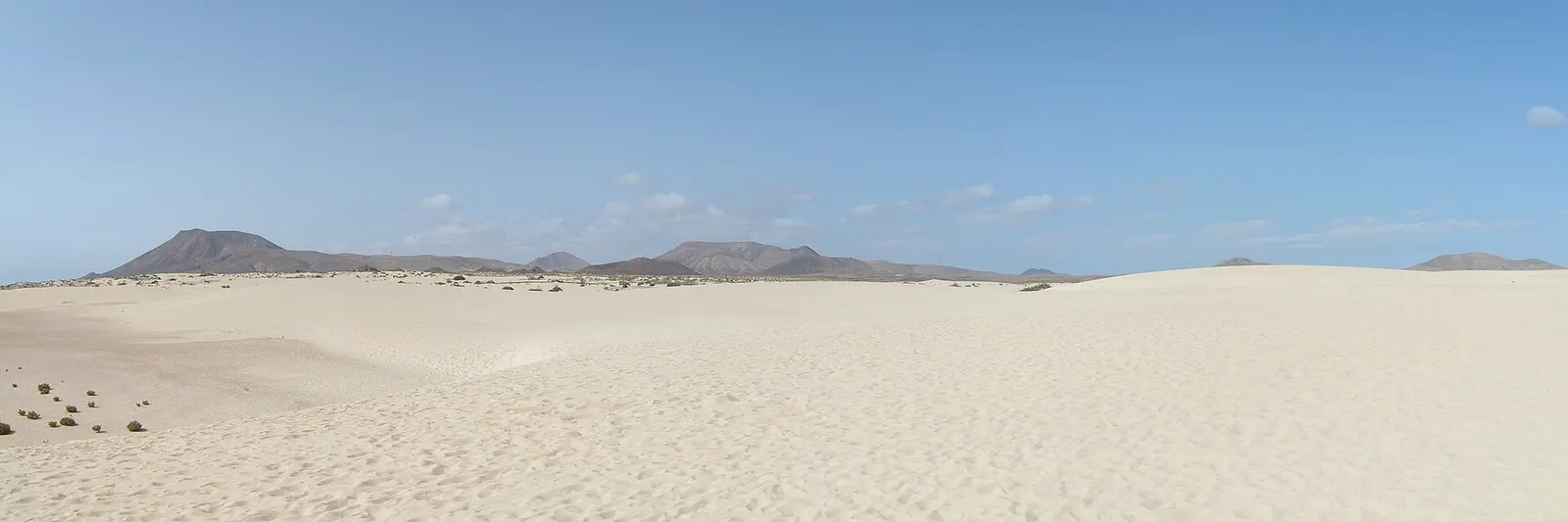
The Corralejo dunes are mostly known from a car window. The road between Puerto del Rosario and Corralejo runs straight through them, and almost everyone watches them slide past or stops for a moment on the verge. It is a pity, because the largest dune field in the Canary Islands reads quite differently on foot: once the traffic noise drops behind the first ridge, all that remains is sand, wind and, in the distance, the outline of Lobos.
The essentials
- It is a nature park: just over 2,600 hectares of pale sand between the road and the sea.
- You visit on foot, and only along the waymarked trails. No cars, quad bikes or motorbikes off the road.
- Do not enter fenced areas, do not build stone shelters and do not take sand away.
- The best times: sunrise and the last light of the afternoon.
- Information as of October 2026.
A desert beside the Atlantic
Corralejo Nature Park covers around 2,668 hectares at the north-eastern tip of the island. The sand is organic and pale, constantly reshaped by the wind, and it ends at the Grandes Playas, facing the islet of Lobos and, beyond it, the coast of Lanzarote. There are no trees and no shade: only dunes that change shape from one year to the next and a low vegetation, adapted to salt and wind, which is exactly what the park exists to protect.
That is why the rule is as simple as it is strict: inside the park you walk on the designated trails. Stepping off them breaks the plants that hold the dune together, and fenced or restricted areas are there so that it can recover.
How to do it well
Park at the designated spots beside the road and walk in along a waymarked trail. You need not go far: ten minutes from the car, the road has vanished and the sense of scale changes completely.
Go at sunrise or late in the afternoon. At those hours the low light picks out every ripple in the sand; the sand is still cool and the park is almost empty. At midday the glare is strong, the heat builds and there is nowhere to shelter.
Carry little, but carry the right things: water, sunglasses, sun cream and a scarf for the wind, which on Fuerteventura is rarely absent and lifts the sand. Comfortable shoes or, if you prefer, bare feet on the cool sand of early morning.
Finish at the sea. The trails lead down to the Grandes Playas, long and open, where you can walk along the shoreline with Lobos ahead. A word on swimming: this is open Atlantic coast, with wind and currents; always respect the flags.
What you never do in the dunes
- Do not leave the waymarked trails or enter fenced areas.
- Do not build stone windbreaks or shelters. They are common on the island’s beaches, but inside the park they disturb the ground and the vegetation.
- Do not drive off the road: no cars, quad bikes or motorbikes.
- Do not take sand or stones as a souvenir.
- Do not fly drones over the protected area.
- Do not camp.
Kites in November
Every November since 1987, the dune beaches have hosted Fuerteventura’s International Kite Festival, around Playa del Burro. It is one of the few times the dunes have a sense of occasion, and even then it is an open-air, unhurried affair. Confirm each year’s dates before planning your trip.
More of the north
- You want an almost empty islet → Lobos, the islet you book ahead: the permit, the boat and the trail.
- You prefer quiet lagoons and a crater → El Cotillo, Lajares and Calderón Hondo.
- You are thinking of staying longer → living in the north of Fuerteventura.
- To choose your dates → when to go to Fuerteventura.
Our view
The dunes need nothing: no booked excursion, no special vehicle. They need an early hour, a waymarked trail and a willingness to walk without a particular destination. It is one of the easiest landscapes on the island and one of the least appreciated. Keep it for the beginning or the end of the day and you will find it almost untouched.
Information as of October 2026, checked against spain.info and published information on Corralejo Nature Park and its kite festival. The park’s rules of use are set by its management plan: always follow the signage on the ground.