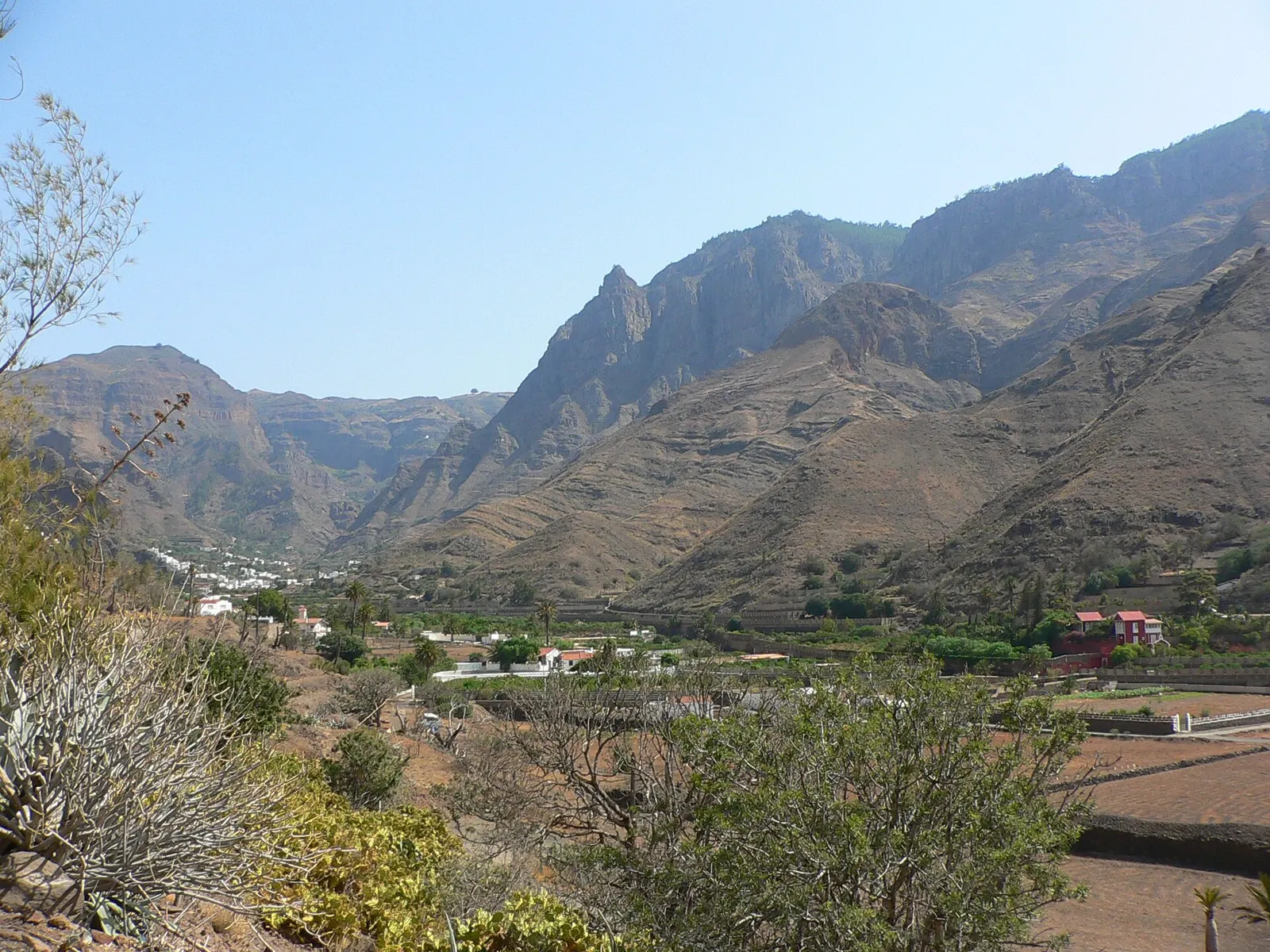
Some cuisines are explained by what they add. Gran Canaria’s is explained by what it kept. An island far from everything, with coast, midlands and summit packed into a few kilometres, learnt to eat from what was close and to preserve it well: potatoes that last, toasted grain that does not spoil, cheese that matures, meat that is salted.
It is not a cuisine of grand gestures. It is a cuisine of produce, which is why it makes more sense at someone’s table than on a menu.
The essentials
- Papas arrugadas with mojo: the dish to understand first.
- Gofio: flour from toasted grain, with Protected Geographical Indication status as Gofio Canario.
- Flor de Guía cheese: Canarian sheep’s milk set with thistle flower, with Protected Designation of Origin.
- Pork: in the Guayadeque ravine, salt-baked, in restaurants cut into the rock.
- Coffee and wine: a coffee almost nobody expects to find in Europe and a wine from volcanic soil, both tended slowly.
Potatoes and mojo
Papas arrugadas are boiled in their skins in heavily salted water until the water has gone and the skins wrinkle and turn white. They are eaten whole, skin and all, dipped in mojo: the red one, with chilli and paprika, and the green one, with coriander or parsley. No recipe is the official one: every household has its own, and it is wiser not to ask which is right.
The small, coloured potatoes that sometimes appear are papas antiguas, old varieties that reached the islands centuries ago and now hold Protected Designation of Origin status as Papas Antiguas de Canarias. If you see them on a menu, order them: a different texture and a different flavour.
Gofio
Gofio is toasted, ground grain — wheat, maize, barley, sometimes blended — and for generations it was the backbone of the islands’ diet. It is taken at breakfast with milk, kneaded with water or stock, or as escaldón, stirred into fish or meat broth. Today it is protected as a PGI, Gofio Canario.
It is the best way into the Canaries: a humble larder staple that nobody has managed to replace.
Thistle cheese and ravine pork
In the north, between Santa María de Guía, Gáldar and Moya, the cheese that best explains the island is made: Flor de Guía cheese, from Canarian sheep’s milk set with a vegetable rennet of thistle flower. It has its own story, told separately.
In the south-east, in the Guayadeque ravine, the tradition is different: salt-baked pork in restaurants dug into the rock, in a ravine where people lived in caves long before the Castilian conquest. It is eaten slowly, in the shade of the stone, and it is one of the most honest meals on the island.
What comes from the sea
On the coast, the day’s catch rules — grilled, or sancochado, boiled with potatoes and served with mojo — and the way to order it has not changed: ask what came in that morning and take advice. There is no better menu than that question.
Coffee and wine
Gran Canaria grows coffee in the Agaete valley and wine on volcanic soils beside the Bandama caldera. Neither is a tourist curiosity: both are crops with a long history that the island is patiently bringing back. We tell that story in coffee in Agaete, wine beside a volcano.
Where people still eat as they do at home
In the villages of the midlands and the summit, in roadside eating houses, in the municipal markets of Las Palmas. The places that work all year with island people rarely make the lists, and do not need to: you recognise them by the hour they fill up and by who sits in them.
And if one evening the island turns serious, Gran Canaria has five starred restaurants in the 2026 guide. We go through them in Gran Canaria’s Michelin stars.
Our view
Order papas and mojo everywhere, and compare. It is the simplest way to tell where the cooking is careful: a dish this plain allows no shortcuts. The rest follows.