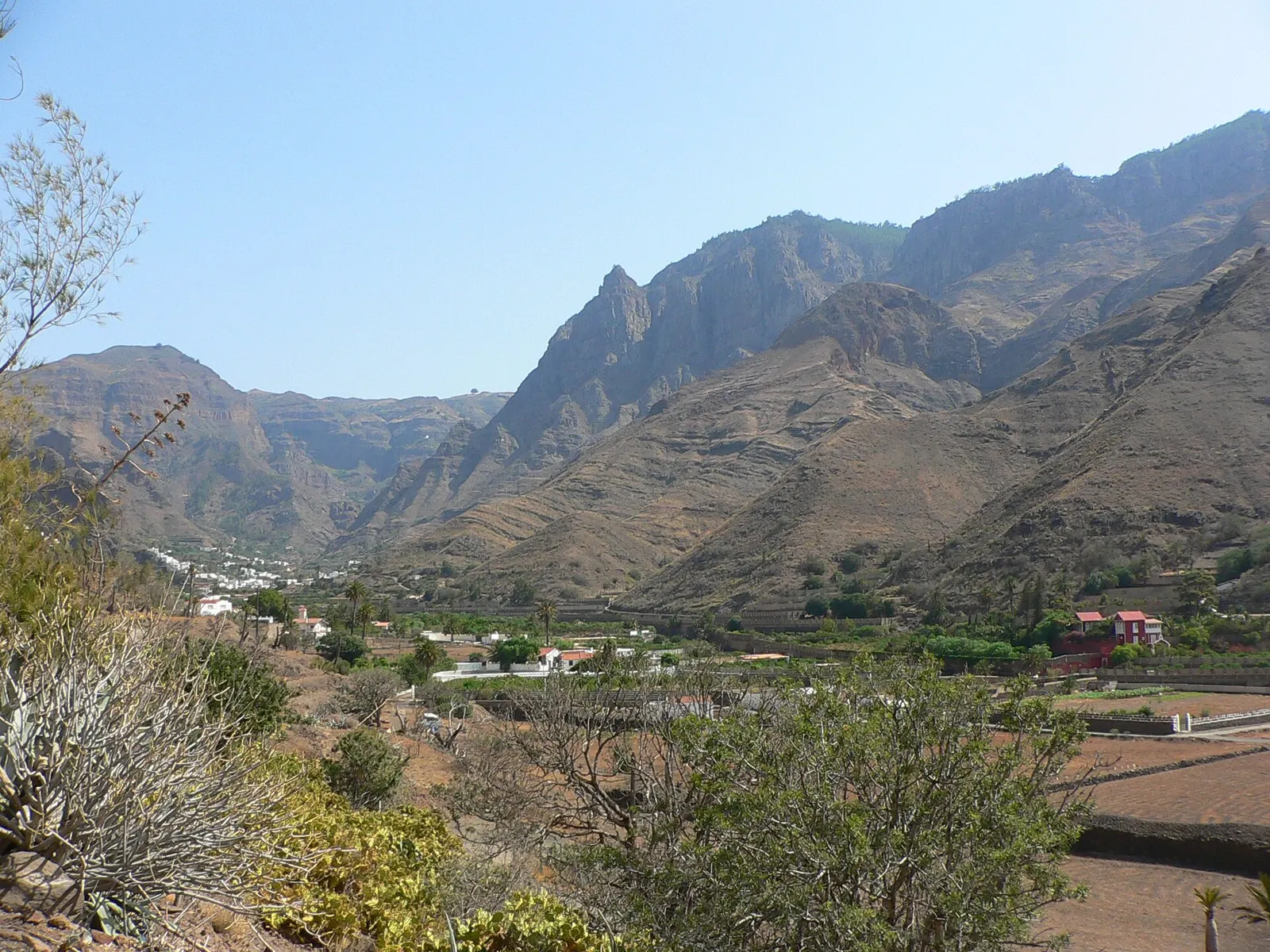
Think of coffee and you think of the tropics. Think of wine and you picture brown hills. Gran Canaria has both, in places that fit neither image: coffee in a valley tucked between mountains in the north-west, and vines on volcanic ash a short way from an Atlantic city. Neither is a tourist draw. They are crops with history that the island keeps going, and partly brings back, with patience.
The essentials
- Agaete valley coffee: Arabica of the Typica variety, established in the 19th century and grown between roughly 150 and 550 metres above sea level.
- A medal in 1889: bronze at the Paris Universal Exposition.
- PGI under review: the application for a Protected Geographical Indication, «Café de Agaete», was sent to the European Commission in August 2026; it would be Europe’s first coffee PGI, but it has not yet been granted.
- The wine: DO Gran Canaria has covered the whole island since 2005, when it absorbed the former DO Monte Lentiscal.
- The Casa del Vino, in Santa Brígida, houses the Regulatory Council.
The valley’s coffee
The Agaete valley runs from the summit down to the sea in the north-west of the island, and its sheltered climate allowed something rare: coffee took root and stayed. The variety is Typica Arabica, one of the oldest, which settled in the valley in the 19th century. In 1889 Agaete coffee won a bronze medal at the Paris Universal Exposition, and it has been grown on a small scale, on family farms, ever since.
It is a coffee of tiny production, presented as the only one grown and processed in Europe. That is why the island has asked for its protection: in August 2026 the «Café de Agaete» PGI application went to the European Commission. If approved, it will be the continent’s first coffee PGI. Until then, it is worth being precise: it is under review.
Some farms in the valley open their plantations for guided visits, walking through the coffee and finishing with a cup. Check in advance which ones still welcome visitors, and when: these are family farms, not museums.
Wine beside Bandama
South-east of Las Palmas, the Bandama caldera is an almost perfect crater surrounded by volcanic soils. On its slopes and on Monte Lentiscal, wine has been made for centuries, and for years the area had its own designation. Since 2005 all quality wine on the island has come under a single DO Gran Canaria, which took in the former DO Monte Lentiscal.
The Casa del Vino de Gran Canaria, in Santa Brígida, is the Regulatory Council’s home and the best starting point to understand what is grown and where. From there, several wineries in the area take visitors: confirm beforehand which are open, as these are small houses and their visiting days change.
One useful note: if you explore Bandama, stay on the paths and do not take stones or volcanic ash away. Bandama is a protected natural area, and removing them is not allowed.
How to plan the day
- Do not combine the two. Agaete is in the north-west and Bandama in the centre-east: they are two separate mornings.
- Coffee wants the morning. The valley light and the visits work best early; then the village and the sea.
- Wine wants a driver. If you are tasting, sort out the return first: a pre-booked taxi or someone who is not drinking.
- Information as of October 2026. Visits, days and times change: always confirm before you go.
For the rest of the island’s larder — potatoes, mojo, gofio and thistle cheese — see eating in Gran Canaria, and for the cheese that suits these wines best, Flor de Guía cheese.
Our view
What interests us about these two crops is not their rarity but their scale. A coffee of tiny production and a wine from volcanic slopes cannot grow fast without ceasing to be what they are. A cup on an Agaete coffee farm, with the valley in front of you, is exactly the kind of luxury we stand for: you cannot buy it anywhere else.