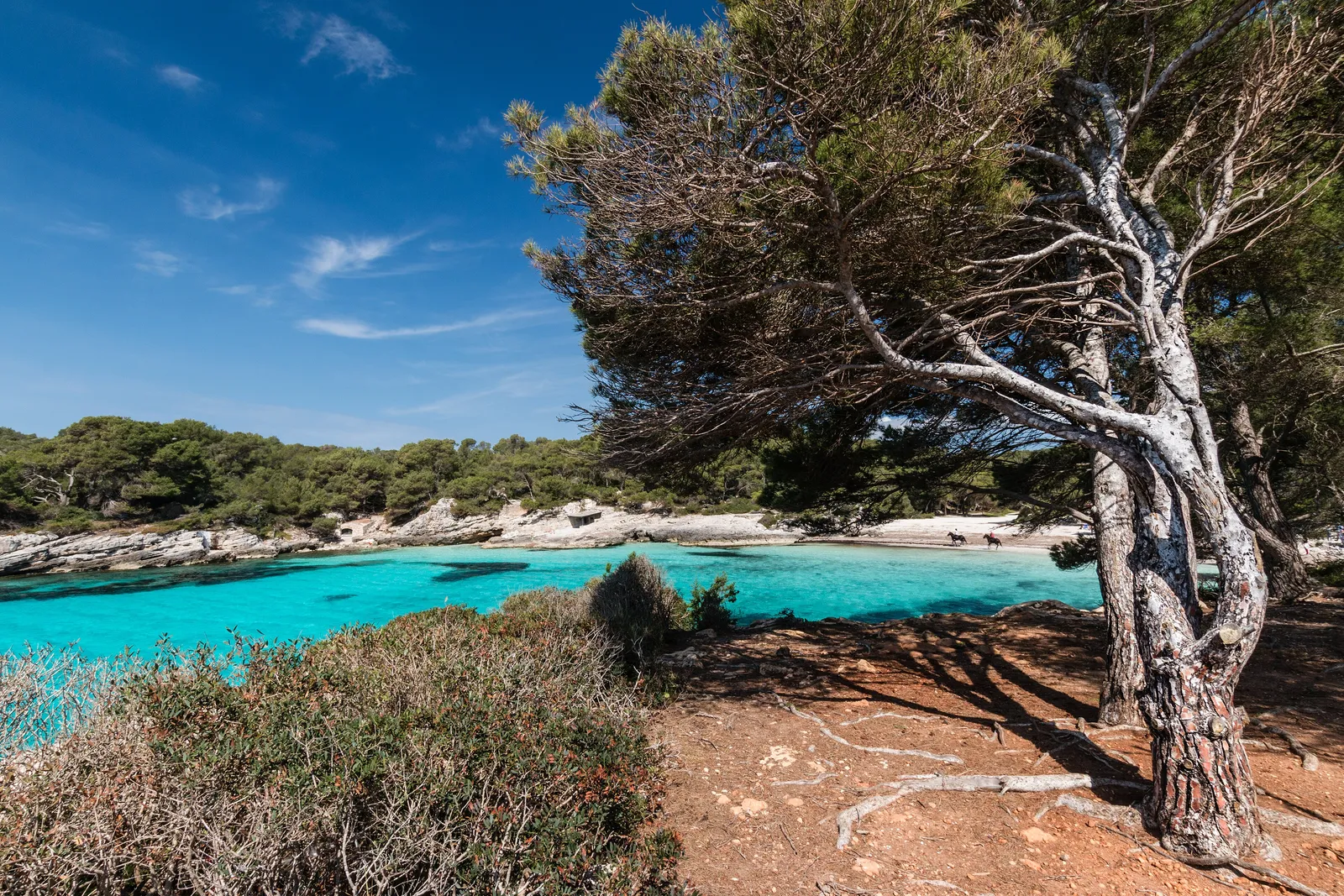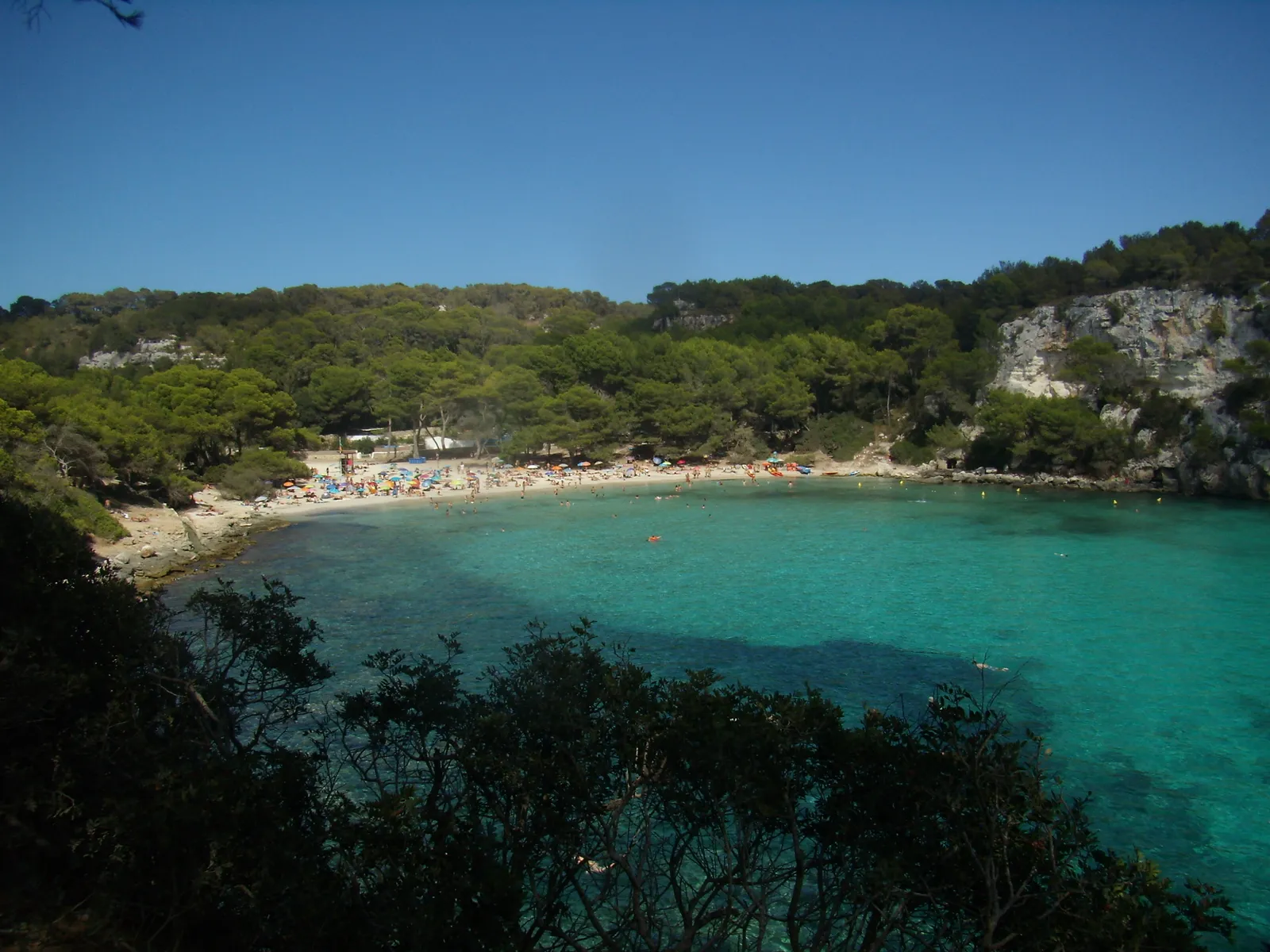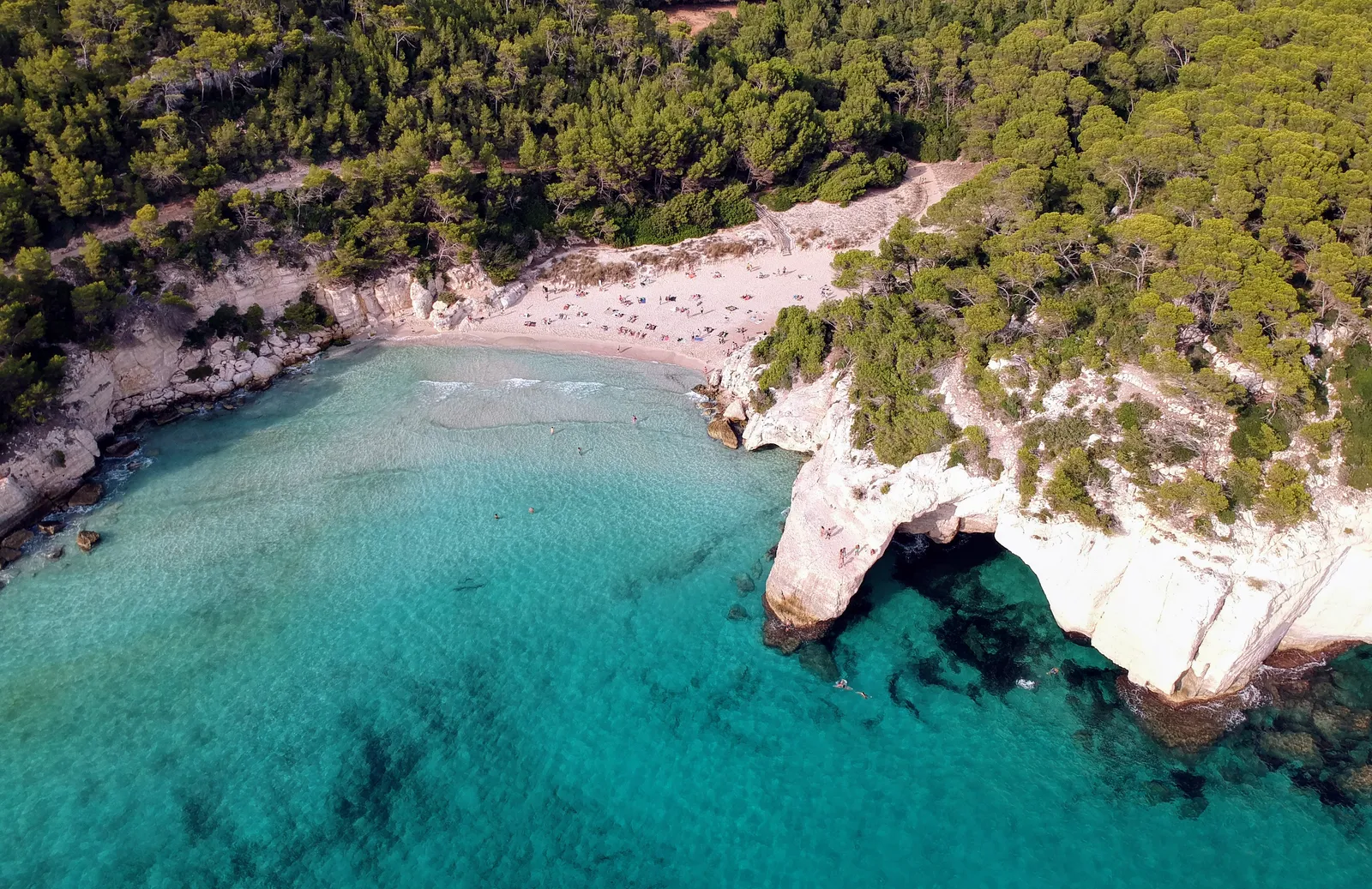
Some unspoilt coves have to be earned on foot, after an hour of trail and sweat, and some unspoilt coves are simply handed to you by geography, asking almost nothing in return. Cala Mitjana, in the municipality of Ferreries, belongs to the second group, and that makes it at once one of the most beautiful beaches in the south and one of the most delicate: when something unspoilt is easy to reach, it has to be looked after with even greater care.
It is the textbook image of southern Menorca — some 140 metres of white sand, clean turquoise water, pale rock cliffs framing it and from which a few brave souls leap into the sea — but without the long walk that protects its neighbours. The car park sits barely 150 metres from the water. That is why this guide isn’t about how to get there, which is easy, but about when to go and how to behave so the cove keeps deserving the journey.
The essentials
- Where: the south coast of Menorca, in the municipality of Ferreries, next to Cala Galdana.
- Access by car: permitted. The car park is just about 150 metres from the sea; of the unspoilt coves, the easiest to reach.
- Watch out in summer: the car park was enlarged in 2024 to ease the traffic, and the side effect has been more people on the sand. Go early or you’ll be left without a comfortable spot.
- Facilities: none at the cove (no beach bar, no lifeguard, no toilets). The nearest are in Cala Galdana, about 10 minutes’ walk away.
- Trail: it is a starting point of the Camí de Cavalls towards the unspoilt coves of Trebalúger, Fustam, Escorxada and Binigaus.
- What to bring: water, your own shade, food and a bag for your rubbish.
How to get there (easier than you think)
From the Ferreries roundabout on the main road, head towards Cala Galdana; shortly before reaching the resort, a signposted turning leads to the Cala Mitjana car park. From there, a flat stroll of about 150 metres through pine trees brings you out onto the sand. No demanding hike, no endless dirt stretches: it is, without doubt, one of the most accessible unspoilt coves on the whole island.
That ease is both its great virtue and its great risk. Unlike the coves in the north, which are earned with half an hour of walking, here you just park and walk for four minutes. It’s worth keeping in mind, because what costs little effort fills up quickly.
A word of warning so you don’t go wrong: Cala Mitjana is not Cala Mitjaneta. The small cove next door, tiny and hemmed in, shares almost the same name and plenty of people confuse the two. Mitjana is the large, open one; Mitjaneta, its miniature sister right alongside. If you were after the broad white-sand beach, it’s the first.
When to go
The decisive factor at Cala Mitjana is no longer the weather, but the crowds. The car park was enlarged in 2024 to ease the area’s traffic, and it did just that; the unintended effect is that more people now arrive at a beach that isn’t huge. In July and August, by mid-morning, the sand can be packed.
The answer is simple and as old as the hills: get up early. If you arrive first thing — before ten in high summer — you’ll find the cove serene, the water still and transparent, and a space in the car park. From midday on, the postcard fills with people and towels. In May, June and September the balance is far kinder: the same beauty, with far fewer crowds.
Mitjana faces south, so it stays sheltered under tramontana (the northerly wind) and turns choppy when the wind swings south. Check the day’s shelter and fit the cove into the rest of your trip:
What you’ll find
An open beach of about 140 metres of fine white sand, with water that shifts from transparent to turquoise depending on the depth, tucked between two arms of pale rock cliff cloaked in pines. It’s the image people have in their heads when they think “a Menorcan cove”, and here it holds true without any trickery.
The side cliffs are part of the spectacle: from them, some visitors jump into the water. It’s a common practice, but it’s worth remembering that there is no lifeguard and that the depth and the state of the sea change; no one is going to watch over you or come to the rescue. Anyone who jumps should do so knowing the risks and with great care.
And one detail that defines the experience: at the cove there is nothing at all. No bar, no parasol hire, no showers, no bin. It’s sand, sea and pine wood. The nearest thing — a coffee, a toilet, something to eat — is in Cala Galdana, about ten minutes’ walk away. Accept that before you head down and the day will be perfect; ignore it and you’ll be hot and thirsty.
The gateway to the unspoilt coves of the south
Here is Cala Mitjana’s best-kept secret: it isn’t just a destination, it’s a beginning. From it starts a lovely stretch of the Camí de Cavalls (the historic trail that rings the island) which links, to the west, with some of the wildest coves in the south: Trebalúger, Fustam, Escorxada and Binigaus. These are beaches with no road access, reached only on foot, and that is precisely why they keep a silence that Mitjana, given how easy it is, no longer always has.
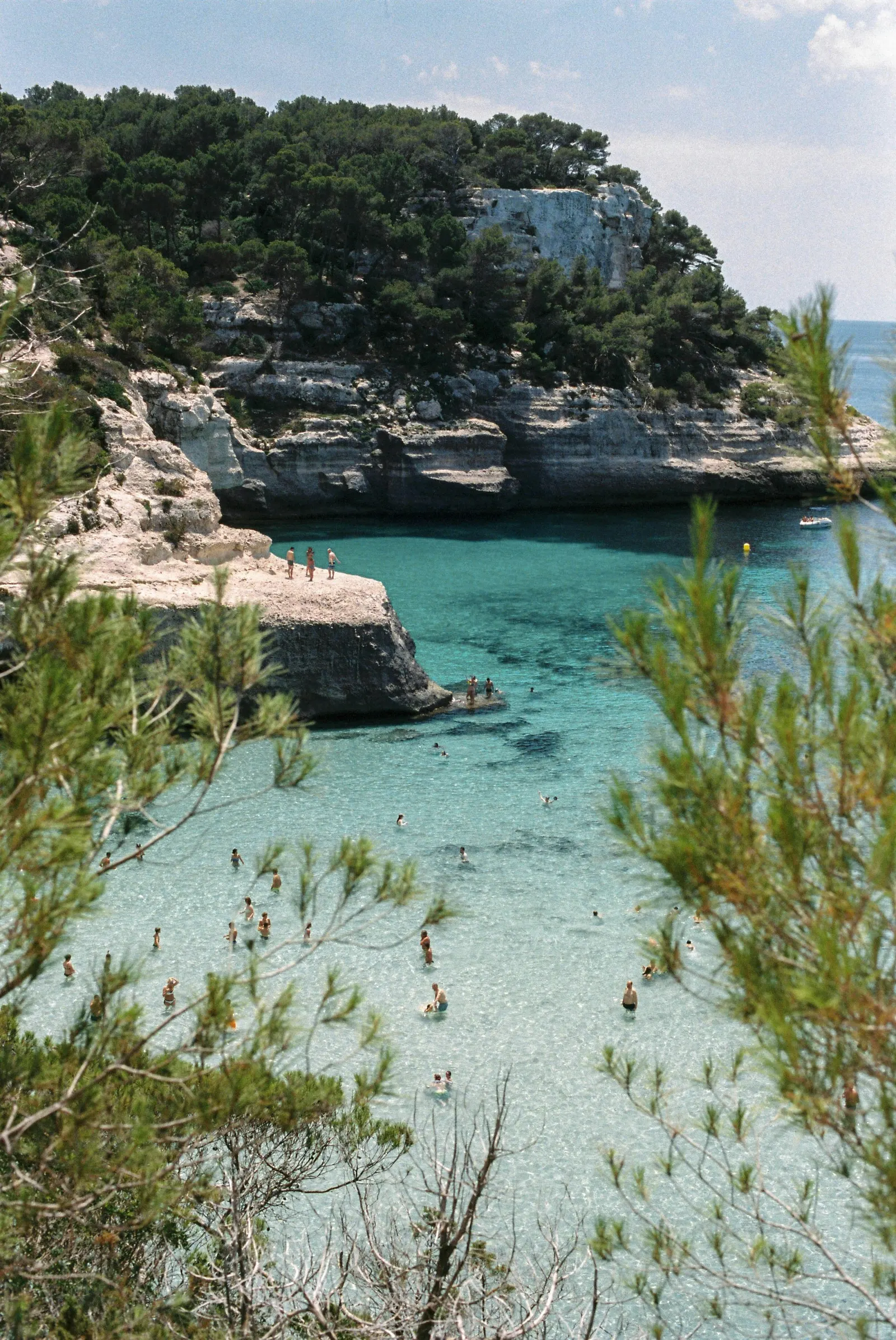
If you’ve enjoyed Mitjana but you’re after more solitude, the play is to park here, swim early and then follow the trail for a few kilometres: each cove you leave behind is a little more unspoilt than the last. Take plenty of water, closed shoes and a hat, because beyond Mitjana there are no facilities of any kind.
How to look after it
When an unspoilt cove is this easy to reach, its conservation depends entirely on the behaviour of those who visit. There is no cleaning service, so what comes in leaves with you: bring a bag for your rubbish and leave nothing behind, not even the “biodegradable” kind. Don’t collect sand or stones, respect the vegetation of the dunes and the pine wood, and don’t light fires.
And there’s a quiet gesture worth more than any rule: go early and stay a short while. Spread the hours out, don’t monopolise the spot, let the cove breathe between visitors. Cala Mitjana doesn’t need saving; it needs to be treated for what it is: a beautiful, fragile place that, for better or worse, is reached far too easily.
If you’d like to keep discovering the coast with a discerning eye, you’ll be interested in our best coves in Menorca and our feature on Ferreries, its crafts and its ravine, the town to which this cove administratively belongs.
Our take
Cala Mitjana is one of those beaches that has it all — cover-shot beauty, clean water, cinematic cliffs — and just one snag: there’s no longer any effort involved in reaching it. At Calma Society we don’t think that’s a flaw, but a responsibility. Go, enjoy it, but do it well: get up early, bring your own supplies, don’t expect facilities that don’t exist, and don’t confuse it with its little sister.
And if you ask us what to do to experience it at its best, the answer is twofold: arrive with the first light and, when the sun is beating down and people start to arrive, sling your rucksack over your shoulder and follow the Camí de Cavalls west. The easy cove will have given you the perfect swim; the hard ones that come after will give you the silence.