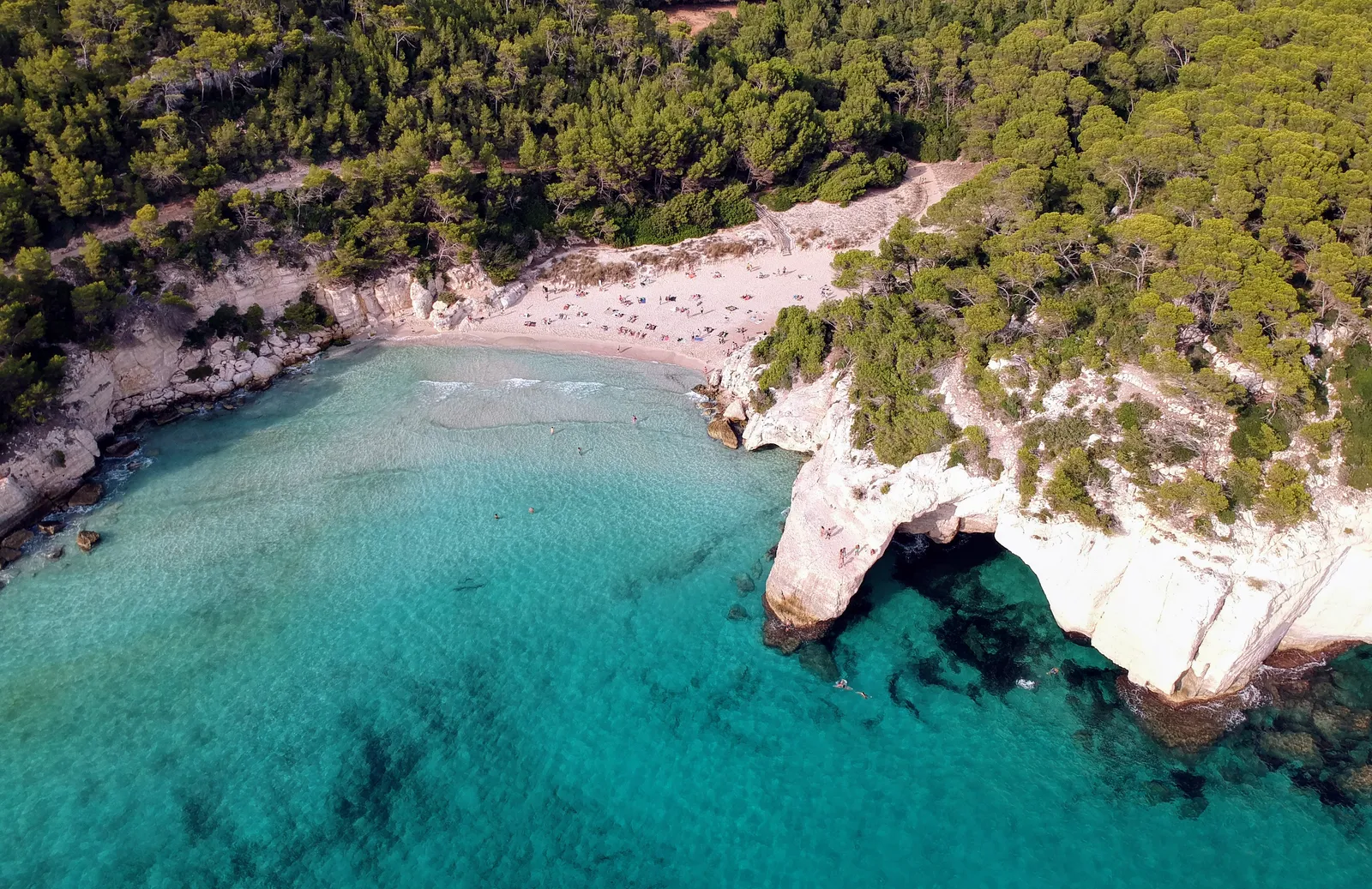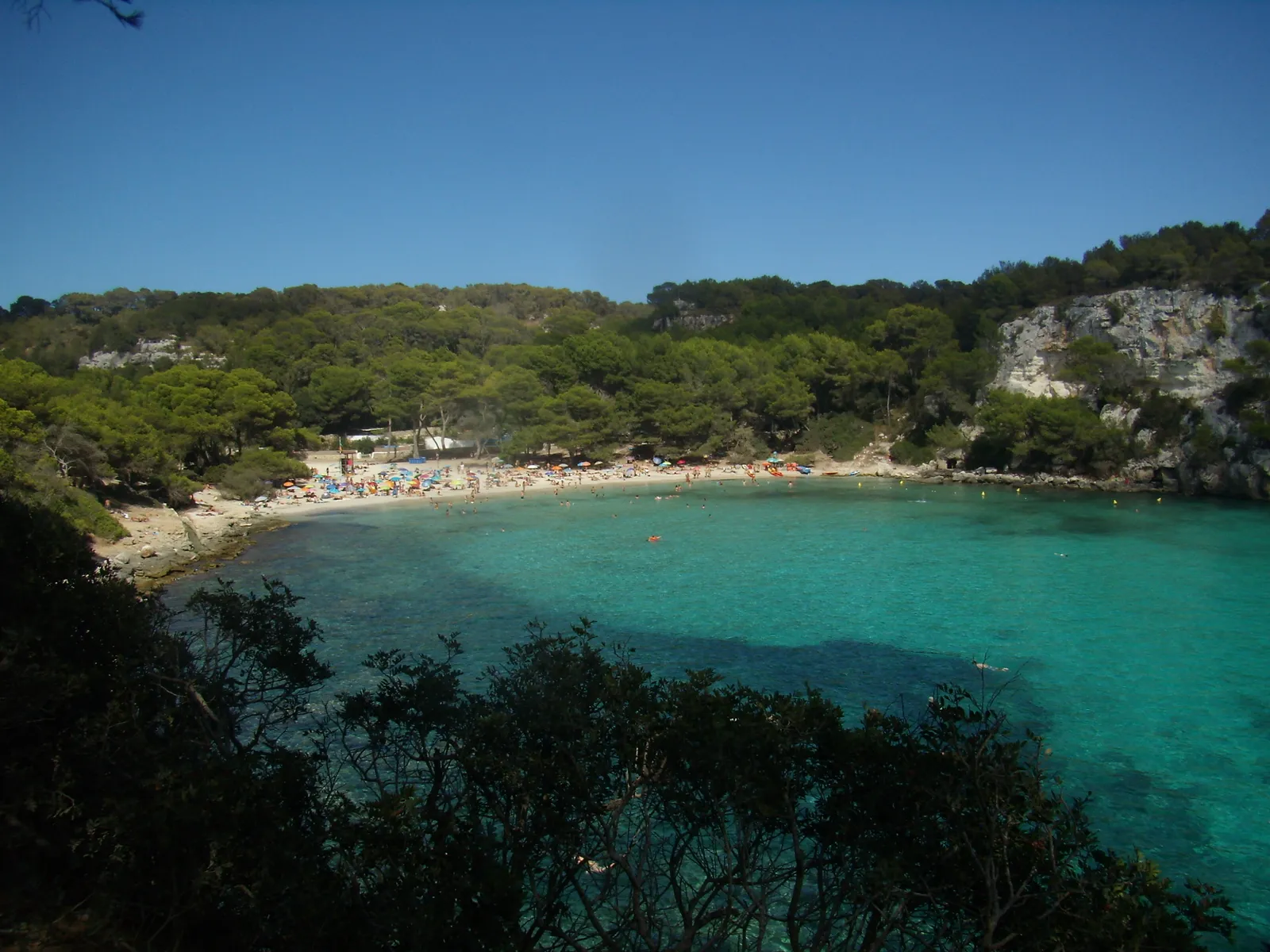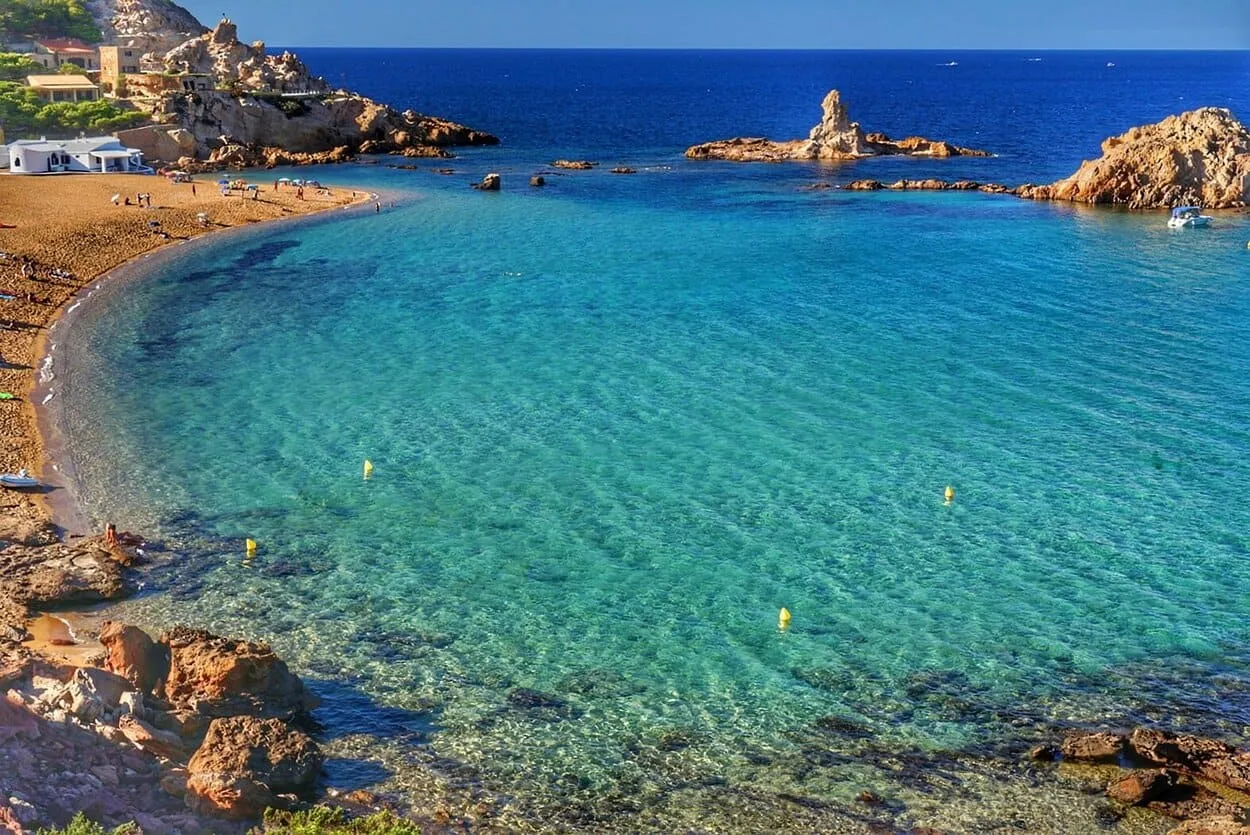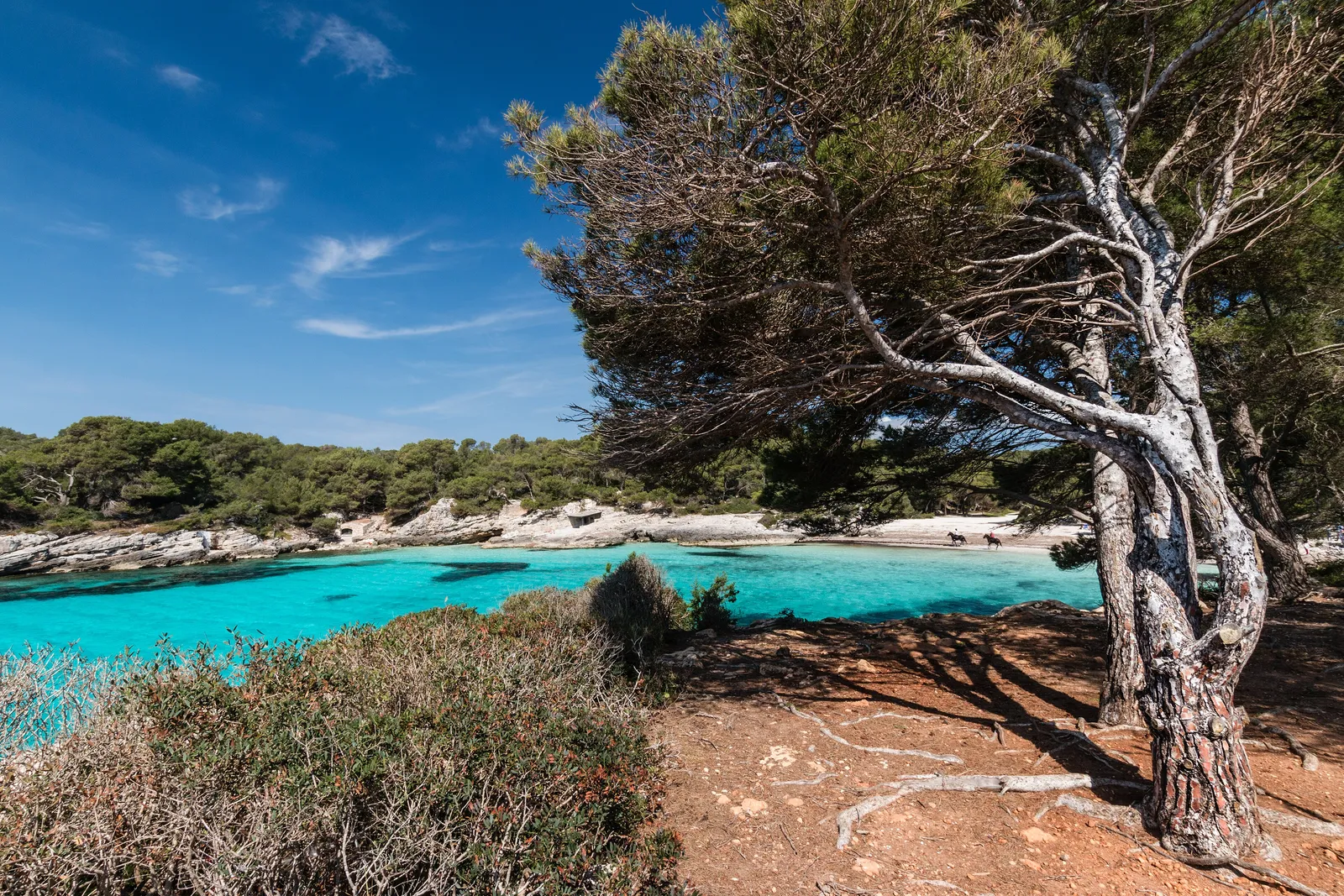
Some coves are earned through effort, others through an early start. Cala en Turqueta, on the south coast of Ciutadella, belongs to the second kind. It is the textbook Menorcan postcard —fine white sand, water of an almost unreal turquoise, a pine wood that embraces the beach and gives it shade— and, precisely for that reason, it is one of the most coveted on the island. The good news is that it remains a sheltered, serene cove of a beauty that justifies the fame. The less good news is that the space for your car runs out sooner than you think.
Turqueta doesn’t have the wild drama of the north, nor the epic access of some untouched coves. Its appeal is something else: the classic perfection of the Menorcan south, that picture of pale rock, pine and clear water that seems designed to make you never want to leave. Two small beaches separated by a rocky outcrop, water that stays shallow for a long way out, and a calm that makes it one of the most photogenic on the island. This is the guide to enjoying it well, without fighting over a parking space and knowing exactly what you’re going for.
The essentials
- Where: south coast, municipality of Ciutadella, between Es Talaier and Son Saura. Access is by an unsurfaced dirt track.
- Access in summer: cars are not banned, but the car park is limited and closes once full —often full by mid-morning—. The convenient alternative is the bus (line 68 from Ciutadella), which drops you at the same car park.
- From the car park to the beach: about 10 minutes on foot through a holm-oak wood.
- Facilities: none. No beach bar, no lifeguard and no toilets. There are picnic tables under the pines.
- What to bring: water, food, your own shade, sturdy footwear for the track and a bag for your rubbish.
- Best time: first thing in the morning, especially in July and August.
How to get there (and why the car park changes everything)
It’s worth understanding properly, because it’s the difference between a good day and a morning lost driving in circles. Turqueta is reached by an unsurfaced dirt track that ends at a car park. That car park has a limited number of spaces and closes when full, something that in high season often happens by mid-morning. It isn’t the model of other nearby coves such as Macarella, where car access is outright banned in summer: here you can drive all the way to the car park, but if you arrive late, you’ll find it full.
That leaves two sensible strategies. The first, get up early: arriving early —the closer to opening time, the better— guarantees a space and, as a bonus, gives you the cove at its finest, with still water and clean light. The second, leave the car in Ciutadella and take the bus up: in summer line 68 runs to the car park itself and saves you the parking problem entirely. Either way, from the car park it’s about 10 minutes on foot through a pleasant holm-oak wood before you reach the sand.
When to go
From May to June and in September, Turqueta is at its best: water already pleasant, beautiful light and a far more manageable crowd. These are the months when the cove can be enjoyed without stress and the parking question stops being a race.
In July and August, there’s only one rule: early or not at all. The calm window is first thing in the morning, before the car park fills and the sand gets busy. If you’re not an early riser, the bus is your best ally, because it takes the parking worry off your hands. And, always, a tip that holds for the whole south coast: check the wind forecast. Turqueta is a sheltered cove, which makes it comfortable on many days, but the south coast especially rewards calm days for bringing out the full colour of the water.
What you’ll find
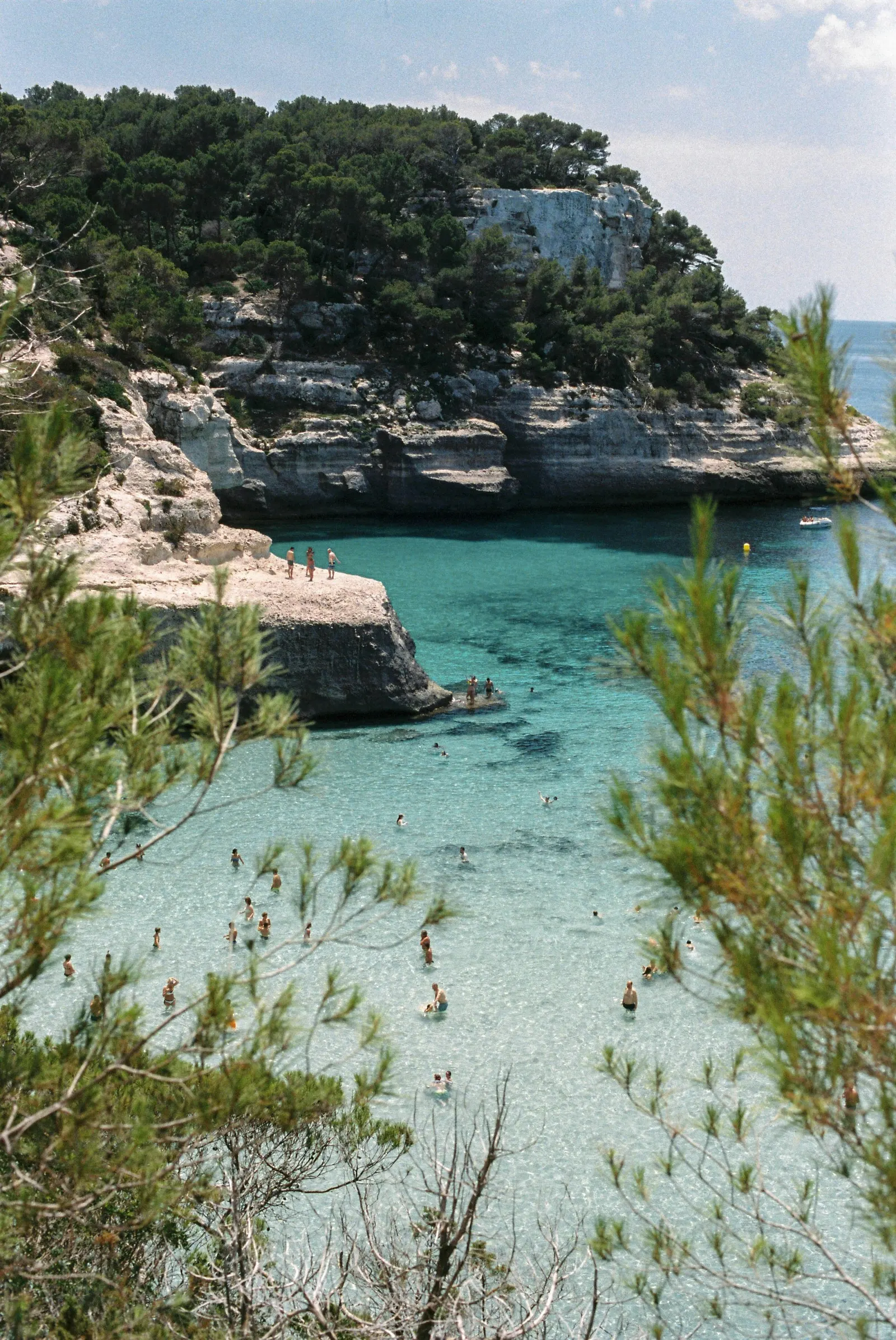
First, that picture you’ve seen a thousand times and that still impresses: fine white sand, transparent turquoise water and the pine wood coming down almost to the shore. The cove is divided into two small beaches separated by a rocky outcrop, a detail that makes it especially photogenic and invites you to explore from one to the other. The water stays shallow for a long way out and remains calm, so it’s one of those coves that work well for a long, untroubled swim.
Second, and it’s worth repeating, is what there isn’t: no beach bar, no lifeguard, no toilets. Turqueta is a natural cove stripped of facilities, and that’s part of its charm. The only thing it offers is picnic tables scattered under the pines, a clear invitation to bring food down and make lunch in the shade part of the plan. The shade of the pine wood, by the way, is a luxury many southern coves don’t have: make the most of it during the middle of the day.
Beyond the cove: the Camí de Cavalls
Turqueta doesn’t stand alone. It forms part of the Camí de Cavalls, the historic path that rings the island, and that opens up the best way to make the most of the area: walking. In one direction, a pleasant stroll connects it on foot with the tiny, lovely Es Talaier; in the other, with the broad Son Saura. It’s a perfect plan for anyone wanting to see three coves in one morning without getting back in the car: you park (or arrive by bus), walk down to Turqueta and, with good footwear and water, string together its neighbours along the path.
If you have time left, it’s worth combining the beach with a visit to nearby Ciutadella, one of the most beautiful cities in the Mediterranean. We tell its story in our guide to Ciutadella, city of palaces. And if what you want is to compare and choose well among all the options along the coast, our selection of the best calas in Menorca will save you hours of indecision.
How to look after it
A cove this perfect is preserved by treating it with common sense. With no bins and no cleaning service, everything that comes in leaves with you: take your rubbish away in a bag, no exceptions. Respect the pine wood and the dunes, don’t take away sand or stones, and use the picnic tables with the same care you’d want to find them in.
Drive slowly along the dirt track, park only where it’s allowed and, if the car park is closed because it’s full, don’t improvise: that’s exactly the day to fall back on the bus or change your plan. Turqueta’s balance is fragile, and in fact in 2025 the Ciutadella Local Police went so far as to propose restricting car access here too, as already happens at other coves nearby —a measure that, for now, is not in force, but that gives the measure of the pressure these places come under in summer—. The better we behave, the longer it will be before it becomes necessary.
Our take
Cala en Turqueta is one of those that don’t disappoint: the postcard image is real and the swim, sheltered and calm, lives up to it. But enjoying it comes down almost entirely to a decision you make before leaving home —what time you go—. Get up early and you’ll have the finest cove in the south almost to yourself; go mid-morning in August and you risk finding the car park closed and the sand packed.
Our advice is simple: treat it as a morning plan, not a midday one. Set off early or take the bus up, head down with a picnic, link it on foot with Es Talaier or Son Saura, and give yourself the luxury of not being in a hurry. Turqueta rewards exactly that: those who arrive early and those who know how to stay.