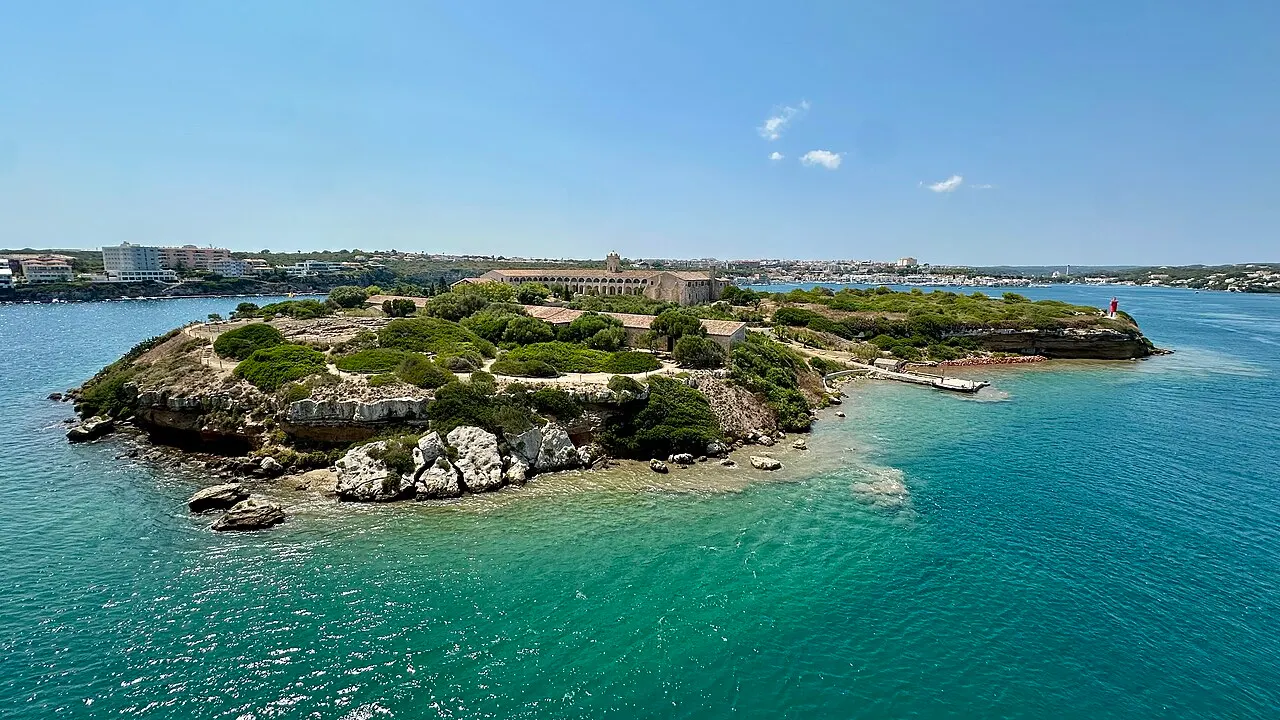
Some buildings make more sense from the sea. La Mola is one of them. Anyone arriving by boat into the harbour of Maó sees it before setting foot on land: a mass of stone crouched on the headland that closes the harbour mouth, looking east like a guardian that never really fired a shot in anger. It is no fairy-tale castle, nor a romantic ruin; it is a machine for defending, conceived with the cold logic of 19th-century military engineering, and that is precisely why it impresses.
Officially it is called the Fortalesa Isabel II, although almost everyone knows it by the name of the place: La Mola. It rises on the headland of the same name, at the entrance to Maó harbour, on the eastern edge of Menorca. Beside it, moreover, lies the easternmost point of the whole of Spain: here the country ends and the open Mediterranean begins.
This is a calm guide to La Mola: why such an enormous fortress was built on a small island, what you see today as you walk through it, and why it is worth reaching this far corner of the island without rushing.
The essentials
- Where: the headland of La Mola, at the entrance (the mouth) of Maó harbour, on the eastern edge of Menorca; about 10 signposted km from Maó.
- What it is: the Fortalesa Isabel II, a great military complex of the 19th century, considered one of the largest European fortresses of its era.
- When it was built: construction begun in 1850, inaugurated in 1852 with the visit of Queen Isabel II — after whom it is named — and finished in 1875.
- What for: a triple role: to defend the harbour, to serve as the base of operations for the Army on the island, and as a stronghold of last resort.
- The detail: beside the fortress lies the easternmost point of Spain.
- How to visit: with guided tours (in several languages) and an audio guide. Check current prices and opening times on the official website, as they vary by season.
Why such a large fortress on a small island?
The answer lies in the water. The harbour of Maó is one of the longest and deepest natural harbours in the Mediterranean, an anchorage capable of sheltering entire fleets from the storms. That virtue made it, for centuries, a prize coveted by every power that contended for the western Mediterranean. Whoever controlled the mouth of the harbour controlled the island, and held almost a key to the sea between Europe and North Africa.
La Mola was born of that logic. In the mid-19th century it was decided to raise a modern fortification that would seal the entrance to the harbour with the most advanced artillery of the moment. The work was colossal for the means of the time: kilometres of walls, moats, batteries, barracks and galleries cut into the rock, all directed towards a single purpose: that no hostile ship should enter Maó without paying dearly for it.
The result is a fortress that belongs to a different family of buildings from the medieval castles. There are no turrets here, no picturesque battlements, but low lines, calculated angles and walls designed to withstand the impact of heavy artillery. It is pure military architecture, and reading it with a little context makes it fascinating.
Isabel II, 1850–1875: the birth of a great mass
The chronology helps to gauge the scale of the undertaking. Construction began in 1850, after the demolition of an earlier castle that occupied part of the harbour entrance. Barely two years later, in 1852, the fortress was inaugurated with the visit of Queen Isabel II, who gave it its name: Fortalesa Isabel II. But a work of this magnitude is not raised in two years: the labour continued for more than two decades, until its completion in 1875.
It is worth being clear about a distinction that confuses many people. La Mola is not the Castell de Sant Felip. They are two different fortresses, set on either side of the harbour mouth: the Castell de Sant Felip is the older of the two and was demolished, whereas La Mola is the great 19th-century fortress that replaced it as the harbour’s main defence. Anyone who mixes them up loses two separate chapters of the same story.
Over time, La Mola kept its military function well beyond the 19th century, which explains why the complex preserves additions and batteries from later periods. Today that past has become its greatest attraction: to walk through it is to walk through a century and a half of defensive engineering.
What do you see today as you walk through La Mola?
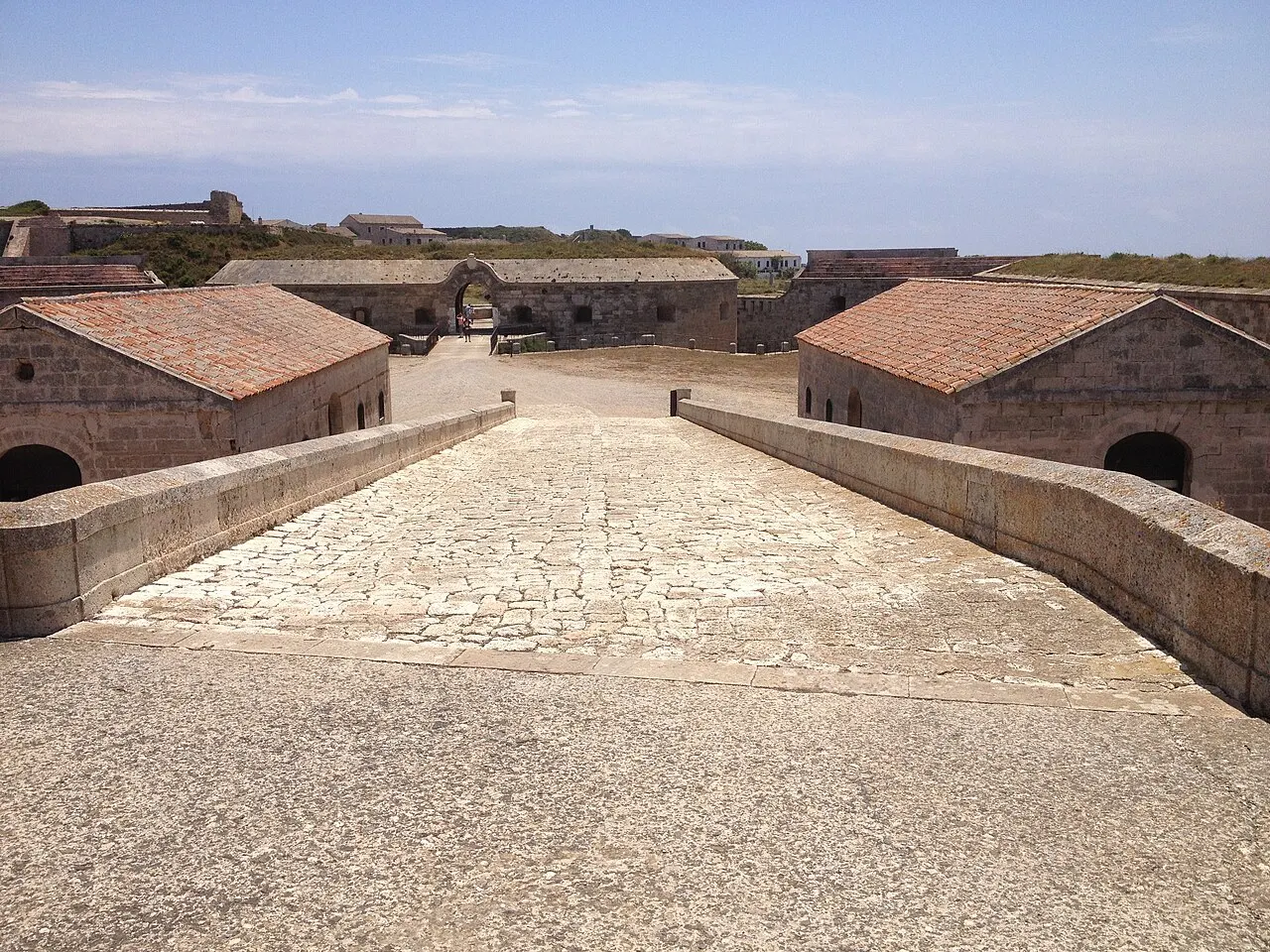
The first thing that surprises you is the scale. The fortress occupies a good part of the headland, so the visit is not that of a single monument but of a whole territory: cobbled ramps, large courtyards, stone barracks, moats and galleries that burrow into the rock. The complex is considered one of the largest European fortresses of the 19th century, and you feel it as you walk: it is hard to take in all at once.
To that military dimension is added the dimension of landscape. From the bastions that look out to sea, the view of the open Mediterranean and of the harbour entrance is immense. Here you understand at a glance why this point was so strategic: it commands the entire eastern horizon of the island.
And then there is the geographical detail that lends a touch of emotion to the visit: beside the fortress lies the easternmost point of Spain. It is worth being precise about this, because it is a fact mistakenly attributed to other places in Menorca: the eastern extreme of the country is here, on the headland of La Mola, not at the Favàritx lighthouse nor at any other cape. It is the first piece of Spanish mainland to receive the sun each morning.
How do you visit?
La Mola is explored on guided tours, available in several languages, and also with an audio guide for those who prefer to go at their own pace. It is the best way to make the most of it: without a little context, such a large fortress can remain a set of impressive but mute walls; with explanation, every battery and every gallery takes on meaning.
Since it is an open-air and extensive site, it is wise to bring comfortable footwear, water and sun protection, especially in summer. And, as with almost everything in Menorca, the most prudent thing is to check current prices and opening times on the official website before you go, as they vary by season and there are sometimes days or time slots with restricted access.
What is nearby: the other shore of the harbour
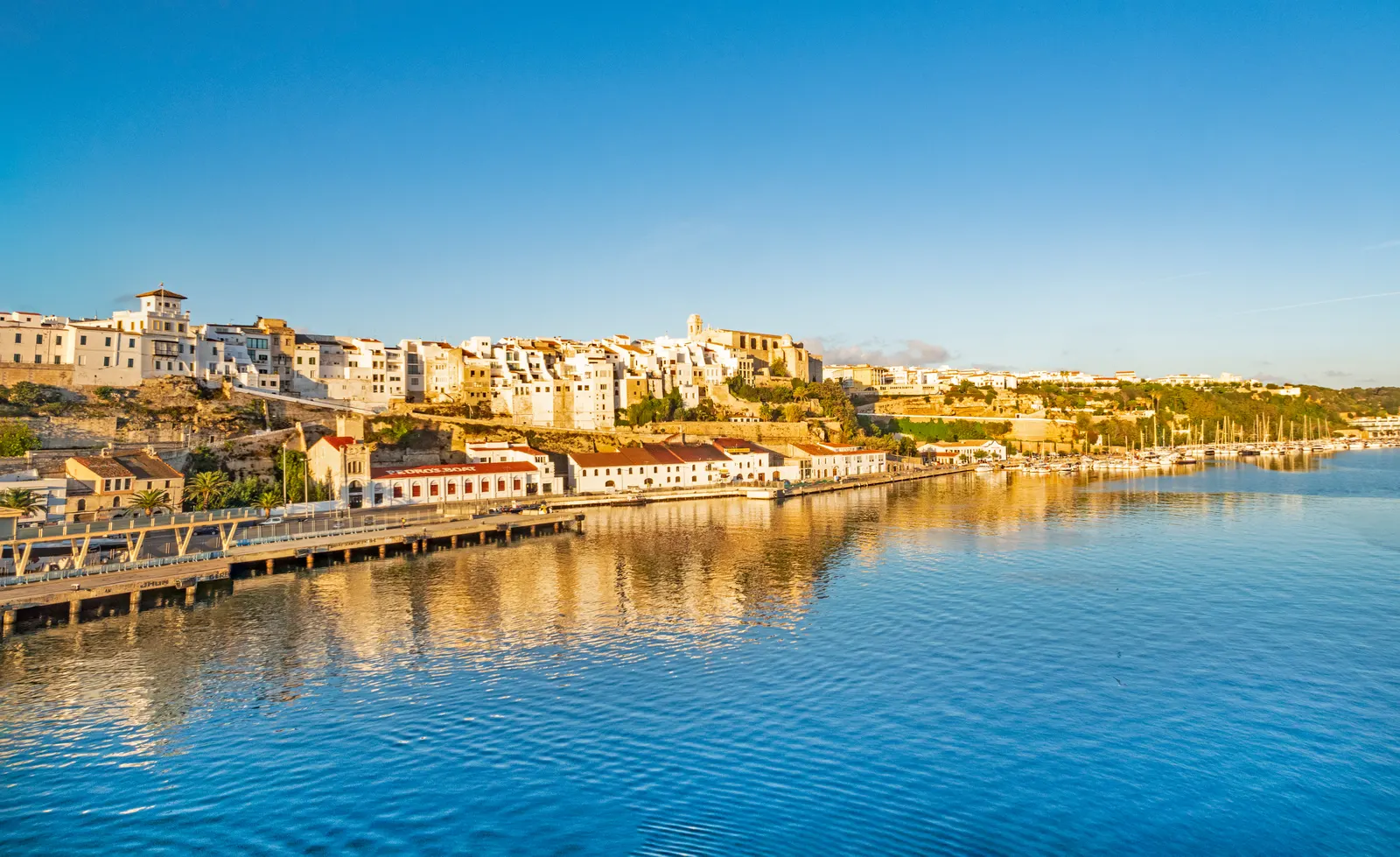
La Mola cannot be understood on its own, but as part of the defensive system of the entire harbour mouth. On the opposite shore lies Es Castell and Cales Fonts, the town of British layout that also watched over the harbour entrance and that today offers the best sunset plan in the area. To visit La Mola in the morning and come down to Cales Fonts in the late afternoon is to walk the two faces of the same story: that of a harbour which, for centuries, was among the most contested in the Mediterranean.
And in between lies, of course, the harbour of Maó itself, the natural basin around which this whole corner of the island revolves. To take in fortress, town and harbour in a single day is to follow the logical thread of a single tale.
Our take
La Mola asks for a different kind of gaze from that of the cove or the beach bar. You do not visit it for easy beauty, but for the power of understanding a place: the power of treading a fortress built so that no one should pass, and discovering, from its walls, why Menorca was so coveted. It is history you walk through, with the open Mediterranean as backdrop and the edge of Spain beneath your feet.
Our advice is simple: go with time to spare, do it with the guided tour or the audio guide so that the stone may speak, and combine a morning at La Mola with an afternoon on the other shore of the harbour. It is quiet luxury of the least obvious kind — that of the depth and silence of an enormous place — and it leaves you with the sense of having understood the island a little better. That, on a journey, is worth more than many photographs.