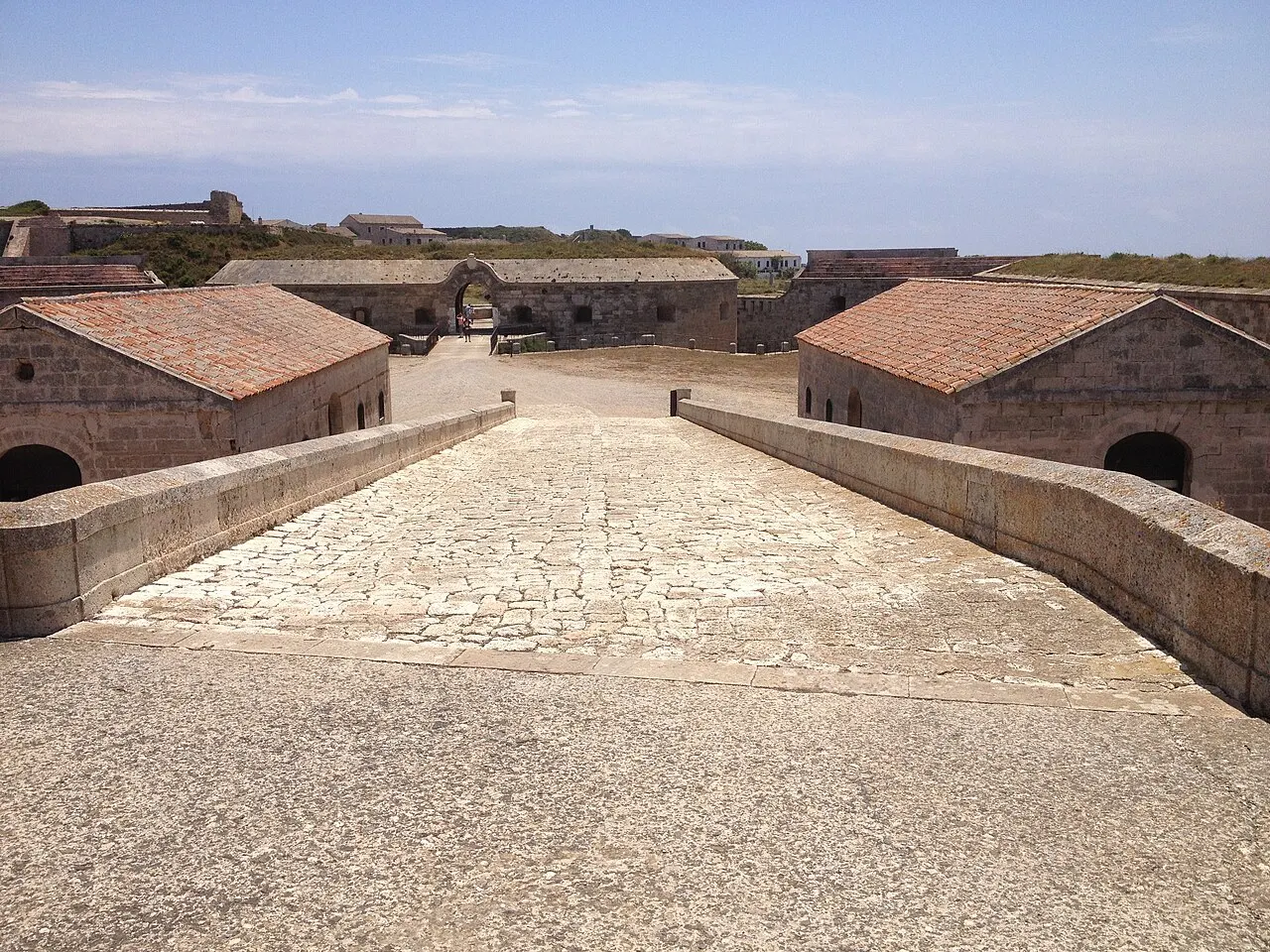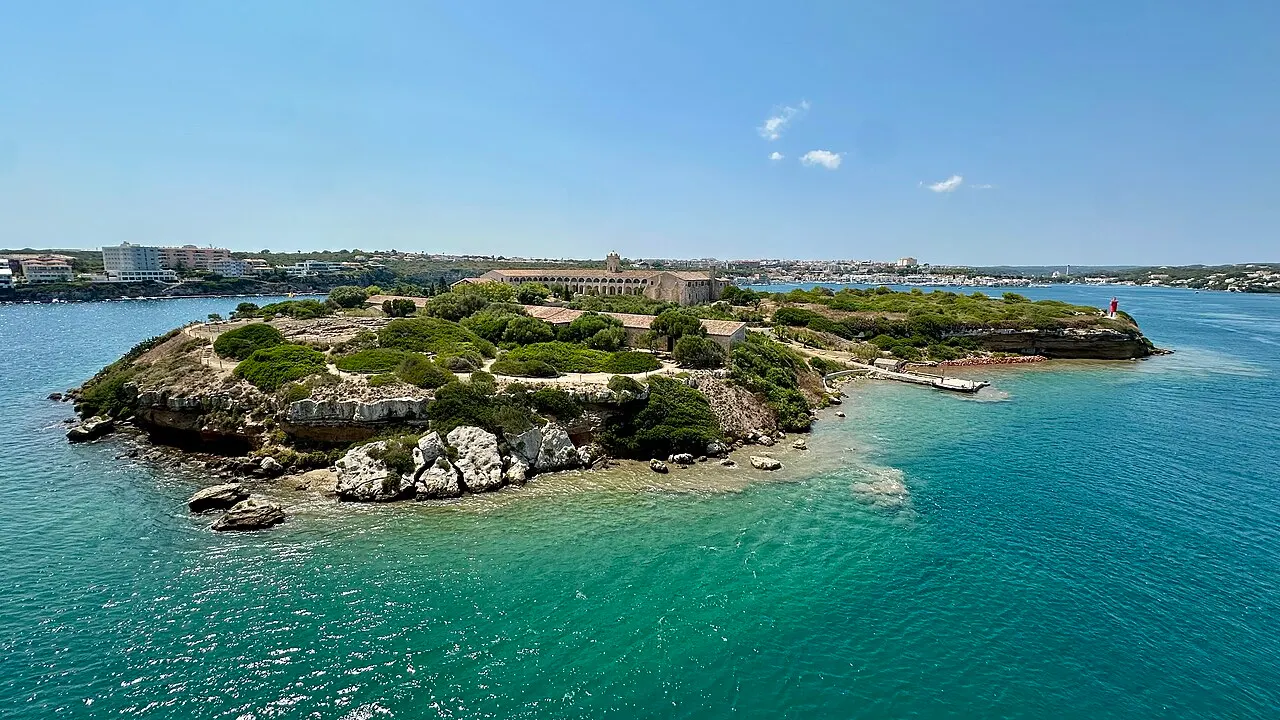
In the middle of Maó harbour, a few minutes by boat from the quays, lies a low, elongated island that most visitors see from afar without quite knowing what it is. It is called Illa del Rei, and few places in Menorca pack so much history into so little ground. Three distinct layers, centuries apart, share the same rock: an early Christian basilica, a military hospital and a contemporary art gallery of international standing.
This is no ordinary islet. Here, so the tradition goes, King Alfonso III landed in 1287 to begin the Christian conquest of the island, and that is where its name comes from. Centuries later, the British chose it as the site of their great military hospital, which is why it is also known as the Hospital Island. And since 2021, restored and reopened, it has been home to the Menorcan outpost of the Hauser & Wirth gallery. Three lives in a single place.
This is a calm guide to Illa del Rei: what it gathers within it, how to read its layers without mixing them up, and why the short boat trip from Maó is well worth it.
The essentials
- Where: an islet in the middle of the natural harbour of Maó, one of the longest dockyards in the Mediterranean.
- Three layers of history: a sixth-century early Christian basilica, a British military hospital and, since 2021, the Hauser & Wirth Menorca gallery.
- The name: it takes its name from King Alfonso III, who landed here in 1287 to begin the Christian conquest of Menorca.
- The hospital: it served as a British military hospital from 1711 and remained in use until the 1960s.
- Recognition: declared a national Historic-Artistic Monument in 1979.
- Getting there: by boat from Maó, with set timetables (check current fares and times before you go).
Where does the name “Illa del Rei” come from?
The name points straight to a founding moment of Christian Menorca. Tradition places here the landing of King Alfonso III in 1287, when he began the conquest of the island, until then under Muslim rule. From that episode came the name by which it is known today: the king’s island.
It is worth knowing that the same islet has had more than one identity. Because of its later use as a hospital, it is also called the Hospital Island, and both names are used interchangeably. The important thing is not to get lost among the harbour’s own islands, of which there are several and which are easily confused (more on this later).
The sixth-century basilica: the oldest layer
Beneath the military and artistic history beats something far older. Illa del Rei preserves a sixth-century early Christian basilica, one of the most valuable witnesses to early Christianity in Menorca. Its remains were discovered in 1888, and systematic excavation did not begin until 1964.
What comes to light is remarkable: the basilica preserves mosaics in the Syrian-African tradition —a detail that speaks of the island’s Mediterranean connections in those centuries— and a circular baptismal font. It is a reminder that, long before it became a summer destination, Menorca was a crossroads of routes and cultures at the heart of the Mediterranean. Anyone who comes to the island thinking only of contemporary art will be surprised to walk, just a few metres away, on a floor fifteen hundred years old.
The military hospital: why it is called the “Hospital Island”
The most recognisable layer from the boat is the great building of the military hospital, which takes up much of the islet. The British built it from 1711 onwards, during their first occupation of Menorca, making the most of the island’s position, isolated and yet sheltered, at the centre of the harbour: an ideal place to tend to the fleet’s wounded and sick, far from the risk of contagion among the population.
The hospital had a very long life. It passed through the various administrations that succeeded one another on the island and remained in use until the 1960s, well into modern times. Then came abandonment and ruin, until an association of volunteers undertook its recovery. That restoration effort is, in large part, what has allowed the island to be alive and open to visitors again today. In 1979 it was declared a national Historic-Artistic Monument, in recognition of the value of the whole site.
Hauser & Wirth Menorca: the island’s third life
The most recent layer arrived in 2021, when the international gallery Hauser & Wirth opened its Menorcan outpost in the island’s restored buildings. It was an event that put Menorca on the contemporary art map in a way unusual for an island of this size: a top-tier gallery installed in a former military hospital, in the middle of a harbour.
The whole is completed by a garden designed by the landscape designer Piet Oudolf, one of the most renowned figures in contemporary landscape design, which converses with the Mediterranean light and vegetation. The combination —art, historic architecture and garden— is what makes the visit more than simply seeing an exhibition.
For the specific exhibitions, the works on show, the opening hours and the entry conditions, the most reliable thing is to check the Hauser & Wirth Menorca website directly, since the programme changes throughout the year. Here we prefer not to anticipate details that may quickly go out of date.
Don’t confuse it: Illa del Rei is not the Lazaretto
A useful word of warning, because Maó harbour has more than one islet and they are easy to mix up. Illa del Rei should not be confused with Illa del Llatzeret (the Lazaretto), another islet in the same harbour that served as a quarantine lazaretto: the place where crews and goods were isolated to prevent epidemics from coming ashore.
They are two different islands, with two different historic roles, even if both speak of Maó harbour’s role as a great maritime gateway to the Mediterranean. If you book a visit, make sure which of the two you are going to.
How do you visit, and what’s nearby?
You reach Illa del Rei by boat from Maó, with set timetables depending on the season; it is worth checking current fares and times before you go, because access is not continuous throughout the day or the year. The crossing is short and part of the appeal: watching the hospital draw closer from the water is the best introduction to the island.
It makes every sense to string the visit together with the rest of the harbour. Just a step away lies Maó and its harbour, one of the longest and deepest natural dockyards in the Mediterranean, around which this corner of the island turns. And at the mouth, watching over the entrance, stands the fortress of La Mola, another of the harbour’s great military pieces. To walk all three is to follow the thread of Menorcan history from the sea.
Our take
Illa del Rei is, probably, the best possible summary of Menorca in a single place: a small island where early Christianity, the British legacy and the art of today all meet, without any layer erasing those before it. It is not a destination for beaches or for hurry; it is a place to read slowly, with the basilica, the hospital and the garden as three lessons in what this harbour has been across the centuries.
If you have only one morning in Maó and you are wavering, this is our recommendation: set sail for the island. Check the timetable first, step onto the boat and let the harbour open up behind you. Few excursions so short give so much.