There is a question almost no one asks while strolling through Mahón and which, nevertheless, explains a great deal of Menorca: why is the island’s capital not in Ciutadella, the old city of kings, but here, at the opposite end, looking out over a seemingly endless harbour? The answer carries a British accent and is little more than three centuries old.
After the Treaty of Utrecht of 1713, Menorca passed into the hands of the British crown. It was neither a uniform nor a continuous occupation —there were interludes, changes of flag and diplomatic to-and-fro— yet it left a mark so deep that you still walk upon it today. It is in the layout of the streets, in the design of the windows, in the name of a road and even in the bottle that opens many a summer terrace.
This guide traces that legacy without nostalgia and without clichés: what exactly the British did on the island, what is still standing and where to look to see it with your own eyes. Because Mahón’s British heritage is not a textbook chapter, but something everyday that most people have right in front of them without knowing it.
The essentials
- The origin: Menorca came under British control after the Treaty of Utrecht (1713).
- Three British periods in the eighteenth century: 1708-1756, 1763-1782 and 1798-1802, with a French interlude (1756-1763) and a Spanish one in between. It was not a continuous rule.
- The capital: the British moved it to Mahón —not Ciutadella— and opened its great natural harbour to trade.
- Engineering: the Camí d’en Kane, the road that Governor Richard Kane ordered to be built.
- Architecture: the boínders (projecting glazed bay windows) and the sash windows.
- Es Castell: founded by the British as Georgetown, with a grid plan and a Georgian air.
Why the capital is Mahón and not Ciutadella
For centuries, Ciutadella had been the heart of Menorca: seat of the nobility, of the Church and of traditional power. But the British arrived with a different logic, maritime and commercial. What interested them about the island was its strategic position in the western Mediterranean and, above all, its harbour.
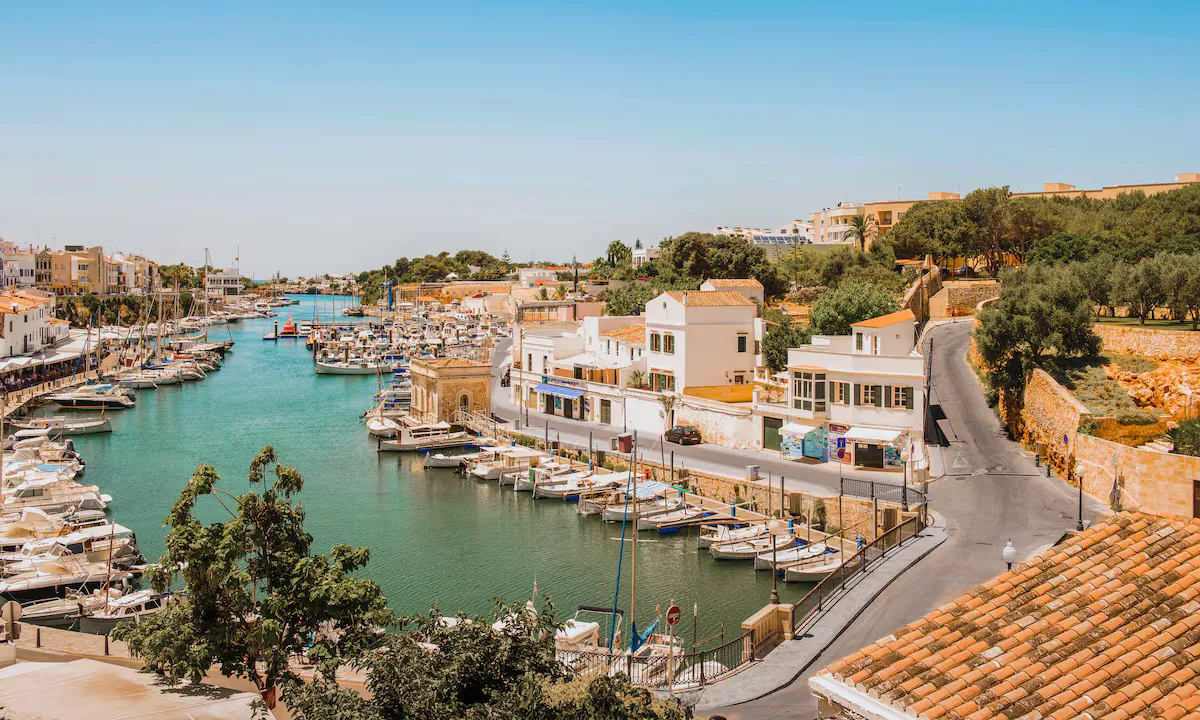
And here Mahón had no rival. Its natural harbour —a long, deep, sheltered inlet of the sea— is one of the finest anchorages in the Mediterranean, capable of taking in an entire fleet out of the wind’s reach. For a naval power it was a treasure. So they moved the capital to Mahón and threw their efforts into turning the harbour into a centre of trade and military activity.
That decision changed the island forever. Mahón grew, filled with merchants, sailors and garrisons, and shifted Menorca’s centre of gravity eastward, where it remains today. If you want to understand the harbour that decided everything, it is worth devoting a whole walk to it: we cover it in our guide to the harbour of Mahón.
What the Camí d’en Kane was
If there is one name in this story, it is that of Governor Richard Kane, the most fondly remembered British figure on the island. He is credited with a vision more ambitious than mere military occupation: to improve the life and economy of Menorca.
His most tangible legacy is the Camí d’en Kane, the road he ordered built to link Mahón with the interior and, originally, with the Ciutadella area. For a long time it was the island’s main thoroughfare, an infrastructure that eased the transport of goods and agricultural development in a territory until then poorly connected by land.
Today part of that route survives as a quiet lane between Mahón and Es Mercadal, crossing fields, dry-stone walls and the odd farmstead, offering one of the most serene panoramas of the Menorcan interior. To travel it —on foot, by bike or by car— is a quiet way of literally treading on the British heritage.
Es Castell: a town of British design
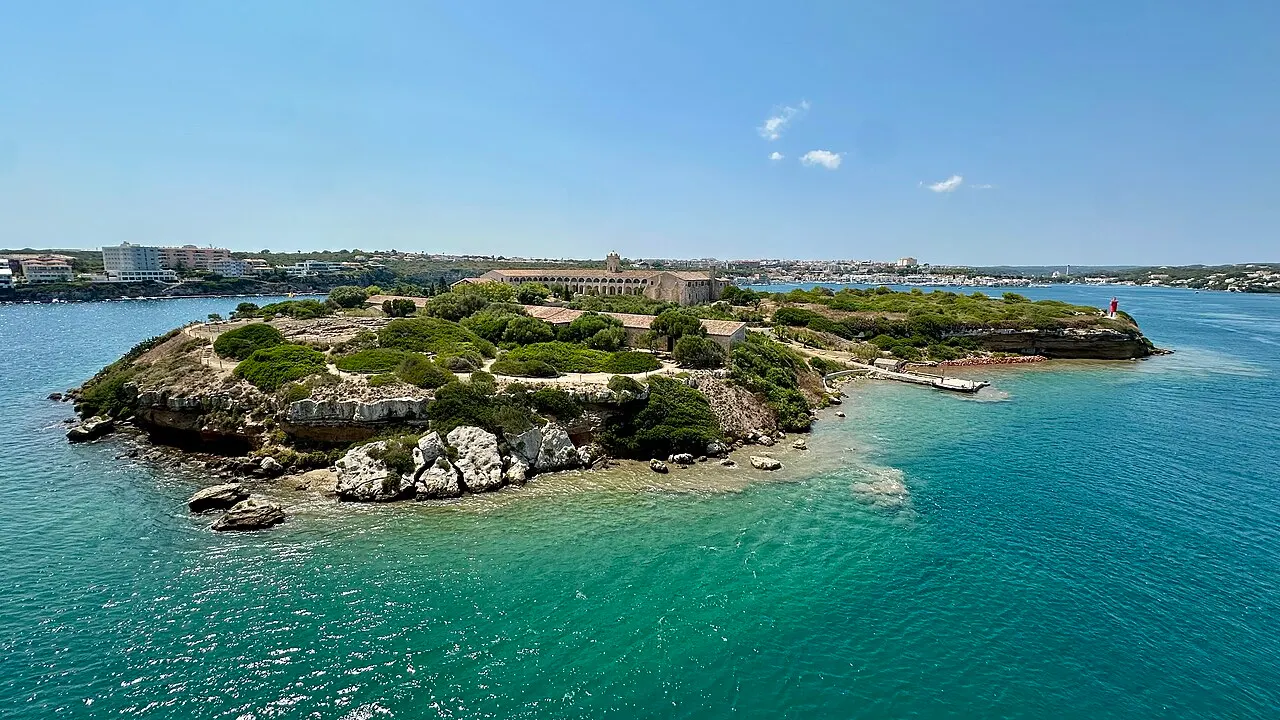
At the entrance to Mahón’s harbour, the British founded a new town beside their main fortress: they named it Georgetown, in honour of the king, and today it is called Es Castell. It is, in all likelihood, the most British corner of Menorca.
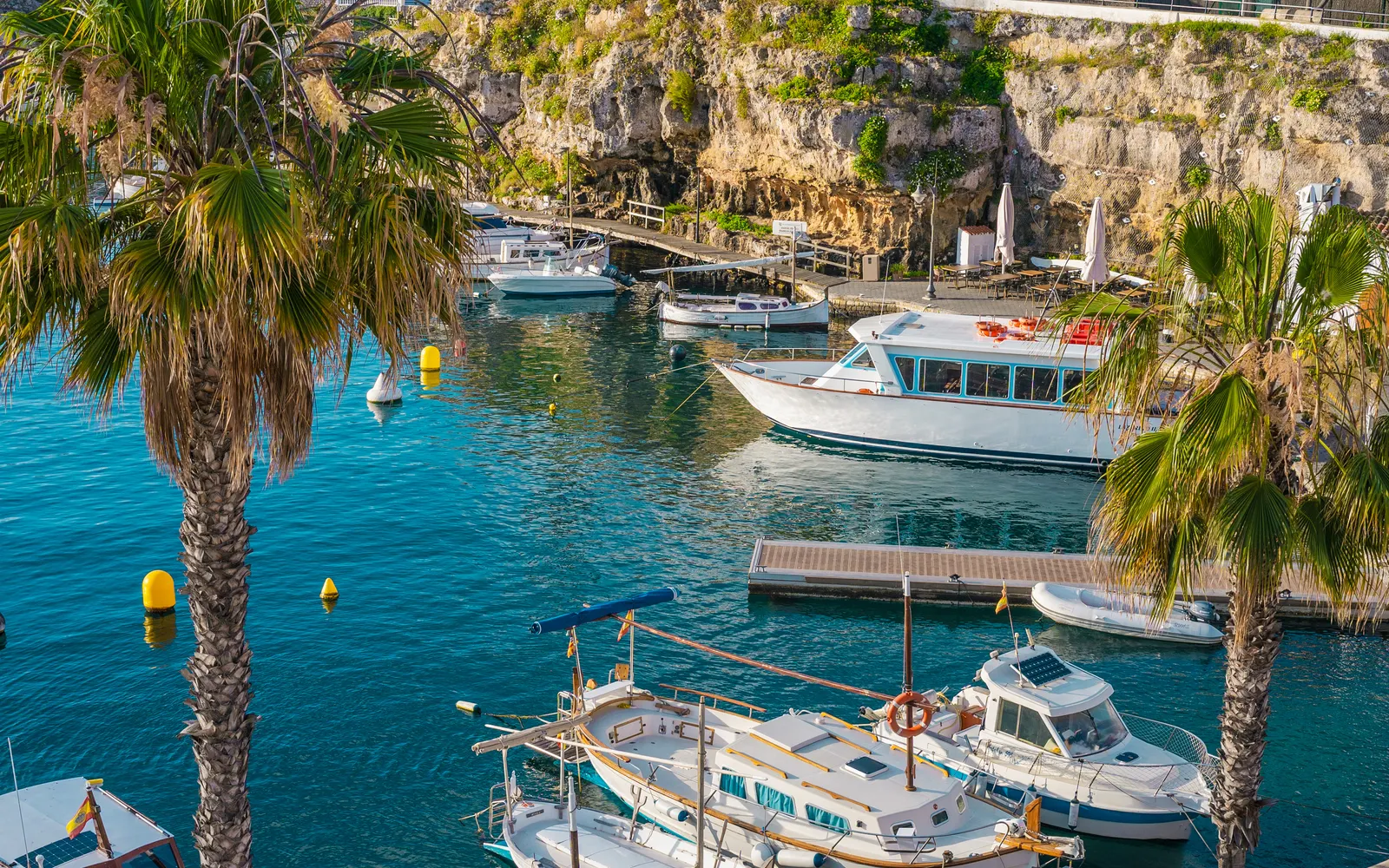
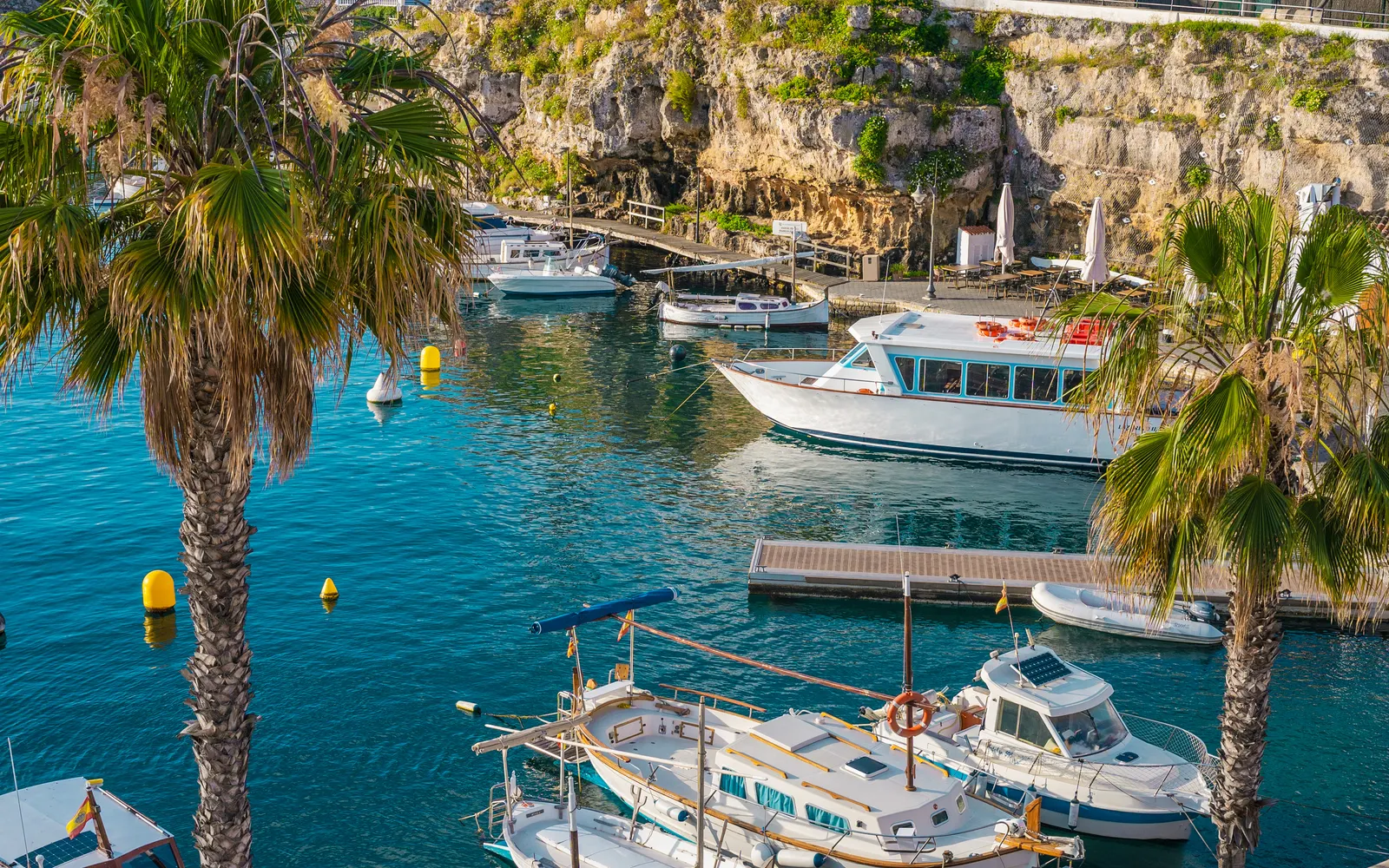
You need only walk through its parade ground to feel the difference: a rectangular, orderly esplanade, presided over by buildings of a military air, with streets that meet at right angles. In contrast to the organic disorder of the medieval Mediterranean towns, Es Castell follows a grid plan, conceived and drawn up in advance, with that Georgian sobriety that betrays its origin. Down towards the sea, the cove of Cales Fonts —today full of terraces— keeps that same air of a garrison harbour reborn as a place to stroll; we cover it in the guide to Es Castell and Cales Fonts.
Boínders and sash windows: the mark on the façades
The most everyday British heritage is not in the monuments, but in the houses. Look up in Mahón and you will see two details you will find almost nowhere else in Spain.
The first are the boínders: glazed bay windows that project from the façade, usually on the first floor, designed to capture the light and look out onto the street while sheltered from the wind. The word itself tells its own origin: “boínder” is the Catalanisation of the English bow window, the projecting window of British houses. Few proofs are as elegant of how a culture leaves its accent even in the language of a place.
The second are the sash windows, which open by sliding one pane over the other from the bottom up, rather than swinging on hinges. It was the usual model in the British architecture of the period, and in Mahón it took such root that it became part of the urban landscape. Today they remain a distinctive feature of the houses in the old quarter.
Was it “the English” throughout the whole eighteenth century?
A cliché is worth qualifying, because the real history is richer than the stereotype. Menorca was not British continuously throughout the whole century. There were three periods of British rule —1708-1756, 1763-1782 and 1798-1802— separated by a French interlude (1756-1763) and by a period of Spanish sovereignty in between.
That alternation of flags explains why the island accumulated diverse influences in just a few decades, with the British strand as the dominant but not the only substrate. To speak simply of “the English throughout the whole eighteenth century” is to simplify a story of comings and goings that is, precisely, what makes Menorca so singular.
Among everything that British naval presence left behind is also the gin. The garrisons’ fondness for gin took root on the island and gave rise to Mahón gin, which over time earned its own Menorcan identity; we devote a separate article to it, Menorca gin.
How to see it today, at your own pace
You don’t need an academic itinerary to feel this heritage. It is enough to walk through Mahón with an eye for the details: the sash windows, the boínders, the scale of the harbour. Then cross over to Es Castell and let yourself be carried along by the geometry of its parade ground. And, if there is time, walk a stretch of the Camí d’en Kane to understand that the British presence did not stop at the city, but ordered the countryside too.
It is a discreet heritage, one that neither imposes nor displays itself, but which is everywhere once you learn to recognise it. And that, perhaps, is its greatest charm: it is part of the island’s daily life without asking permission or seeking the limelight.
Our take
Mahón’s British heritage is not visited, it is recognised. There is no great monument to sum it all up, but rather a trickle of clues —a word like boínder, a window that slides, a square too orderly to be Mediterranean, a road with a foreign name— that reward those who look slowly. That is our advice: set aside a morning with no plan, leave the guidebook in your pocket and learn to read the city. When you begin to tell the British apart from the Menorcan, Mahón will cease to be just another capital and become what it truly is: the still-visible result of an extraordinary century.