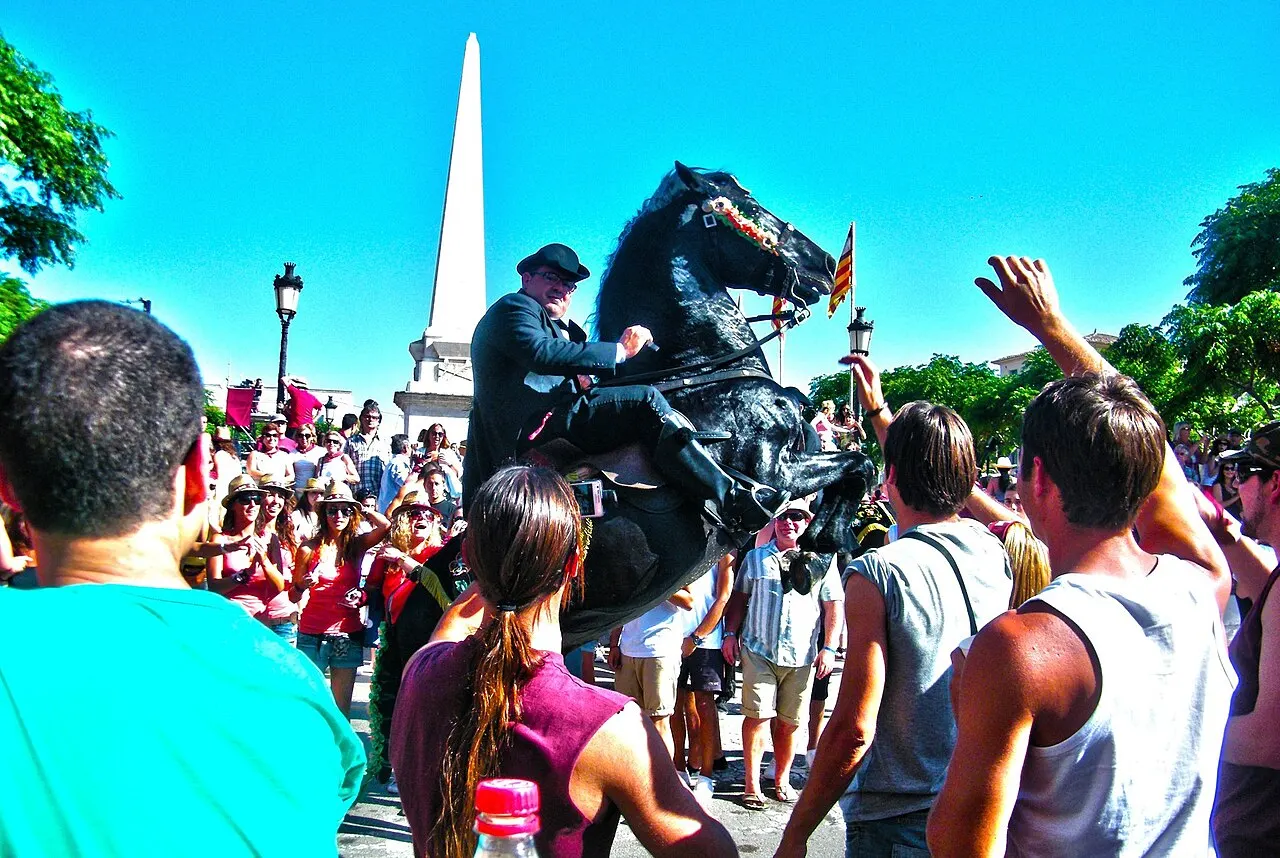
There are images that sum up an entire island. In Menorca, one of them is that of a jet-black horse standing upright on its hind legs, in the middle of a narrow, packed street, while hundreds of hands reach out to touch it. This is no circus act or conventional equestrian display: it is the heart of the Menorcan festivals, and the animal at its centre is the Menorcan horse, a breed of its own, recognised and proudly islander.
It is worth saying early on, because the confusion is common: the Menorcan horse is not the Andalusian horse, nor a type of Pure Spanish Breed. It is a distinct native breed, the Pura Raça Menorquina, with its own character, its own history and its own studbook. It shares roots in the Iberian horse stock, but it has taken its own path on this Mediterranean island, becoming a marker of identity as recognisable as the cheese or the dry-stone walls.
In this portrait we tell what makes the breed unique, how to identify it, why its coat is always black and what role it plays in the festivals, where it ceases to be a stable animal and becomes a symbol. Without fuss, as befits a horse that commands more by its bearing than by spectacle.
The essentials
- What it is: an equine breed native to Menorca, the Pura Raça Menorquina, descended from the Iberian stock.
- Coat: always black (jet black). A white or chestnut horse is not of the breed.
- Bearing: baroque, elegant and collected, with elevated movements.
- Official recognition: the breed was recognised in 1988.
- Height: around 1.50–1.55 m (stallions around 1.54 m; mares around 1.51 m).
- Population: more than 3,000 registered animals, with around 150 births a year.
A breed of its own, not an Andalusian variant
The first misunderstanding worth clearing up is the most widespread. Many a visitor, on seeing an elegant black horse performing capers, immediately associates it with the Andalusian equestrian show. But the Menorcan horse is a distinct breed, with its own standard and its own register. It descends from the Iberian stock —the great family from which other peninsular breeds also draw— but its evolution on the island, over generations, has given it features of its own.
That identity was officially sealed in 1988, the year the breed was recognised. The studbook is managed by the Associació de Criadors i Propietaris de Cavalls de Raça Menorquina, which safeguards the purity of the line and registers every animal. This is no minor detail: in a world of crossbreeding and fashions, keeping a rigorous studbook is what guarantees that the breed remains what it is.
How to recognise it: the rule of black
If you remember only one fact about the Menorcan horse, let it be this: its coat is always black, a deep jet black. There are no white, grey or chestnut Menorcan horses. The black coat is a defining trait of the breed, not an aesthetic preference. A horse of any other colour, however much it may be born on the island, is not a Pura Raça Menorquina.
To that unmistakable black is added a baroque bearing: an arched, collected neck, an elegant carriage, elevated movements and a presence that fills any space. The height ranges around 1.50–1.55 metres —stallions are around 1.54 m and mares around 1.51 m—, a medium size that combines power and agility. It is a horse made to shine over short distances, among people, rather than to gallop in open country: precisely what the festivals ask of it.
The star of the festivals
The Menorcan horse cannot be understood without the festivals. They are its natural stage and the moment when the whole island celebrates it. The best known are those of Sant Joan in Ciutadella, in late June, but the rest of Menorca’s towns have their own festivals throughout the summer, and in all of them the horse is the absolute centre.
The iconic gesture has a name: the bot. It is the moment when the horse rears up on its hind legs in the middle of the crowd, while the throng surrounds it and tries to touch it during the jaleo. Far from taking fright, Menorcan horses, well trained and used to the commotion, hold that posture with astonishing poise. It is a scene that blends emotion, controlled risk and centuries of tradition, and it explains why the breed is so tied to the island’s festive character.
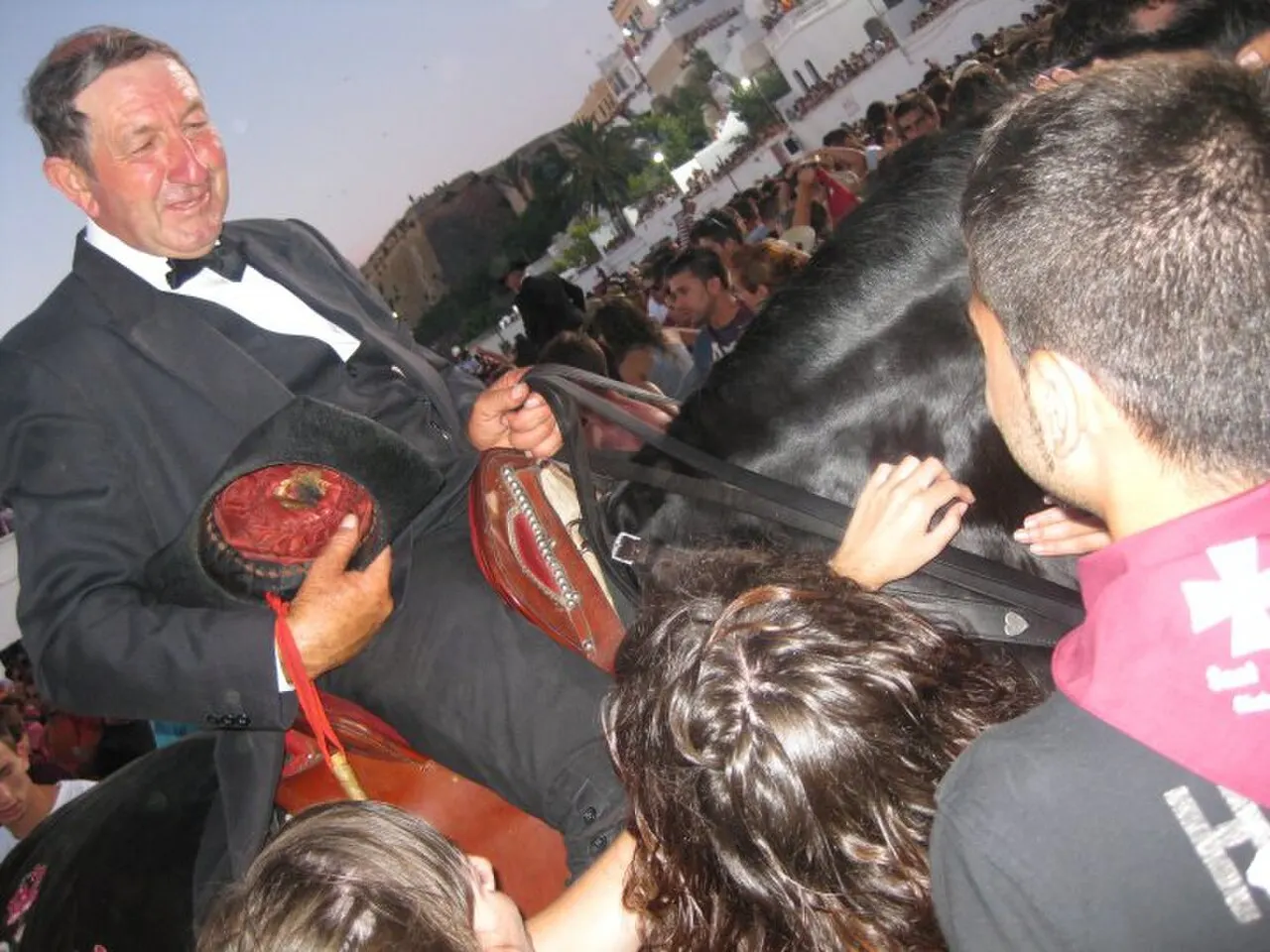
On the horse rides the caixer, the rider who is part of the colla, or group of festival protagonists, dressed for the occasion. Horse and rider act as a single figure, and the training and care of the animal are a responsibility that many Menorcan families take on with pride all year round, not only on the special dates.
If you want to truly understand what this animal means to the island, the best thing is to experience it in its context: we tell you all about it in our guide to the Sant Joan festivals in Ciutadella, the most famous setting for the jaleo.
A living breed, not a museum piece
One of the best pieces of news about the Menorcan horse is that it enjoys good health as a breed. The population exceeds 3,000 registered animals, and around 150 foals are born each year. These are figures that speak of a living breed, raised and cared for by breeders and enthusiasts who keep the line going generation after generation.
That vitality is no accident. The horse’s starring role in the festivals gives it a social and cultural function that goes far beyond the merely symbolic: there is a broad community of breeders, owners and riders who have a real reason to keep breeding and preserving it. The studbook, managed by the breeders’ association, brings order to that effort and ensures that the jet black and the baroque bearing reach the next generations intact.
Beyond the jaleo: where to see it
The festivals are the high point, but not the only chance to see Menorcan horses. Throughout the year there are conformation contests, exhibitions and equestrian events where the breed is shown outside the festive context, calmly and in full daylight —a splendid opportunity to appreciate the animal’s bearing without the giddiness of the jaleo.
They are also part of the island’s everyday landscape. It is not unusual to see them grazing in farms and meadows inland, especially in the central strip of Menorca. And Ciutadella itself, cradle of the most celebrated festivals, preserves in its old town the genteel atmosphere that frames this whole tradition; we explore it in our stroll through Ciutadella, city of palaces.
Our take
The Menorcan horse is one of those symbols that can only be fully understood when seen in its place. Away from the island it may look like just another black horse; in Menorca, rearing up amid the crowd during the jaleo, it is the distillation of an entire culture. Our advice is twofold. If you visit the island in summer, seek out a festival —Sant Joan or those of any other town— and watch the respect with which people treat the animal: that is where the key lies. And if you come out of season, ask about exhibitions or contests, where you can admire the breed with the serenity it deserves. In both cases you will see the same thing: an animal of black coat and ancient bearing that, without asking permission, has become the soul of Menorca.