Buying an old house in Menorca is the easy part. The hard part — and what truly decides whether you end up with a house that ages well or one that fights you every winter — comes afterwards: the renovation. And renovating a Menorcan house is nothing like doing up a city flat. Here the aim is not to modernise but to understand: why the walls are thick, why the windows are small, why the white of the walls is cal (lime) and not paint, and why almost everything an interiors manual would recommend doing to a house like this is, in fact, wrong.
This guide is the natural sequel to a restored stone house inland: if there we told you the why — what marès is, why the island’s interior is the most serene luxury Menorca has to offer — here we get into the how. It is not a piece about trends, nor a catalogue of “before and after”. It is a map of judgement so that, when you sit down with an architect or a master builder, you know what to ask, what to defend and what not to allow. Because in a Menorcan stone house, mistakes don’t show in the first summer: they show in the third winter, when the damp has begun to climb up a wall that someone sealed believing they were protecting it.
The essentials
- The material is marès: a local calcareous sandstone, golden and porous, foundational to all Menorcan architecture. The llocs (the old farmhouses) usually had their own quarry right beside them. To understand marès is to understand the house.
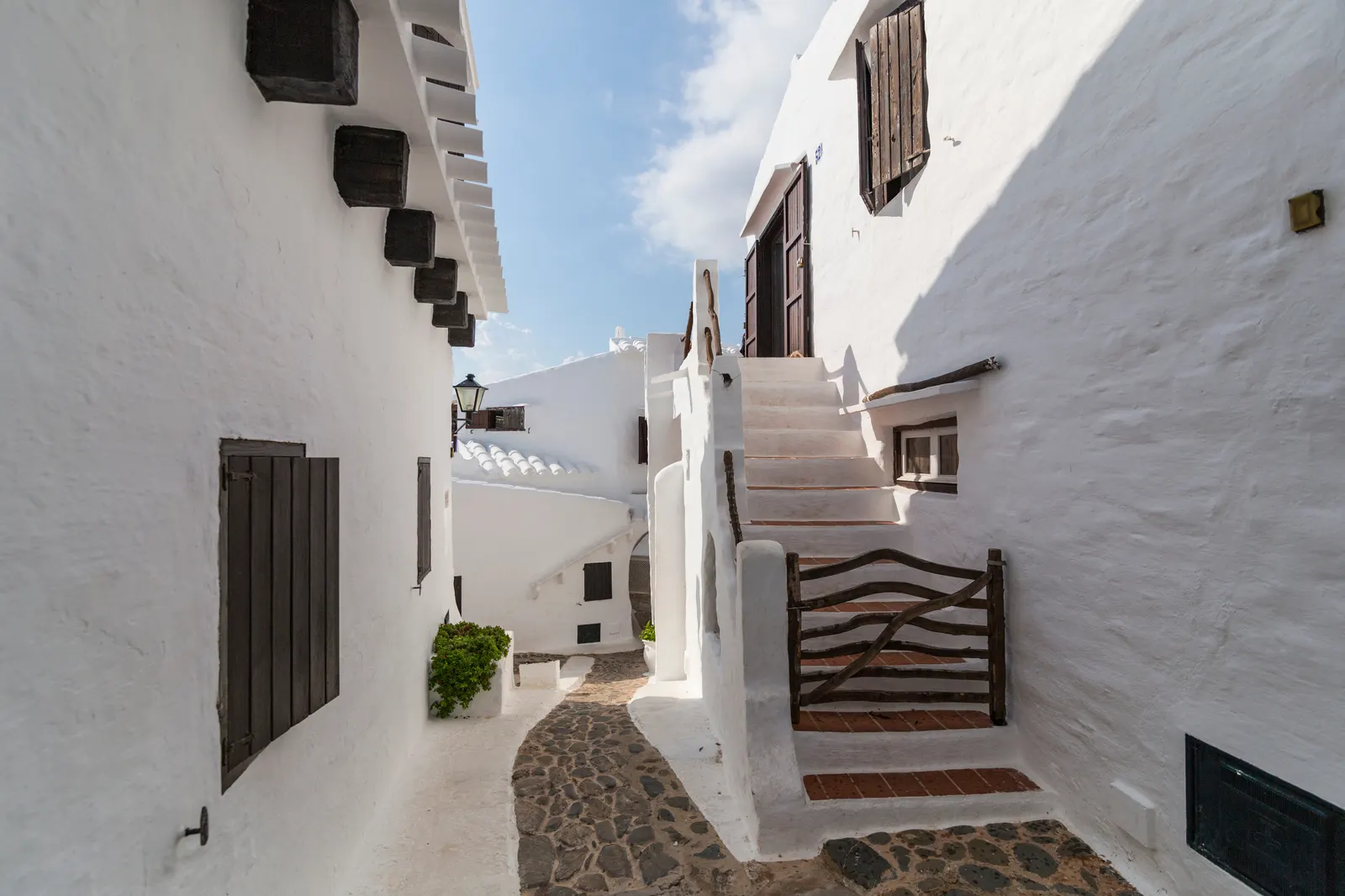
- Menorcan white is lime, not plastic paint. Marès walls were lime-washed with lime mortar, which lets the wall breathe. Imitating that white with plastic paint is the most common mistake, and the one that is paid for soonest: it is the line between the authentic and the pastiche.
- A marès wall has to breathe. Sealing it — with cement, with plastic, with poorly fitted insulation — traps the damp inside and ruins the stone. The principle that governs every honest renovation here is: breathe, don’t seal.
- Autumn and winter are the best season for the work. Lime mortars need to dry slowly, without extreme heat. And the island’s good trades have full diaries: plan months ahead.
- The rules matter more than you think. If the house sits on rural land or is listed as heritage, what you can and cannot do with the façade, the volume and the materials is constrained. It is wise to confirm this with the council of the specific municipality before designing anything.
Why a stone house isn’t renovated like a flat
The modern instinct in the face of an old house is almost always the wrong one. We see thick walls and think “wasted space”; small windows and think “not enough light”; a cool, damp interior in April and think “we must seal it and air-condition it”. And we begin to act against the house.
The trouble is that a marès house is a system that works in a very particular way, tuned over centuries to a very particular climate: dry, hot summers and damp winters battered by the tramuntana, the north wind. The thick walls are not inefficiency: they are thermal mass, a body that stores the cool of the night and releases it slowly by day, and that in winter holds the warmth of the hearth. The small windows are not a lack of ambition: they are the defence against the low western sun and against the wind. The cool April interior is not a flaw to be corrected: it is a marès wall doing what it knows how to do — regulating the humidity of the air.
Renovating with judgement, then, is not imposing on the house how it ought to be. It is listening to how it is made and helping it do that better. Almost always, that means doing less than you arrived intending to do — and doing it with materials the house recognises.
Lime versus cement: the decision that shapes everything else
If you take only one idea from this article, let it be this: in a marès house, lime; not cement. It is the technical decision on which nearly all the others depend, and the one that ruins the most well-meaning renovations.
Marès is a porous stone: it lets water vapour pass through. A marès house manages damp by letting the wall “breathe”, so that the water that gets in (from rain, from capillary rise, from the air itself) can leave again by evaporation. Lime — in mortars, renders and the lime wash of the walls — is permeable to vapour: it works with that wall, lets it breathe, and is also flexible, so it accommodates the small movements of an old building without cracking.
Cement does precisely the opposite. It is impermeable and rigid. A cement render or mortar seals the surface of the wall: the water inside can no longer leave that way, so it rises, looks for another exit and, along the way, dissolves and damages the stone. It is the cause of much of the chronic damp seen in “renovated” stone houses: no new water came in, the way out for the water already there was blocked. That is why cement — so convenient and cheap — is, over time, the most expensive material you can put into a marès house.
The practical rule for the work: lime for everything that touches the historic wall — bedding mortars, renders, joints, lime wash — and reserve cement, if at all, for new, clearly distinct elements that are not in contact with the old stone. It is slower, it calls for a hand that knows how to work lime (not every builder still masters it) and it costs a little more. It lasts decades longer and keeps the house healthy.
The wall has to breathe: the principle that governs the whole renovation
From all this follows the principle worth keeping fixed in your mind throughout the work: breathe, don’t seal. It applies not only to renders; it runs through the entire renovation.
- Insulation. You will want the house to be more comfortable in winter, and that is legitimate. But insulation badly understood — plastic membranes, foams, sealed dry linings stuck to the wall — turns the marès into a wall that can no longer evaporate, and the damp is trapped between the wall and the insulation. There are ways to improve comfort without sealing (breathable insulation, well-ventilated solutions from the inside, attention to floors and roof rather than the walls). This is the architect’s territory: what matters is that you enter the conversation knowing that sealing the wall is not the solution, it is the future problem.
- Floors. A marès floor or an old hydraulic tile floor can almost always be recovered; replacing them with porcelain stoneware over a sealed cement screed can cut off the breathing through the base and push the damp towards the walls.
- Paints. Traditional lime wash breathes. Modern plastic paints do not: they form a film that seals the wall. A marès wall painted with plastic is a wall whose pores have been blocked.
The underlying idea is simple and deeply counter-intuitive: in an old stone house, total waterproofing does not protect, it suffocates. What protects is letting the water in sparingly and out easily.
When to do the work: the calendar matters
In Menorca, summer is not for renovating. The heat is fierce, the island is full, the local trades are overwhelmed with seasonal commissions, and lime mortars — which need to dry slowly, without extreme heat or frost — do not cure well at 35 degrees. If you can choose, autumn and winter are the best season for serious work: mild weather, trades more available, lime that dries at its own pace.
There is a second, very Menorcan reason to plan ahead: the good trades have full diaries and noble materials are not always at hand. A master who knows how to work lime, a stonemason who understands marès, a fine carpenter — none of them are hired from one day to the next. Planning the work months in advance is not bureaucracy: it is what separates a serene renovation from a race against the calendar, and it is often what decides whether the house is built by the right hands or by the ones that happened to be free.
Which trades to seek out (and why you need them)
An honest Menorcan house renovation is not done by a single trade: it is done by a handful of crafts that still know how to work with local materials. Knowing they exist — and seeking them out before you begin — is half the job done.
- The lime master. The one who knows how to prepare and apply lime mortars, renders and washes. It is the key craft of the whole renovation, and the one fewest builders still master, because for decades almost everything was done with cement. Without a good lime hand, the principles in this article stay theoretical.
- The stonemason — the marès specialist. The person who knows how to cut, lay, repair and replace marès stone, respecting its coursing and its texture. Old and new marès age differently; a good craftsman knows how to marry them.
- The marger. The master of paret seca (dry-stone), stone laid without mortar. This craft rarely touches the inside of the house, but if your land has the dry-stone walls that draw the Menorcan countryside, the marger is the one who keeps them alive. Those walls are heritage of the landscape, not merely a boundary.
- The carpenter. In the Menorcan tradition, the artisan carpenters — known as araders — worked with local timbers such as the wild olive (ullastre in Menorcan, acebuche in Spanish), a native, hard and noble tree, for farm tools and implements. Today a good carpenter is the one who repairs and reproduces windows, shutters, beams and doors with judgement, rather than replacing them with catalogue joinery that breaks the scale of the house.
You don’t need every one of them on every job, but you do need to know which ones you require and to seek them out early. And it is worth having a local architect or surveyor who knows both traditional construction and the island’s rules: they are the ones who orchestrate the trades and who protect you from the expensive mistakes.
What the rules let you do (and what they don’t)
Here comes the least romantic and most important part of all: before you fall in love with a project, find out what the law lets you do. In Menorca, two frameworks shape the renovation of an old house, and both must be confirmed case by case.
Rural land. If the house is out in the countryside — and many Menorcan stone houses are — it is governed by the rules for rural land, where the land has an agricultural vocation, not a residential or tourist one. Renovating the existing house is usually possible, but extending, raising new volume or changing the use is subject to a licence and to limits on buildable area that can be very strict. The healthy mental rule is: count on being able to care for and restore what is there, but do not take for granted that you will be able to add square metres, put on a storey or build outbuildings until you have confirmed it.
Listed building. Many Menorcan municipalities have a heritage catalogue. If your house appears in it, the renovation is constrained: there may be restrictions on the façade, the volume, the roofs and the materials, and even an obligation to conserve specific features. This is not necessarily bad — it often obliges you to do exactly what good judgement would do anyway — but it changes the timescales, the permits and the budget, and it is worth knowing beforehand, not halfway through the work.
Two honest warnings, because this is shifting ground:
- The catalogue’s restrictions depend on the specific municipality. Ciutadella is not the same as Es Mercadal or Es Castell. The prudent thing is to consult the catalogue and the planning rules of your municipality’s council — and a local architect — before asserting what can be done to your house. In this article we do not give limits as absolutes, because they depend on your plot and your catalogue entry.
- The island’s planning framework is under review. Menorca’s territorial framework (the PTI and the territorial rules) has been under review in 2025–2026, and may affect buildable area, residential uses in the countryside and the minimum plot size. Before designing, it is wise to confirm with the council which rules are in force at the moment you apply for the licence, because what was true two years ago may have changed.
The practical conclusion: the rules are not a formality at the end, they are a decision at the outset. A local architect who knows your municipality’s catalogue will spare you grief — and, sometimes, will tell you that the house you imagined is not the house the law allows. Better to know it before you sign the purchase. The full mental order of that purchase — procedures, precautions, taxation — we set out in the guide to buying a home in Menorca.
A glossary of materials: the words worth knowing
When you talk to trades and architects in Menorca, these words will come up again and again. Handling them is not showing off: it is understanding what is being proposed to you and being able to defend a point of view.
Marès
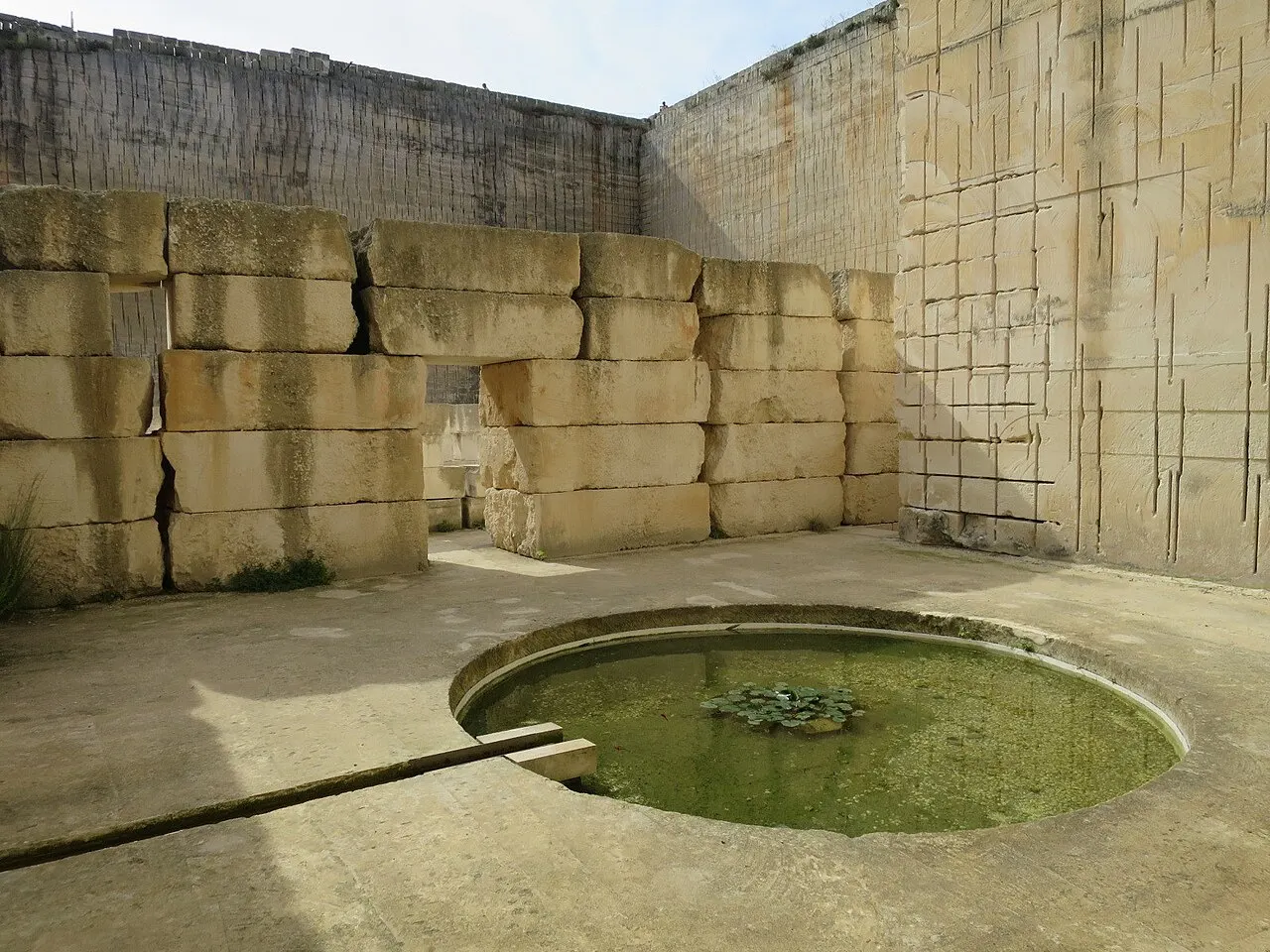
The local calcareous sandstone, golden and porous, which is the foundational material of Menorcan architecture: from the houses to the churches, the city walls and much of the heritage. It was quarried in open-cast pits (the pedreres) — today you can walk those of Líthica, at s’Hostal near Ciutadella — and it was so central that the llocs — the farmhouses — usually had their own small quarry beside the building. Its great virtue for a house is that it regulates humidity and temperature: walls that breathe and keep the interior mild without machines. Its great demand is the matching one: because it breathes, it must be allowed to breathe.
Cal (lime)
The traditional binder with which mortars, renders and, above all, the lime washing of the walls were made. The characteristic Menorcan white is not plastic paint: it is lime. Lime is permeable to vapour (it lets the wall breathe) and flexible (it accommodates the movements of an old building without cracking). Lime washing is, moreover, an act of maintenance: traditionally the houses were gone over with lime from time to time. The difference between lime washing and “painting white” with plastic is exactly the difference between an authentic house and a pastiche that looks Menorcan in the photo and grows damp inside.
Paret seca (dry-stone)
The dry-stone: walls raised without mortar, fitting the stones together by hand, which divide the Menorcan countryside and have drawn its landscape for centuries. It is a traditional craft — that of the marger — and forms part of the island’s protected landscape. On a plot, keeping the paret seca alive is caring for heritage, not just enclosing a piece of land. It is not “repaired” with cement: it is rebuilt with the age-old technique, fitting stone upon stone.
Lloc
The Menorcan farmhouse or country estate, with its agricultural logic: the buildings were organised according to the work of the land and daily life, with a cistern to collect rainwater, and farm structures around it. Renovating a lloc is, to a large extent, understanding that logic before redistributing it, so as not to break what gave the house its sense.
Our take
If we had to reduce this whole guide to a single piece of advice, it would be the same one we give for the purchase and for life on the island: don’t be in a hurry, and do less. The best renovation of a Menorcan house is not the most complete or the most striking; it is the one that respects what the house already knew how to do. Lime before cement. Letting the wall breathe before sealing it. Repairing before replacing. Few materials, local, well used. And the rules confirmed before designing, not after.
The expensive mistake is rarely about money: it is about judgement. It is sealing what should have breathed, painting with plastic what called for lime, extending what the law did not allow, hiring the hands that were free instead of the ones that knew. Those mistakes don’t show in the handover-day photo; they show in the third winter, in the form of damp, of cracks and of a house that is no longer quite of Menorca.
Doing it the other way round — slowly, with trades that understand marès, with the lime and the law on your side — costs more patience and, sometimes, a little more money. But the result is the only luxury that truly matters to us: a house that ages well, that gets along with its climate and that is still Menorcan when the work is done.
The mistake in a marès house is rarely about money: it is about judgement. Lime before cement, breathing before sealing, and the rules confirmed before designing.