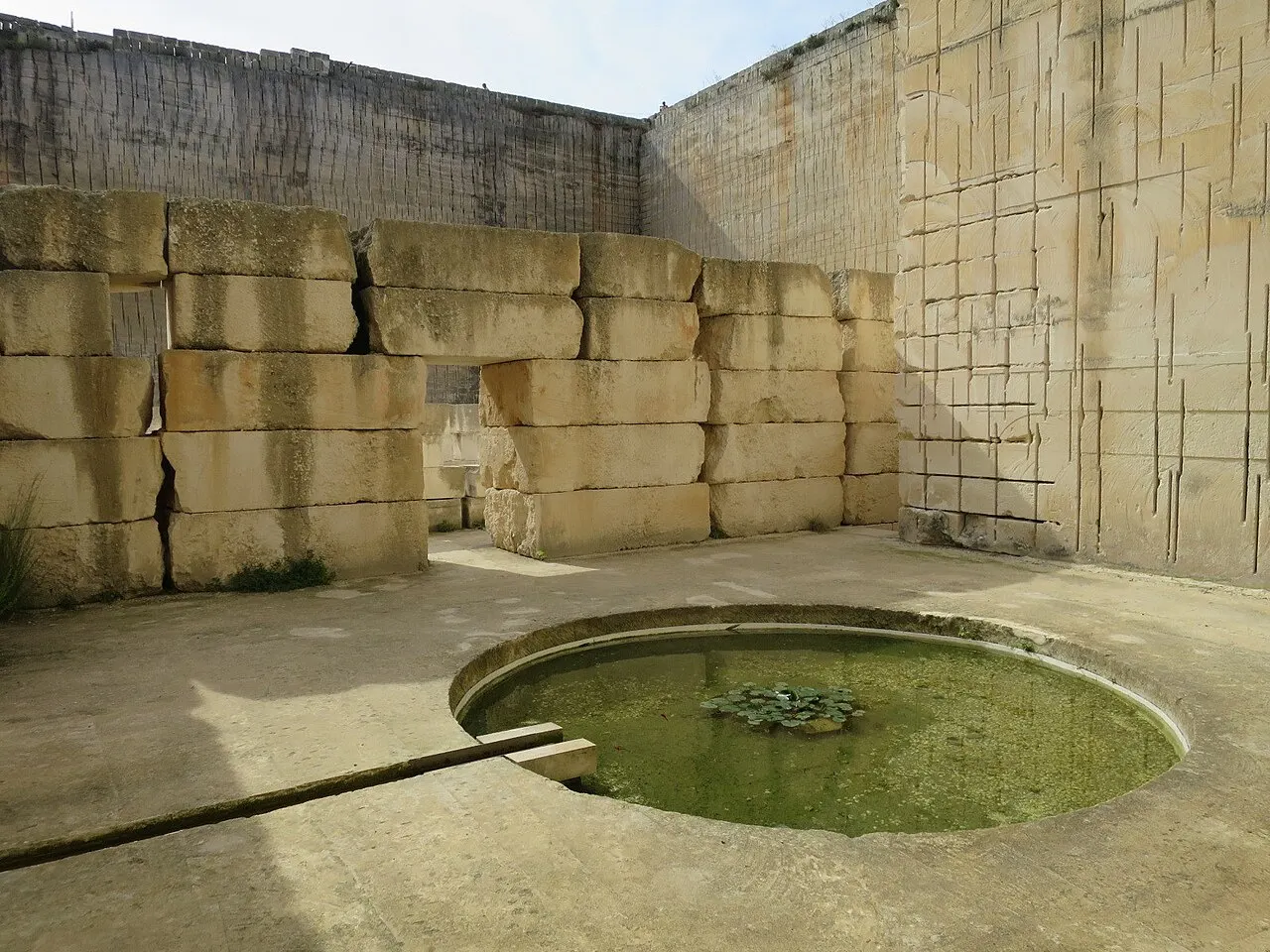
There are landscapes in Menorca that were not made by the sea but by the hand of man. Barely a kilometre from Ciutadella, hidden behind a wall that announces nothing, the Pedreres de s’Hostal are one of them: former marès quarries where, for more than a century, the land was prised open for the stone with which half the island was built. The result, hollowed out block by block, is a monumental void. Where there was once rock, there are now great open-air halls, vertical walls of golden light and a silence that clings to the stone.
Marès is the stone of Menorca: a local sandstone, warm and porous, from which the houses of Ciutadella, its palaces and its churches are made. It is not marble —this is worth saying plainly, because the two are often confused— but a soft, workable stone that was cut into rectangular blocks straight from the ground. Quarrying it left hollows, and those hollows, over the years, became these inverted cathedrals we now call Líthica.
This is an unhurried guide to the Pedreres de s’Hostal: what they are, why they were saved, what you see inside, and why they deserve at least an hour and a half of an unrushed gaze.
The essentials
- Where: about 2 km from Ciutadella, at the western tip of Menorca, beside the Camí Vell de Maó.
- What it is: former marès quarries (local sandstone, not marble) reborn as a cultural space and run by the Líthica foundation.
- Its history: the quarry was worked from the 19th century until 1994, the year it closed and the foundation that saved it from disappearing was born.
- Two landscapes: manual extraction (19th and early 20th century) and mechanical extraction (1960–1994), with walls and vertical shafts of great height.
- Also: a botanical garden, a maze and corners for contemplation; in summer, concerts in the deepest quarry.
- How long to allow: at least an hour and a half; check current opening hours and prices at lithica.es.
What is marès, and why does it matter here?
To understand Líthica you have to understand the stone. Marès is a sandstone —never marble— formed from consolidated sand, warm and golden in tone, soft as it leaves the quarry and harder once it cures in the air. That very pliability is what made it indispensable: it could be sawn and cut into clean blocks without heavy machinery, and with it a good part of Menorca was built, most especially the Ciutadella of palaces that lies just a step away.
Quarrying marès was not a matter of chipping away at a mountain but of hollowing out the ground: rectangular blocks were cut and the quarry descended ever deeper, leaving perfectly smooth vertical walls. That is why the Pedreres de s’Hostal resemble neither a mine nor a cave but architecture in the negative: halls, passages and courtyards that exist precisely because something was taken away.
From abandoned quarry to cultural space
The Pedreres de s’Hostal were worked from the 19th century until 1994. That year marks a double ending and a beginning: extraction ceased and, at the same time, the Líthica foundation was created to keep the quarries from being lost —buried under rubble, as so many others on the island ended up being. The coincidence of dates is no accident: the closure and the rescue go hand in hand. What might have become a dumping ground turned instead into a project to recover the landscape and the memory of the trade.
Since then, Líthica has worked to conserve the place, to bring it back to life with gardens and water, and to open it to the public as a cultural space. It is an unusual case: a site that is worth visiting not for what nature put there but for what generations of quarrymen took away, and for the decision not to let that void be erased.
The two quarries: the hand and the machine
Inside, you can make out two very different landscapes, and understanding them is half the visit.
The first is that of manual extraction, from the 19th and early 20th century. Here the quarrymen worked with pick and saw, and the result has a human, almost organic scale: irregular walls, nooks, terraces at different heights. Over time this sector has been reclaimed by vegetation, so that the bare stone coexists with gardens, water and corners to sit in. It is the gentle, contemplative part.
The second is that of mechanical extraction, between 1960 and 1994, when machines could descend far deeper into the vertical. From here came the most spectacular halls: soaring walls and vertical shafts of smooth, perfectly geometric faces that produce an overwhelming effect. It is here, in the deepest quarry, that the place truly becomes a cathedral of stone: the sound changes, the light falls from above, and you understand, without anyone explaining it, what it means to wrest stone from the earth for a century.
Garden, maze and the art of the pause
Líthica is not only geology and industrial memory. The foundation has woven into its interior a botanical garden of Mediterranean species, a leafy maze and a series of corners designed for stopping: benches, ponds, shade. The route invites you to slow down, to lose yourself a little among the walls, to look upwards.
It is, at heart, a lesson in what on these pages we call the art of Menorcan calm: a place that is not consumed in ten minutes nor summed up in a single photo, but one that asks for time. Hence the recommendation to set aside at least an hour and a half. Those who enter in a hurry leave with a handful of images; those who enter with calm carry the place away with them.
Concerts in a quarry?
Yes. In summer, the deepest quarry —the one with the great vertical walls— becomes a singular stage. The stone that for a century was cut and carried away now gives back something different: open-air concerts, with the audience seated among marès walls that act as a natural sounding box. It is hard to imagine a more unexpected auditorium, or a better way to close the circle of a place like this.
The dates and the programme change each season, so it is worth checking the up-to-date calendar and prices before planning your visit. But the underlying idea is the one that wins you over: a space born of the hardest labour ends up devoted to the most serene of things.
When to go and how to get around
Líthica is about 2 km from Ciutadella, the city of palaces, which makes it a perfect outing to pair with a morning or an afternoon in the old town. It can be visited for much of the year, although opening hours and prices are seasonal: the sensible thing is to confirm them at lithica.es before you go. In the warmer months, the first hours of the day and the late afternoon give the best light on the golden walls, and they are also the coolest stretches for exploring the quarry away from the midday sun.
To get there, bear in mind that parking is limited, and the summer heat: bring water, comfortable footwear and plenty of time.
Our take
Líthica is one of those places that never make the shortlist of postcard beaches and yet leave more of a mark than many of them. It is not spectacular in the obvious sense: it is a void, an absence worked over a century. But that is precisely why it moves you. To walk its walls is to understand where the stone of Ciutadella came from, what trade sustained the island, and what we choose to save when an activity falls silent.
It is quiet luxury in its purest state: silence, scale, golden light and the sense of standing in a place unlike any other in the Mediterranean. Go in without hurry, look upwards and let the maze carry you along. And if you happen upon a concert night, stay: rarely does stone sound so good.