There is a way of knowing Fuerteventura that never appears in beach photographs: wait for nightfall, drive away from the villages and switch off your torch. The island is dry, with little cloud and wide stretches almost free of artificial light, and the reward is visible to the naked eye. Once your eyes adjust, the Milky Way runs from one side of the sky to the other, and the only sound is the wind.
This guide explains what it means for Fuerteventura to be a Starlight Reserve, where the viewpoint built for sky-watching is and how to plan the night so it goes well.
The essentials
- Starlight Reserve since 2015, renewed until 2029 after the Starlight Foundation’s second evaluation.
- The viewpoint: Sicasumbre, beside the FV-605 road between Pájara and La Pared. You will need a car.
- What is there: constellation panels, sundials and spaces for telescopes.
- When: moonless or nearly moonless nights; a full moon washes out many stars.
- What to bring: a properly warm layer, a red or dim torch and something hot to drink.
What being a Starlight Reserve means
The Starlight Reserve certification is awarded by the Starlight Foundation to places with an exceptionally high-quality night sky and a genuine commitment to protecting it. Fuerteventura received it in 2015 and, having passed its second evaluation, keeps it until 2029, as the Canary Islands public broadcaster RTVC reported in November 2025.
It is worth being clear about what the label does not say. There is a separate certification, Starlight Tourist Destination, and we have not been able to confirm that Fuerteventura holds it. Nor does it mean that every corner of the island has a perfect sky: near resorts and lit roads, quality drops. The label recognises the whole; the good night is something you have to go looking for.
The Sicasumbre viewpoint
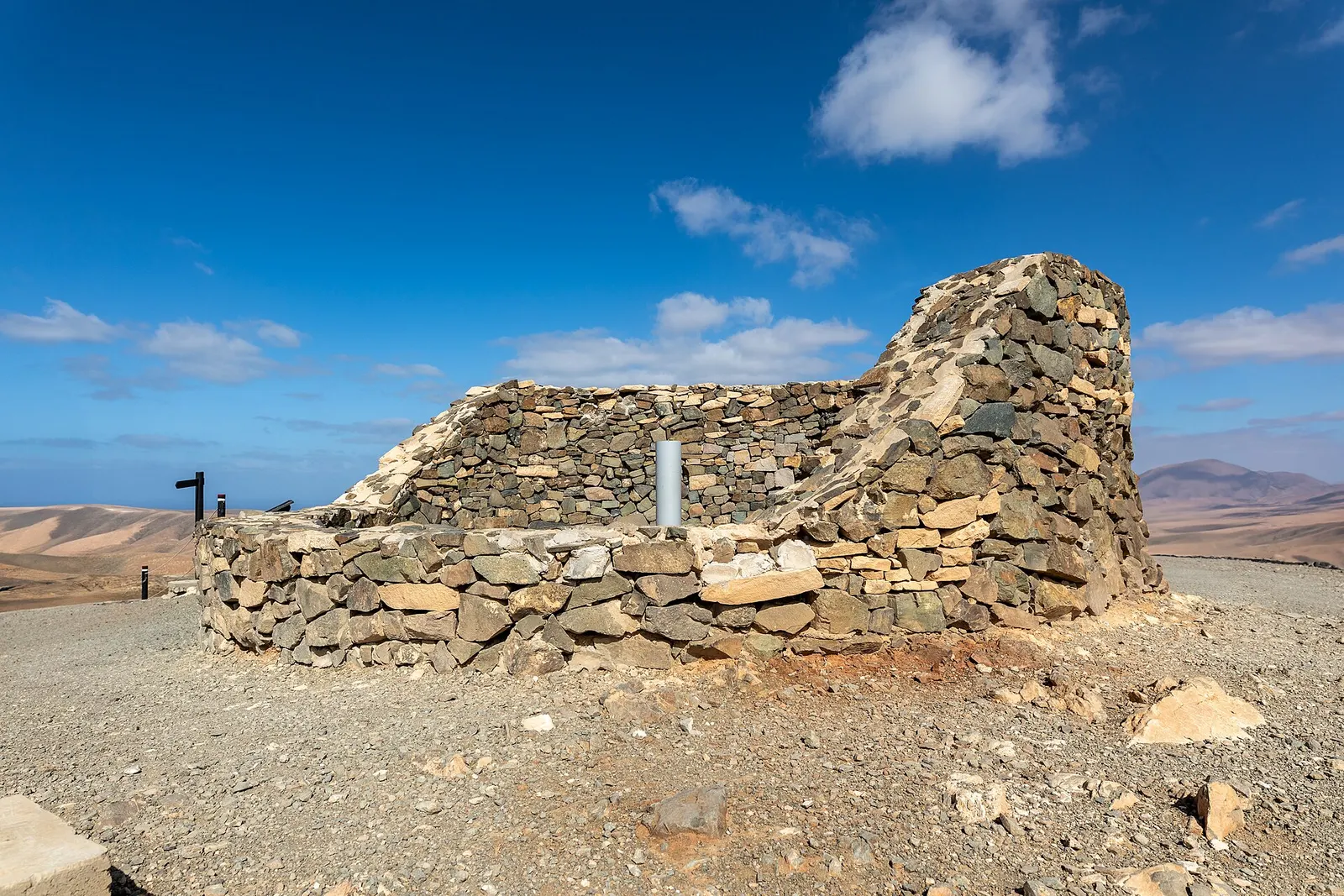
In the centre-west of the island, beside the FV-605, the road linking Pájara with La Pared, lies the Sicasumbre Astronomical Viewpoint. It is a simple space, with panels to help you identify the constellations, sundials and areas set up for telescopes. What makes it valuable is what surrounds it: no light.
You need a car to get there. Drive slowly at night, park only in the designated area and switch off your car lights as soon as you arrive: your headlights are the brightest thing at the viewpoint. And do not wander off across the surrounding ground; night is not the time for walking cross-country.
How to prepare the night
- Check the moon before the weather. New-moon nights, or nights before the moon rises, are best. Under a full moon the main constellations remain, but the Milky Way disappears.
- A warm layer, even in summer. Sicasumbre is exposed and Fuerteventura’s wind makes nights feel cold. Jacket, hat and something to sit on.
- Red light. A red torch, or your phone’s light on its lowest setting, keeps your eyes adapted to the dark. Avoid shining it at others.
- Patience. Your eyes take about twenty minutes to adjust fully. Arrive, switch off, wait.
- No drones, no fires. Not for the photo, not for warmth.
If you would like someone to explain the sky, there are companies that run guided astronomy outings with telescopes on the island; choose those working in authorised spaces and in small groups.
Which suits you
- You want to fill the day before the night → in the same centre-west area, the Las Peñitas gorge or Ajuy and its rocks.
- You want a day on the sea → Fuerteventura from the water, and the night here.
- You want long nights and an unhurried stay → Fuerteventura in winter.
Our view
The luxury of Fuerteventura’s sky cannot be booked or bought: it is prepared. A moonless night, the car switched off at Sicasumbre, an extra jacket and twenty minutes of patience are enough to see something many people can no longer see from home. It is the island’s quietest experience, and perhaps its rarest.
Information as of October 2026, from regional press (RTVC) and public guides to the viewpoint. Access conditions and signage may change: confirm them before you go.