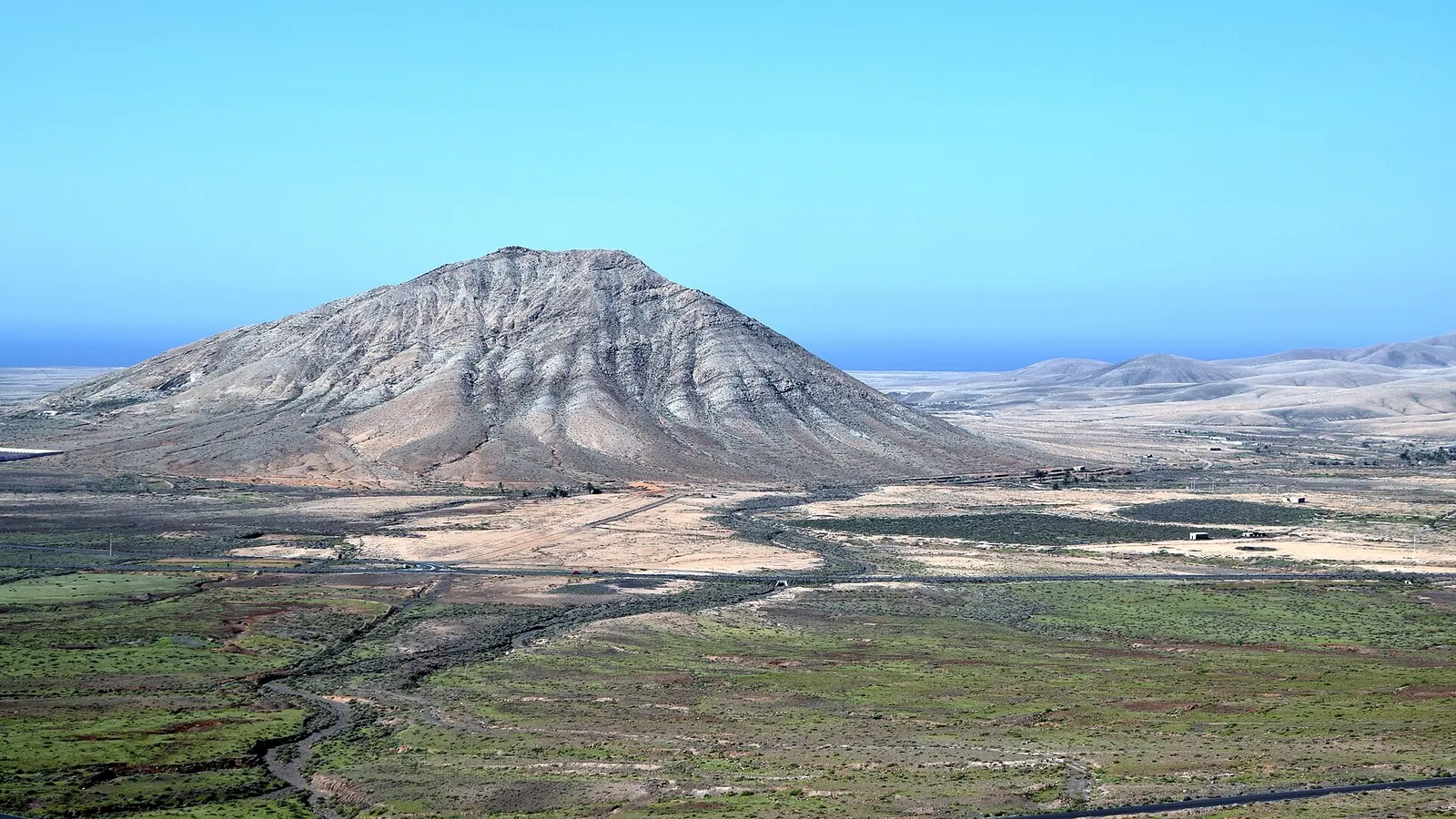
In the north of Fuerteventura, among brown plains and rounded volcanoes, stands a mountain unlike the others. Tindaya rises on its own, sharp in profile, its colour changing with the hour: ochre in the morning, almost pink at dusk. For the Majos, the island’s original inhabitants, it was a sacred place. We know this from what they left on its summit.
The engraved feet
At the top of the mountain are hundreds of podomorphs: outlines of feet engraved into the rock. Inventories do not agree on the number — anywhere from around 250 to more than 300 — but the overall picture is clear: it is one of the most remarkable rock-engraving sites in the Canary Islands. Exactly what they meant is still being studied. What does seem clear is that the mountain held ritual value for those who lived here before the conquest.
The summit engravings are listed as a Bien de Interés Cultural, Spain’s highest heritage protection, and the whole mountain is a natural monument and a site of geological interest. The extent of that protection is still under debate: the Canary Islands Government has proposed enlarging the protected heritage area, and Fuerteventura’s Cabildo, the island council, has formally objected.
The void that was never carved
In the 1990s the sculptor Eduardo Chillida conceived one of his most ambitious works for Tindaya: hollowing out the inside of the mountain to create a vast space of light and silence, open to the sky and the sea. He imagined it as a monument to tolerance.
The project divided the island for some twenty-five years. To some it was a unique opportunity for art and international recognition; to others, an irreparable assault on a sacred, protected place. There were studies, controversies, court cases and changes of course. In 2019 the authorities abandoned the project. Chillida, who died in 2002, did not live to see it settled.
Today Tindaya’s story is also that of a work that does not exist — and perhaps that is its best lesson: there are places where the most valuable thing is to leave them as they are.
Why you do not climb it
Let us be clear. Climbing to the summit of Tindaya without authorisation is forbidden. This is set out in a decree issued by the Cabildo de Fuerteventura in December 2019 under the Canary Islands Cultural Heritage Law, and the ban is signposted around the mountain. Authorisations are handled by the Cabildo’s Historical Heritage department and are not a tourist formality. In recent years the Guardia Civil has reported people who climbed without permission and shared it on social media, leading to administrative penalties.
The reason is simple: every footstep on the summit wears away engravings that have survived for centuries, and every photo from the top encourages others to follow. Do not climb, do not walk the slopes off the permitted paths, do not touch the engravings and do not fly drones.
Access rules checked in October 2026. If you are interested in an authorised or guided visit, ask the Cabildo de Fuerteventura directly.
How to look at it
Tindaya is best understood from below, at some distance, where you can see it whole:
- From the village of Tindaya, at the foot of the mountain, with low houses and stone walls in the foreground.
- From the surrounding plains at sunset, when the low light draws out every shade in the rock.
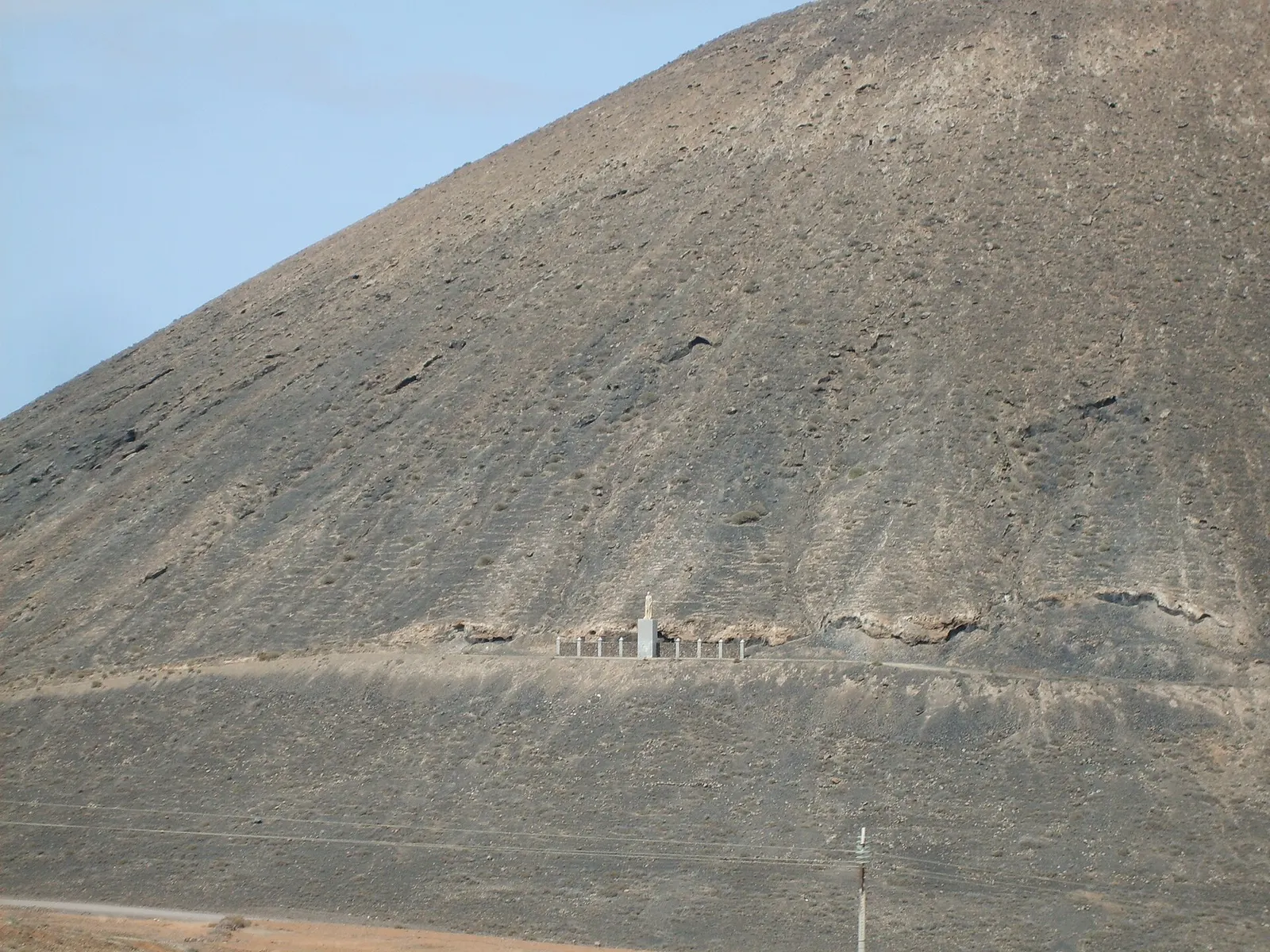
- From Montaña Quemada, close by, where a monument honours Miguel de Unamuno, who wrote about this bare island with a devotion that still comes through on the page.
Our view
Tindaya does not need to be conquered. It is a mountain to contemplate in silence, knowing what it holds above even if you cannot see it. Go at dusk, park without trampling the fields, stay a while. The mountain of engraved feet is best respected with your own feet on the plain.
To keep reading the island in stone, head down to the west coast: at Ajuy the oldest rocks in the archipelago come to the surface.