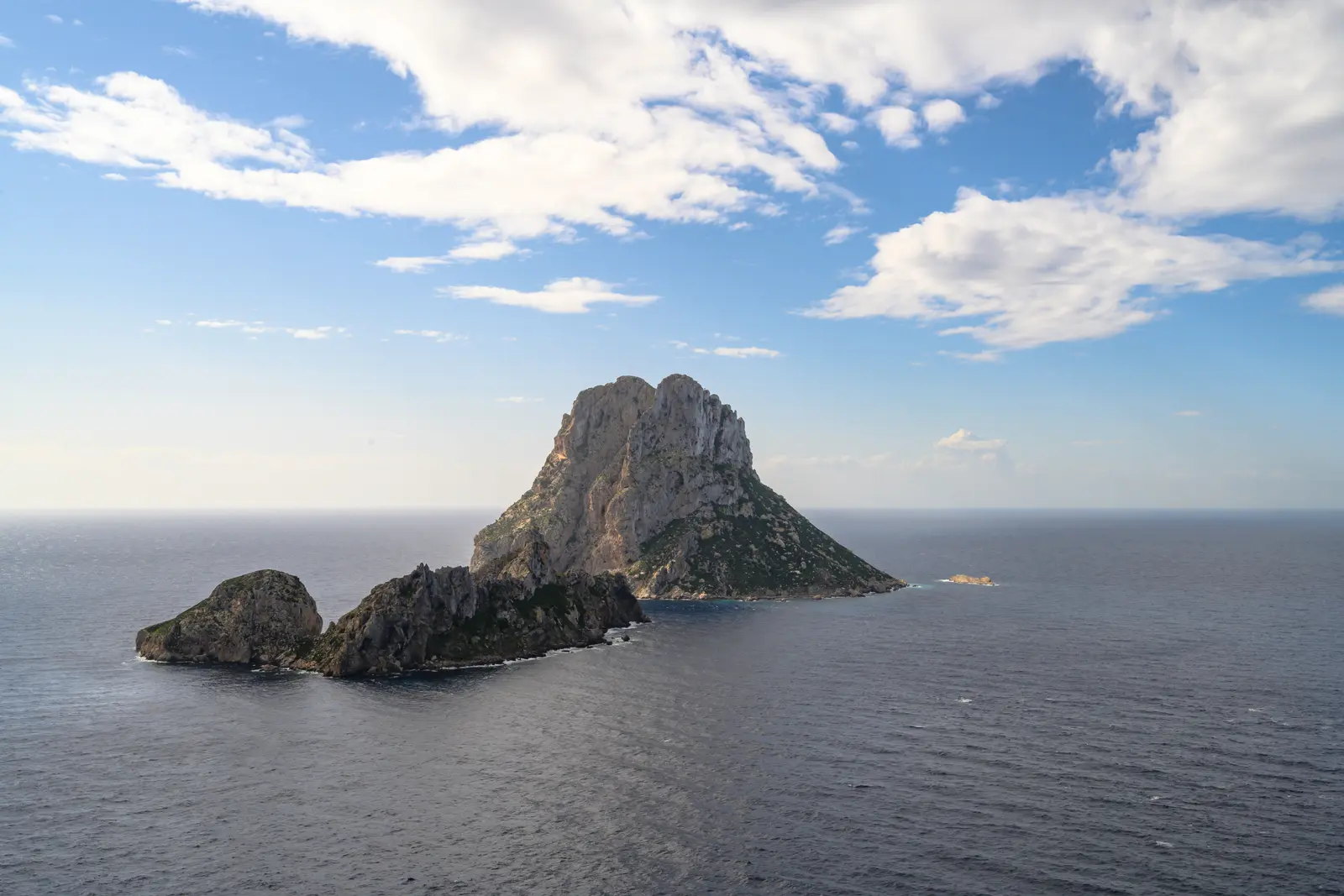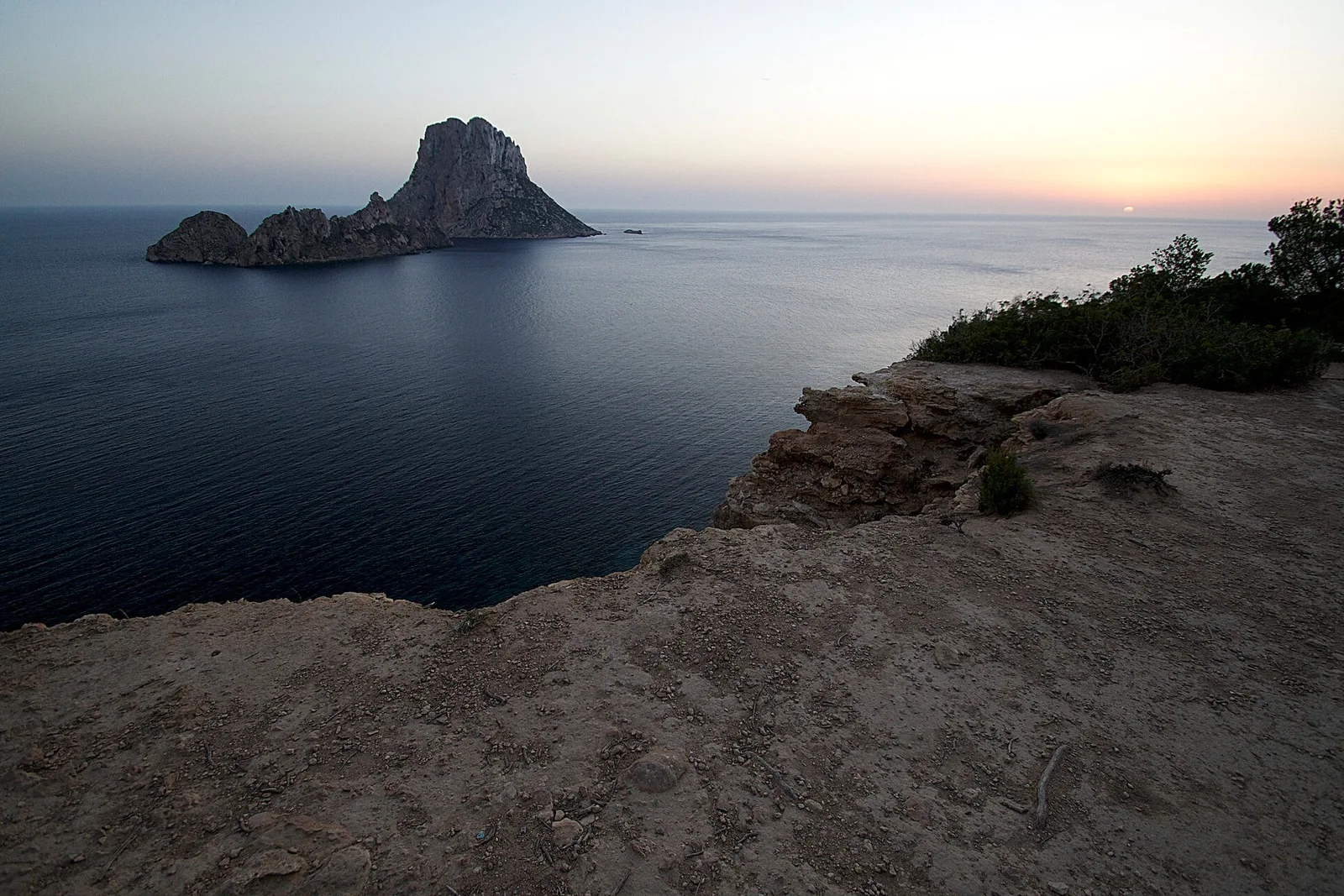
It is the image of Ibiza everyone carries in their head: a stone islet almost four hundred metres high, rising from the sea off the south-west coast, with the sun setting behind it. For years, the way to see it was to lean over the cliff opposite, by the Torre des Savinar, and then climb down to the old quarry Instagram renamed “Atlantis”.
That is over. And almost no guide has said so.
The essentials
- Since February 2025, the owners of the Cap Blanc and es Savinar estates have barred people from the es Vedrà viewpoint and the Torre des Savinar, and blocked the car parks with stones.
- Sa Pedrera (“Atlantis”) lies behind those estates: it is not something to attempt, and a reckless rescue is charged for.
- Es Vedrà can still be seen, and very well, from Cala d’Hort beach and, above all, from the sea at sunset.
- Es Vedrà has owners. It is a privately owned nature reserve, and you do not land without a permit.
What was closed, and why
On 20 February 2025 the owners of the Cap Blanc and es Savinar land cut off access: they blocked the car parks with earth and large stones and barred pedestrian access to the viewpoint and the tower. They did it, according to the local press, to stop what the place had become: crowds every sunset, street vendors, litter and damage to the hillside.
A year and a half on, in August 2026, pedestrian access to the viewpoint was still being described as restricted, and the area’s main car park, the one at Cala d’Hort, had been closed for much of the season.
Sa Pedrera, the famous “Atlantis”, is an old sandstone quarry at the foot of that cliff; according to the local press, its stone was used to build the walls of Dalt Vila. Getting there means crossing the closed estates and climbing down terrain that does not forgive mistakes. On top of that, the Consell d’Eivissa charges for reckless rescues: in 2025 it opened three cases, one of them for sa Pedrera, and a four- or five-hour rescue with four firefighters can come to more than 500 euros a person. It is not an adventure; it is an expensive mistake.
Where to see it now
1. From Cala d’Hort beach. It sits right opposite the islet, and from the sand es Vedrà fills the whole horizon. This summer’s problem has been parking: on 23 June 2026 the Ajuntament de Sant Josep agreed with the landowners on two free car parks by the turn-off towards Cala Vedella. As the situation has changed several times in a few months, check it before you go.
2. From the sea, at sunset. This is the good way, and it always has been. From a boat, es Vedrà faces you head-on, with the westward light lighting it up and nobody around. You do not land: you anchor on sand or on a buoy, never on posidonia, which is protected in the Balearics under Decree 25/2018. In Ibiza from the water we explain why this island’s luxury is out at sea.

3. From your own terrace. It sounds like a joke, but it is the practical conclusion: on the Sant Josep coast, whoever sleeps nearby does not have to park when the sun goes down. The houses we recommend are in our guide to quiet luxury hotels in Ibiza.
Who owns Es Vedrà
Here is what almost nobody knows: es Vedrà is privately owned. In 2016, when the Govern balear ordered the removal of the feral goats that were eating its vegetation, its own documents referred to “the islet’s owners”, who denied owning the goats. According to the local press, they are families from Sant Josep.
At the same time, it is a protected area: it forms part of the Es Vedrà, Es Vedranell i els Illots de Ponent Nature Reserves. Across its 62.94 hectares there are 166 plant species, twelve of them endemic. That is why you do not land without a permit.
And one more curiosity: Cala d’Hort briefly had nature park status in 2002, but the land portion was withdrawn the following year, according to the Enciclopèdia d’Eivissa i Formentera. Today the protection is limited to the islets and their surrounding sea.
If what intrigues you is the legend of compasses going haywire in front of the islet, we take it apart in does Es Vedrà really send compasses haywire?
Our view
The closure of the viewpoint has been, deep down, good news in disguise. The clifftop had turned into a car park with a view, and at eight in the evening on an August day what you saw from there was not es Vedrà: it was people.
The best way to look at it remains intact, and it was always the same one: from the water, with the sun behind it, in silence. It costs more than parking on the verge. It is also incomparably better.
For the rest of the west coast, at the right hour, there is Ibiza’s western coves, at the right hour. And for all of the island’s postcard views, Ibiza’s famous places, at the hour they fall quiet again.
Access details checked on 22 September 2026 with the local press (Noudiari, Periódico de Ibiza), the Govern balear and the Consell d’Eivissa. The situation at the viewpoint and the car parks has changed several times since 2025: check it before you go.