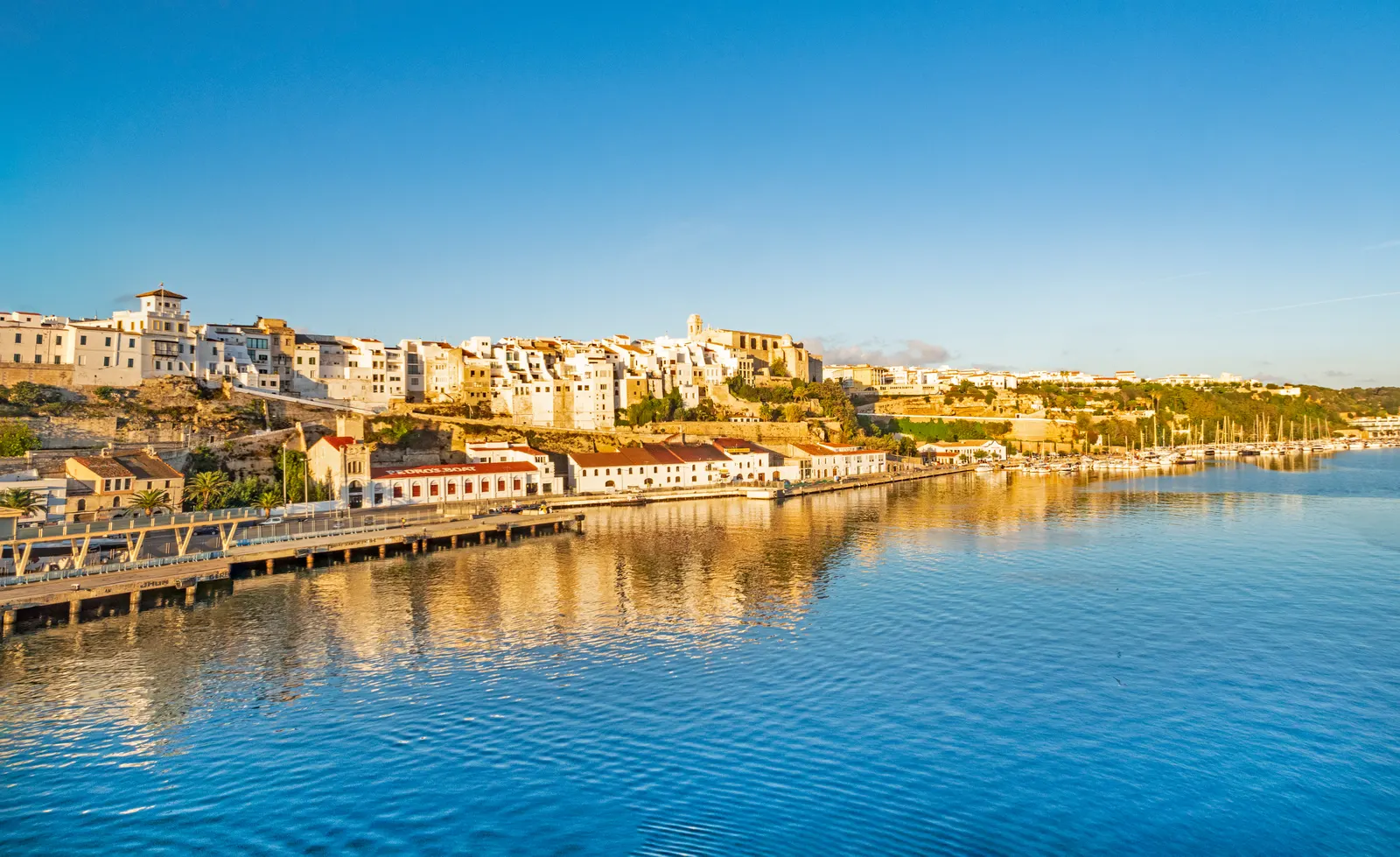
Some towns in Menorca were born of the sea, and others were born of a drawing. Es Castell belongs to the second kind: the British laid it out in 1771 with set square and ruler, straight streets around a great parade ground, designed to house soldiers and keep watch over the mouth of the port of Mahon. Two and a half centuries later, that military logic has settled into something unexpectedly peaceful: an orderly town of colourful façades and sash windows, looking out over one of the most photogenic corners of the island.
It sits on the east coast, right next to Mahon, just where the land runs out and the open Mediterranean begins. That is why it carries a curious title: as the easternmost municipality in Spain, it claims to be the first place in the country where the sun rises. It is — for eight months a year; in summer Cap de Creus gets there first, as we explain below. But the title captures the spirit of the place well: here, life is lived facing the sunrise and the water.
This is a calm guide to Es Castell and to Cales Fonts, its small, luminous harbour: where its English air comes from, what to see without hurrying, and why it pays to stay until the sun goes down.
The essentials
- Where: east coast of Menorca, beside the mouth of the port of Mahon; the easternmost municipality in Spain.
- Its origin: founded by the British in 1771 as “Georgetown”, in honour of George III, with a grid layout around the parade ground (s’Esplanada).
- The draw: Cales Fonts, a fishing harbour where the old store-caves cut into the rock are now restaurants and terraces.
- What to see: Fort Marlborough, San Felipe Castle, the Military Museum of Menorca and the Georgian architecture of the old town.
- Character: a town of around 7,300–7,500 inhabitants, serene, colourful and closely tied to the island’s military history.
- When: all year round; the sunset at Cales Fonts is the standout moment.
Why a town with an English air in Menorca?
To understand Es Castell, it helps to remember that Menorca changed hands several times in the 18th century, and that the British occupied it at different stages. In 1771, during one of them, they founded this town beside the port and named it Georgetown, in honour of King George III. It was not a spontaneous settlement but a garrison town: the layout was organised in a grid around a broad parade ground, s’Esplanada, surrounded by military buildings.
When Spain recovered the island in 1782, the town was renamed Real Villa de San Carlos —later known as Villacarlos, after Charles III—. It is worth knowing this because that name still appears on old maps and in the conversations of older residents, but today the municipality is officially called Es Castell. Villacarlos is a historical name, not the current one.
What does survive is the British imprint in the stone: the straight streets, the painted façades, the sash windows that slide up and down instead of opening outwards, and a town hall of English inspiration. To stroll the old town is to read, without realising it, a chapter of 18th-century geopolitics.
Cales Fonts: from fishermen’s quay to the finest terrace
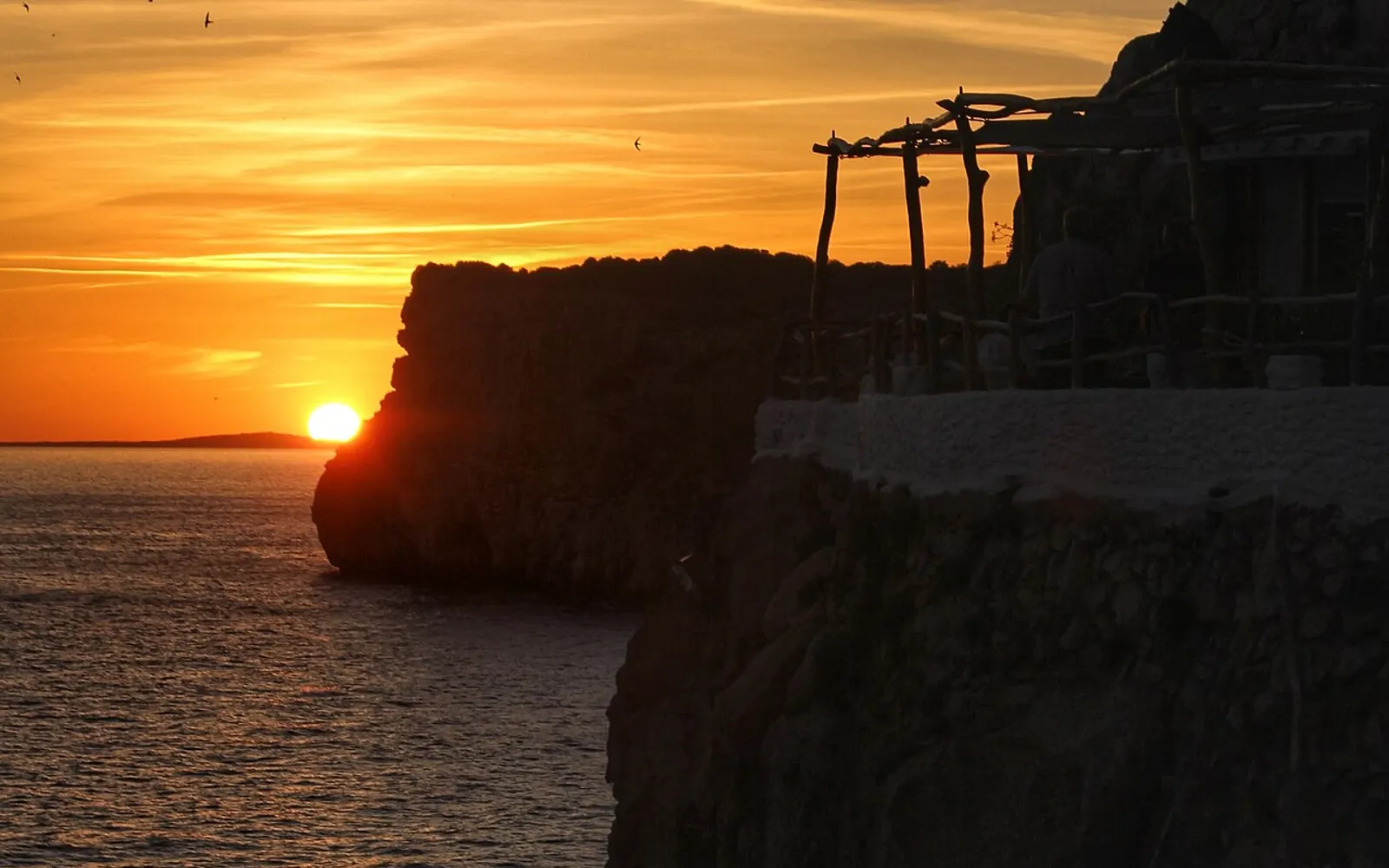
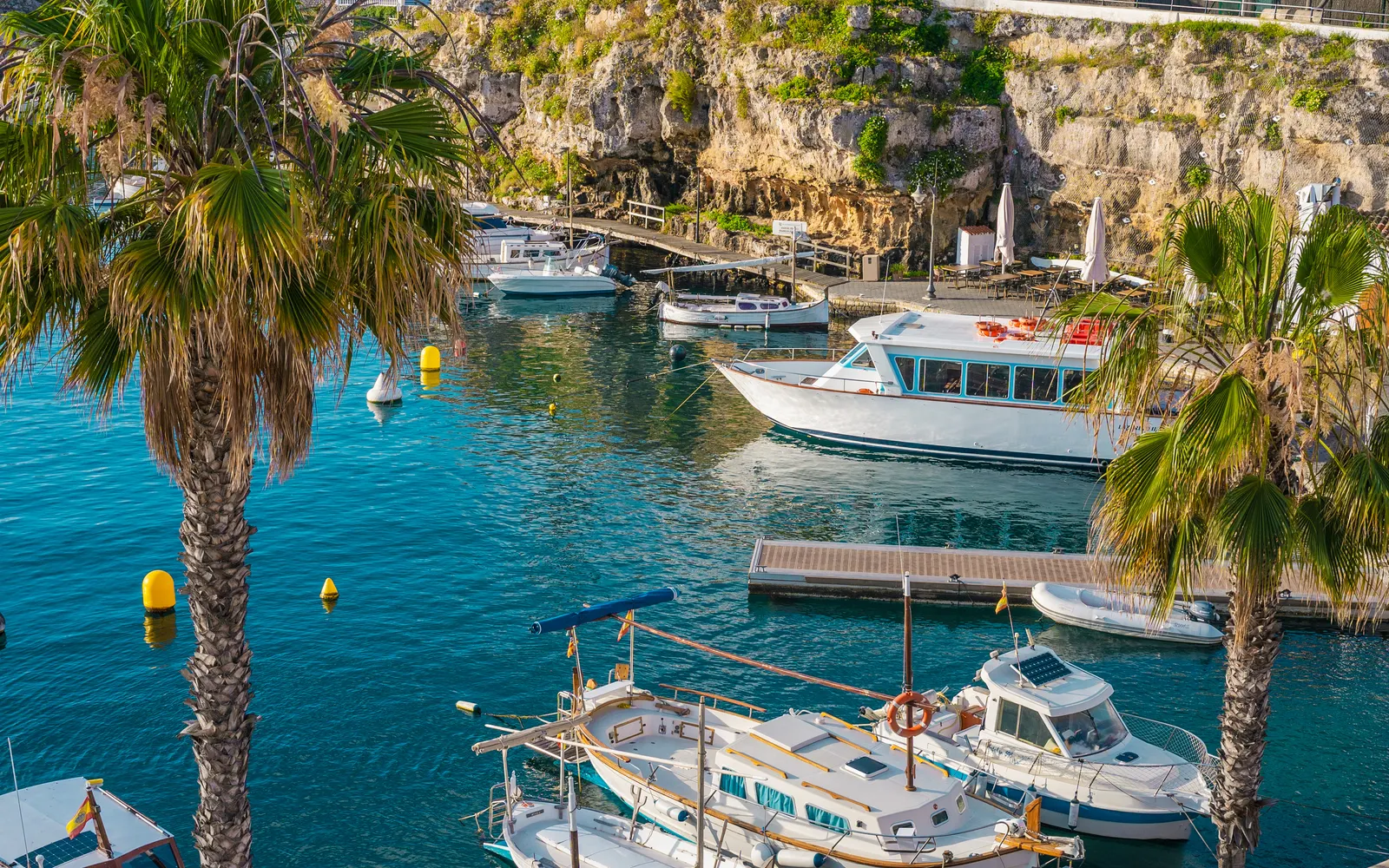
If Es Castell has a heart, it lies below, by the water. Cales Fonts was for generations the quay of the town’s fishermen: a small, sheltered cove where the boats were kept and the tackle was stored in caves dug out by hand in the rock. Today those same store-caves are restaurants, bars and terraces, and the cove has become one of the most cherished sunset plans on the island.
The scene is hard to improve on: boats rocking gently, the houses stepped above the cliff, the lights coming on in the caves as the evening falls. This is not a place to rush; it is a place to sit down, order something well made and let the light do the work. As everywhere on the east of the island, it pays to confirm opening hours and book in high season, because the tables with views over the water vanish the moment the sun goes down.
Two different fortresses: Fort Marlborough and San Felipe Castle
Here it is worth not getting confused, because the area holds two different fortresses, both built for the same purpose: to defend the priceless mouth of the port of Mahon.
The first is Fort Marlborough, in the neighbouring Cala de Sant Esteve. It is a British fortress built between 1720 and 1726, partly carved into the rock and designed to fire on anyone attempting to enter the port. Today it is a museum and can be visited; its underground route, with galleries and moats, is among the most distinctive in Menorca. (It is worth confirming opening hours before going, as they vary by season.)
The second is San Felipe Castle, a much earlier fortress, from the 16th century, also situated at the entrance to the port. It was key to the island’s military history and preserves a network of underground tunnels open to visitors at certain times. They are, we stress, two different constructions: Fort Marlborough is British and from the 18th century; San Felipe Castle is from the 16th. Anyone who confuses them misses half the story.
In the town itself, on s’Esplanada, the old barracks now houses the Military Museum of Menorca, which helps to make sense of all this past of sieges, changing flags and fortifications.
The first sunrise in Spain (eight months a year, to be exact)
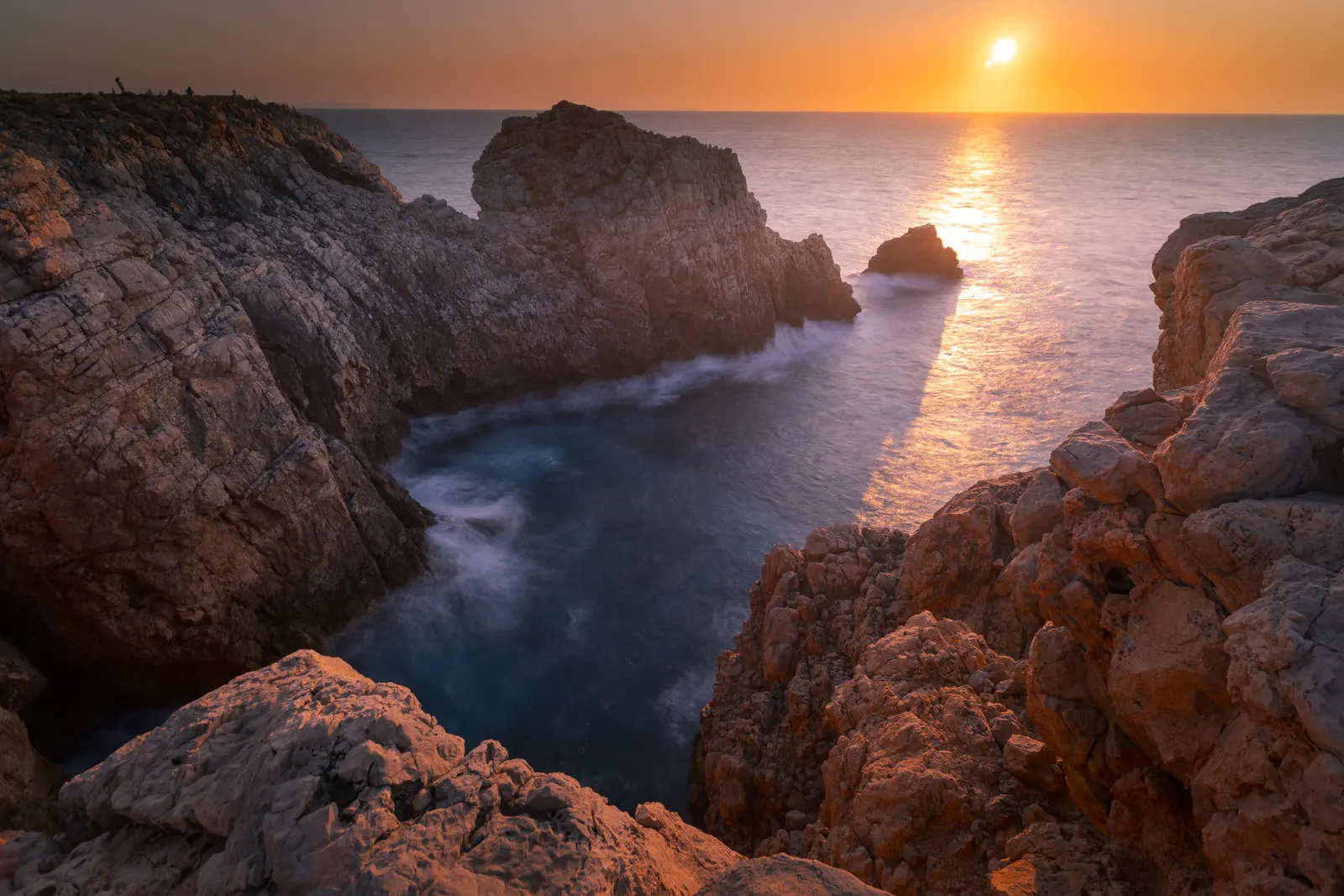
Es Castell is the easternmost municipality in Spain, and from this comes its most repeated title: the first place in the country where the sun rises. It is true — but it deserves to be said precisely, which almost nobody does. For eight months of the year the sun does reach here before anywhere else in Spain. The other four, it doesn’t: between 23 April and 19 August — the summer, precisely — the tilt of the Earth’s axis brings the sunrise forward at Cap de Creus, at the northern tip of the Costa Brava, which sees the sun some four minutes earlier at the June solstice.
There is no need to treat it with the solemnity of a record: the lovely part is what lies behind it. A town oriented to the east, with its back to the rest of the peninsula, that wakes up facing the light.
If you rise early, the reward is real. The sunrise over the mouth of the port, with the water still calm and the caves of Cales Fonts in silence, is one of those moments that justify setting the alarm on holiday.
What’s nearby: Mahon and the spirit of the harbour
Es Castell cannot be understood without its neighbour. Just a step away lies Mahon and its harbour, one of the longest and deepest natural anchorages in the Mediterranean, around which this whole corner of the island turns. What Es Castell watched over from its fortresses was precisely the entrance to that harbour, so to take in both in a single day is to follow the logical thread of history.
And where there is a British harbour, there is gin. The English presence in Menorca left a distilled legacy in Menorca gin, which is still made beside this very harbour. To round off the evening with a pomada —gin with lemonade— facing the water of Cales Fonts is no tourist cliché: it is, quite literally, drinking the history of the place.
When to go and how to get around
Es Castell works all year round, and that is one of its virtues: being right next to Mahon, it doesn’t shut down entirely in winter as other coastal towns do. The best moment of the day is, without question, the sunset at Cales Fonts, when the terraces light up. In summer the cove fills up, so to enjoy it calmly it pays to arrive early or to book. It is easy to reach from Mahon, but parking in the old town and beside the harbour becomes tricky in high season.
Our take
Es Castell is best enjoyed in two stages. First, up above: walk s’Esplanada and the straight streets, notice the colourful façades and the sash windows, and, if history interests you, book a visit to Fort Marlborough or San Felipe Castle —remembering that they are two different places—. Then, down below: head to Cales Fonts in the late afternoon, find a terrace in the old caves and stay until the light fades over the water.
It is quiet luxury of an unusual kind: not that of the untouched cove, but that of a town with memory, orderly and luminous, that learned to live facing the sea and the sunrise. Nothing to tick off in a rush; much to look at slowly.