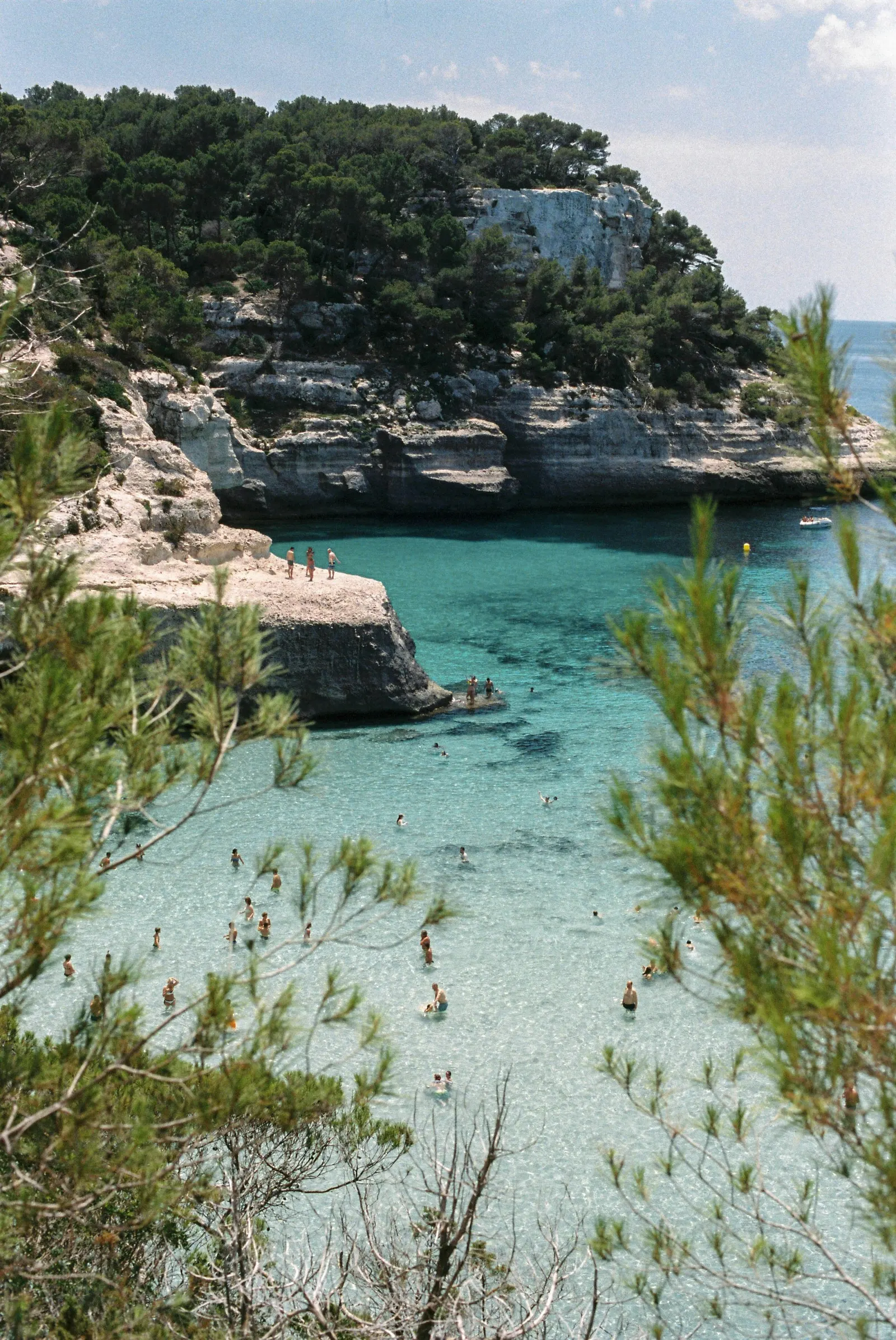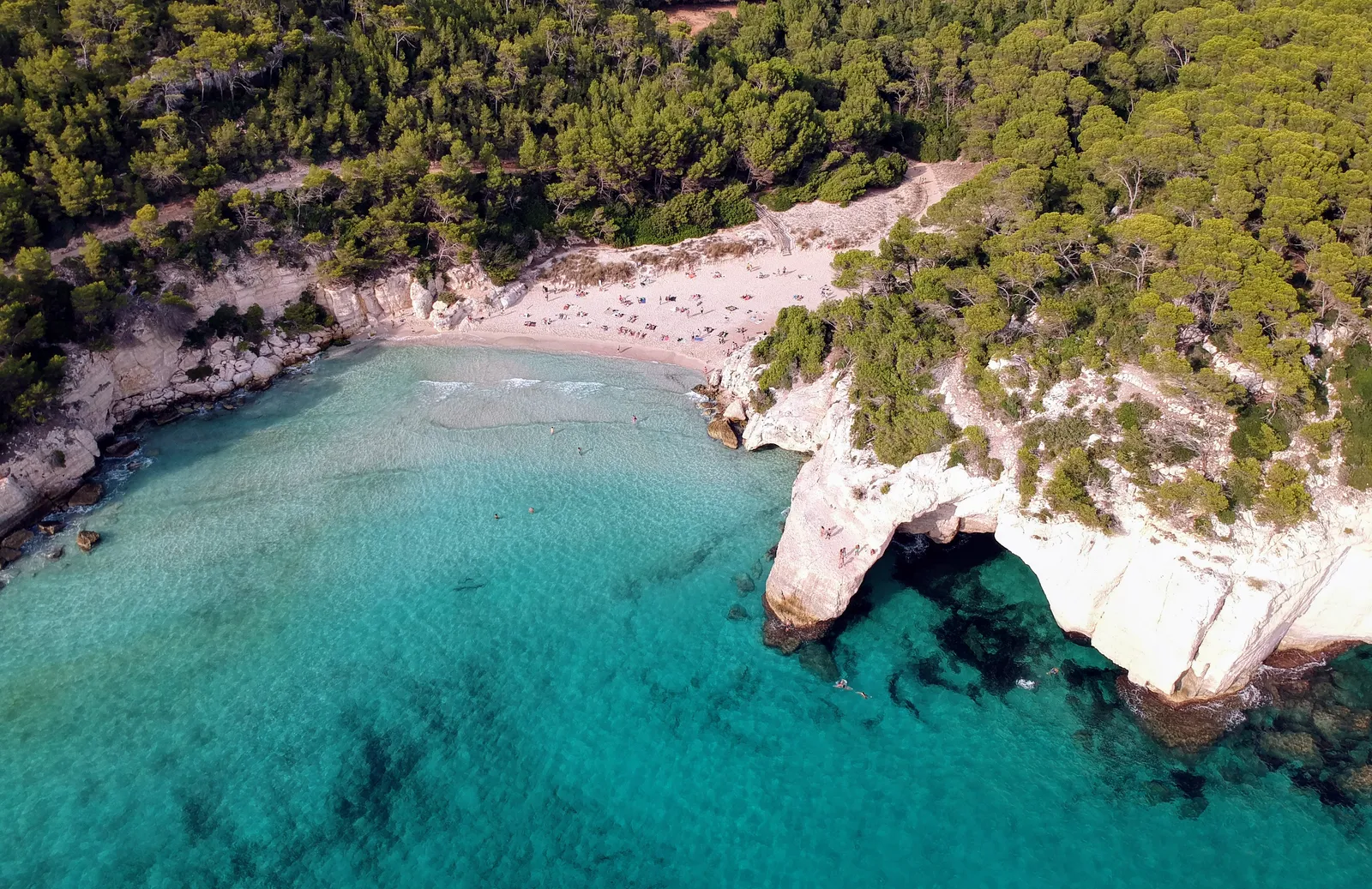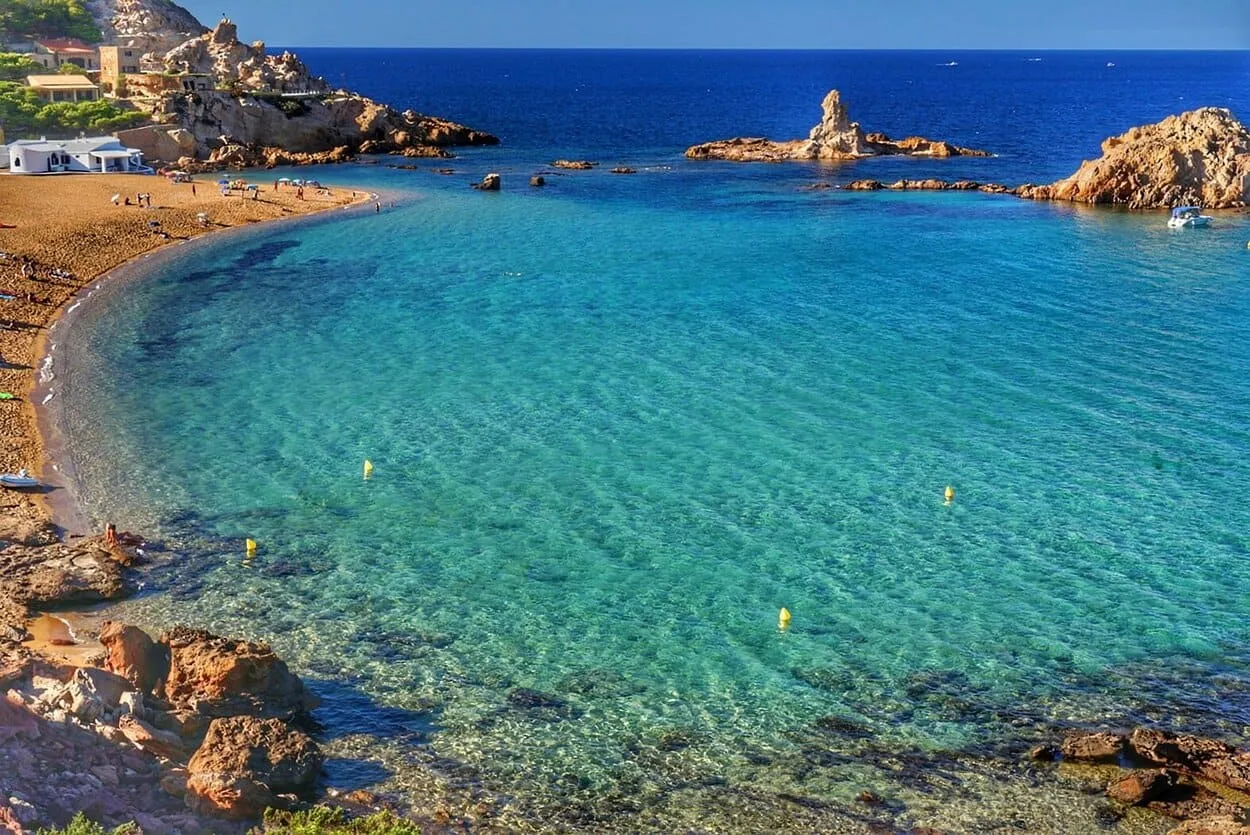
There are coves you can see from the car and coves you have to earn. Cala Pregonda belongs to the second kind, and almost all its secret lies in that demand. No road reaches it: to set foot on its sand you have to park at Binimel·là, cross a first beach and follow the Camí de Cavalls for twenty or thirty minutes, with the northern sun as your witness. The effort is modest, but enough to filter out the rush. When the landscape finally opens up, you understand why so many consider it the most iconic cove of the Menorcan tramuntana.
And the thing is, Pregonda looks nothing like the Caribbean postcard many people expect of Menorca. Its sand has a golden, reddish, almost coppery tone, the result of the iron-rich rock that surrounds it. Off the shore rise islets that give the whole scene an unreal, almost Martian air, set against water of a turquoise that seems impossible in such a backdrop. This is the wild north in its purest form: the island’s ancient, untamed face, the one that remains pristine precisely because nobody can drive all the way to it.
The essentials
- Where: Menorca’s north coast, in the municipality of Es Mercadal. Reached from the Fornells road with a turn-off towards Cavalleria and Binimel·là.
- Access to Pregonda — on foot only: you park at the free car park at Binimel·là, cross Binimel·là beach and follow the Camí de Cavalls for about 20-30 minutes. There is no car access.
- Facilities at Pregonda: none. It is a pristine cove, with no beach bar, no parasols, no showers and no bins.
- Facilities at Binimel·là: it does have a car park and, depending on the season, sometimes a beach bar. Cala Mica is also nearby.
- When: May, June and September are the ideal months; in August, first thing in the morning.
- The wind: this is a tramuntana coast; with a strong northerly wind the sea turns rough. On those days, head south instead.
How to get there: the Camí de Cavalls from Binimel·là
The starting point is always Binimel·là. From Es Mercadal you take the Fornells road and, before reaching the village, turn off towards Cavalleria and Binimel·là along a narrow road that ends at the beach’s free car park. This is as far as the car goes; from here on, it’s feet only.
Once at Binimel·là, you have to cross the beach itself and look, at its far end, for the path climbing west. It is a stretch of the Camí de Cavalls, the historic trail that rings the whole island. In twenty or thirty minutes of walking among rock, scrubland and open sea views you reach Pregonda. The route is not particularly difficult, but it’s worth knowing that part of the final stretch crosses private land: you must scrupulously respect the signs, the gates and the marked passages. That balance between public and private is exactly what has kept the cove the way it is.
This is no trivial walk under the midday sun. There is barely any shade on the path nor any water to buy along the whole route, so closed footwear, plenty of water and sun protection are not optional. They are part of the deal.
When to go
The best months for Pregonda are May, June and September: the light is clean, the water has already warmed up and the crowds are moderate. In those weeks the walk is pleasant and you can enjoy the cove without any stress. In August, the only genuinely quiet window is first thing in the morning; if you arrive early, the reward is a cove almost to yourself and a calm, transparent sea.
The decisive factor, however, is the wind. Pregonda faces north and, when the tramuntana blows hard, the sea turns rough, the water clouds over and the sand flies. The local rule is simple and worth its weight in gold: northerly wind, southern beach; calm day, the north is a gift. It’s always worth checking the forecast before loading up your gear and setting off.
What you’ll find
First of all, that landscape that doesn’t look Mediterranean: golden-reddish sand, islets cut out against the water and ancient rock formations the wind has sculpted over millennia. It is photogenic to an improbable degree, but its true luxury is something else: the absence. There is no music, no rows of sunloungers, no bars. There is space, silence and time.
For exactly this reason it’s worth going down self-sufficient: plenty of water, food or a picnic, your own shade and a bag to carry your rubbish back. Whatever comes into Pregonda leaves with whoever brought it. On calm days, snorkelling in the rocky areas at the ends is usually excellent, and the afternoon light — if you brave the walk back with the sun low — sets the sand ablaze in copper tones that stay in the memory.
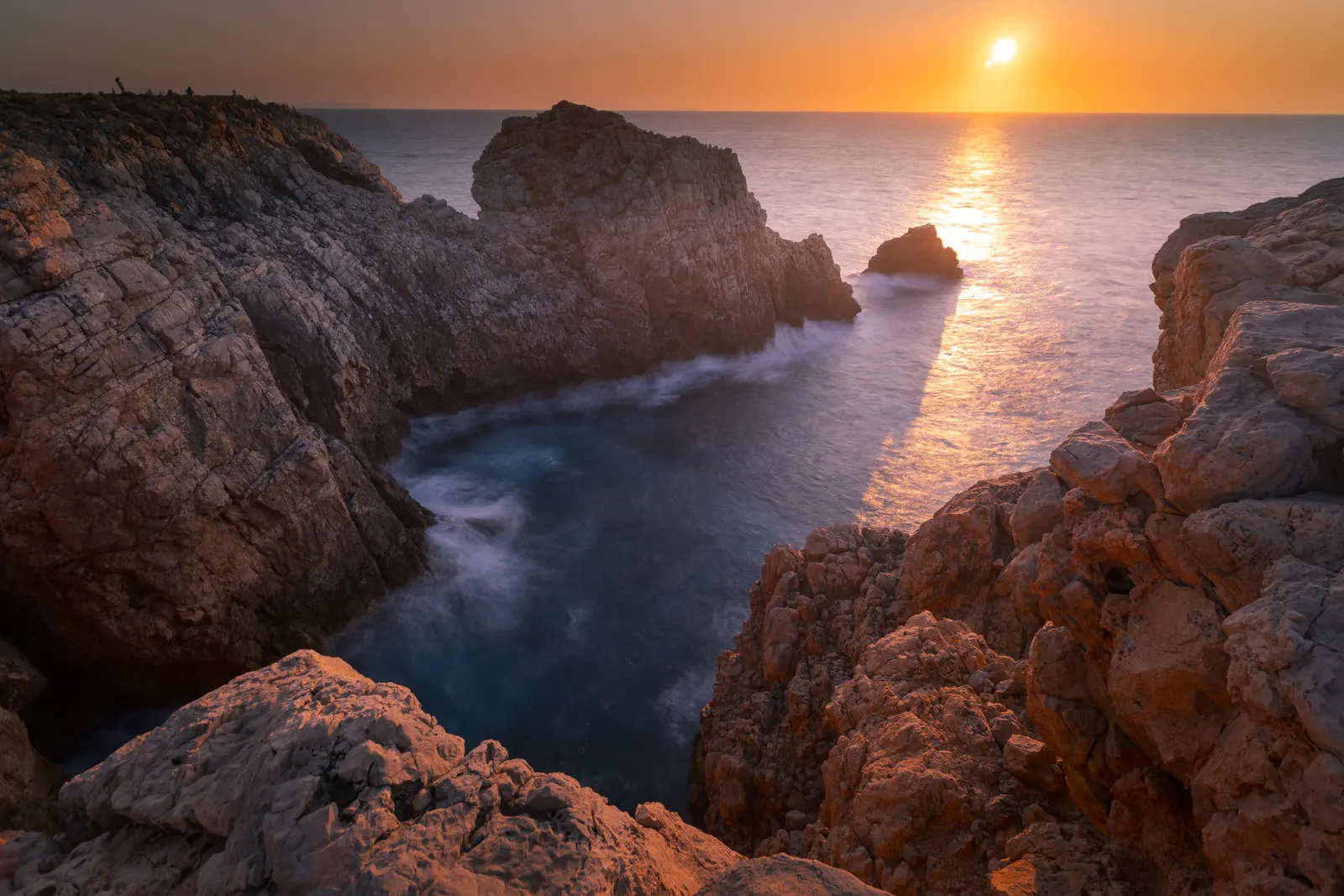
If the walk feels too long, or if you’re travelling with children or short on time, Binimel·là is a more than worthy alternative: dark sand, parking right by the beach and, depending on the season, the odd facility. It is also the gateway to Pregonda, so many people make their base there and decide on the spot whether or not to take the walk. Cala Mica is very close by, another spot to stretch out a day exploring the north.
How to look after it
That Pregonda remains what it is is no accident: it is the result of many people treating it well. The cove has no cleaning service, so each visitor is responsible for their own trace. Don’t collect sand or stones, don’t light fires and don’t leave anything behind, not even what seems harmless.
The other essential gesture is to respect the private land on the final stretch of the path: stick to the marked passages, don’t open gates and don’t cut across country. Access to a place like this is a fragile privilege, and it is preserved by treating it with the same calm with which you walk there. And, for safety, common sense with the sea: if there’s a red flag or a swell from the tramuntana, it’s better not to go in; the northern currents are not to be taken lightly.
To carry on discovering this coast, it’s well worth reading our guide to the northern coves that still keep their silence and, to round off the day with something well done, the stop at Fornells, the fishing village of the northeast.
Our take
Pregonda is, for us, the north of Menorca distilled into a single cove: the impossible sand, the islets, the path you have to earn and the absence of everything else. If you can only see one tramuntana beach, this is the safe choice. But the deeper advice is not a destination, it’s a way of going: set off early, carry water and shade, check the wind forecast first and accept that nothing will be set up when you arrive.
Anyone after the comfort of a beach bar will find in Binimel·là a friendly, honest base. Anyone after that rare silence and the landscape that doesn’t look like it belongs here should lace up properly and walk the twenty minutes. Pregonda is not visited in a hurry: it rewards those who rise early, those who respect the path and those who know how to sit still for a while listening to the northern sea.