Formentera has a reputation for being nothing but sea: white sand, impossible water, and little else. It is an unfair reputation. The smallest of the Balearics’ four main islands holds, just minutes from its beaches, some of the archipelago’s strangest stories. Almost nobody stops to see them, which is exactly why they remain calm.
The essentials
- Can Blai: a Roman fort that, according to a 2024 study, was never finished because of a war between emperors.
- Ca na Costa: the oldest megalith in the Balearics, according to the Consell, dating to around 2000 BC.
- Camí de sa Pujada: the “Roman road” up La Mola, which is not Roman.
- Cala en Baster: a cove where fishermen keep their boats in caves.
- The “100,000-year-old” seagrass: its discoverers never claimed that.
- Sky: Formentera has been a Starlight Destination since 2023.
Can Blai: the fort a war between emperors left unfinished
Between kilometres 9 and 10 of the road to La Mola, before reaching es Caló, there is a square stone enclosure with four towers. It is the Castellum de Can Blai, a late-Roman fort from the late third or early fourth century, a Bien de Interés Cultural since 1994. It can be visited, and it is almost always visited alone.
The fascinating part is why it looks the way it does. A book published in 2024 by the Museu Arqueològic d’Eivissa i Formentera concludes that the fort was never finished. According to that study, it was built in the middle of the civil war between Constantine and Maxentius, in the early fourth century, and when Maxentius died at the Milvian Bridge, the work was simply abandoned. That explains something that was a mystery for decades: why the 1979 excavations found neither coins nor grave goods. Nobody ever lived in it.
Ca na Costa: the oldest megalith in the Balearics
Between es Pujols and the Estany Pudent there is a circle of stone slabs that looks like very little from the road. It is Ca na Costa, a megalithic tomb discovered in 1974 and used between 2000 and 1600 BC. It held the remains of eight people and fifteen bone buttons. According to the Consell de Formentera, it is the oldest megalith in the Balearic Islands: older than anything on Menorca or Mallorca, the islands with the reputation for prehistory.

It has been a Bien de Interés Cultural since 1994. Until its discovery, in fact, it was believed that Formentera had not been inhabited in prehistoric times.
The Camí de sa Pujada: the “Roman road” that is not Roman
To walk up to La Mola there is an old path almost everyone calls the Camí Romà. It is the Camí de sa Pujada, green route 25: it sets off from es Caló, climbs to the La Mola viewpoint and continues to el Pilar. It is about 4 kilometres and 80 minutes, rated as difficult, with the island’s best views over the Racó de sa Pujada.
The “Roman” part is a nickname. Formentera’s official tourism website describes it as the historic path used before the early-twentieth-century road, without attributing a Roman origin to it. It has been a Bien de Interés Cultural since 1993. Its real value needs no legend: walking up on foot, early, and watching the whole island appear below.
Cala en Baster: where the boats sleep in caves
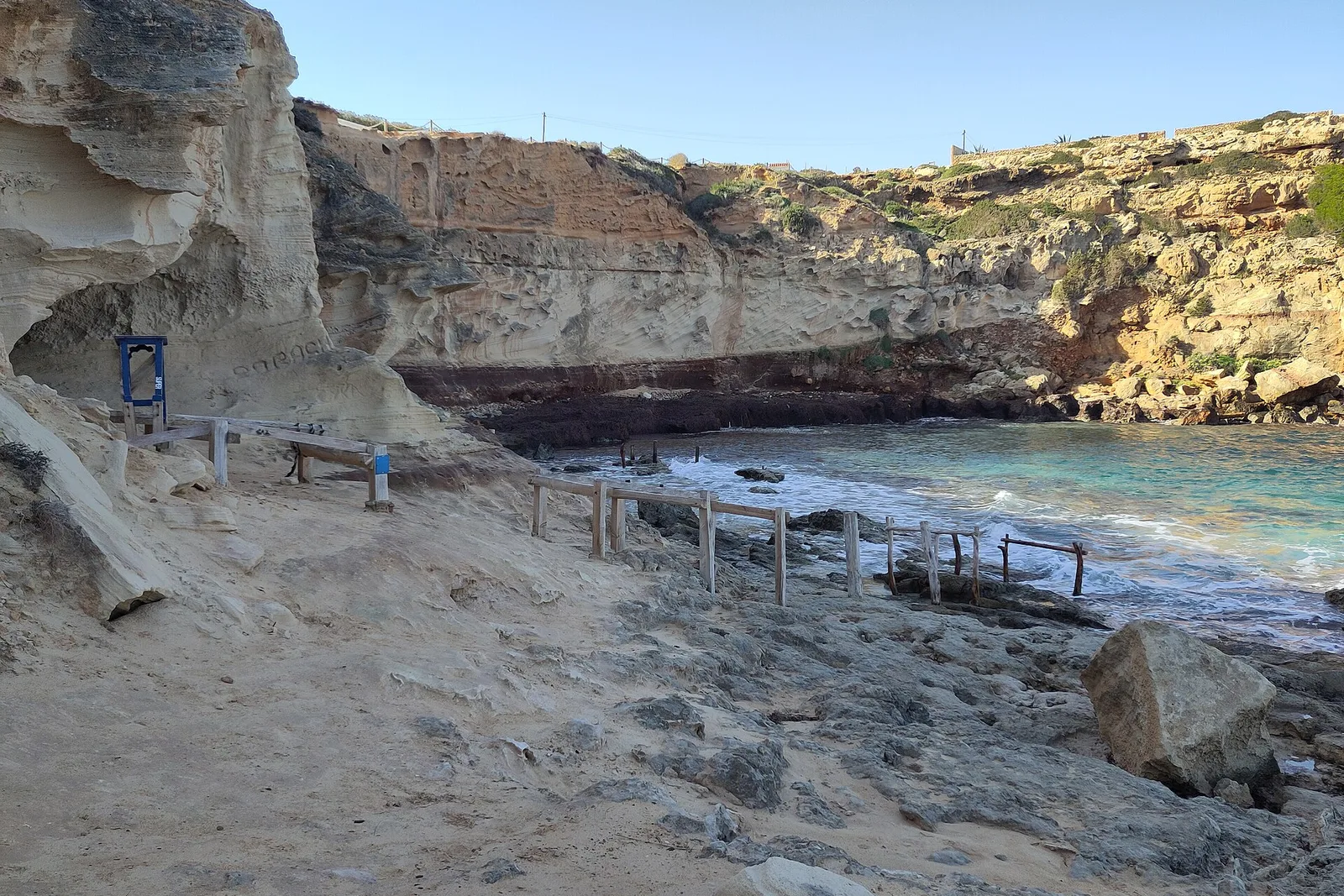
On the Tramuntana coast, about three kilometres from Sant Ferran, Cala en Baster is a small cove with no facilities, where fishermen keep their boats inside caves cut into the rock, with wooden ramps to lower them into the water. It is the image that opens this article.
It is reached along the route linking Sant Ferran, Cala en Baster and Migjorn beach: about 4.2 kilometres, easy going. One word of caution: the sandstone wall is soft; do not stand underneath it.
Es Caló de Sant Agustí: the boat slipways that are heritage
At the far end of the north coast, at the foot of La Mola, es Caló is a tiny natural harbour whose wooden boat slipways have been a Bien de Interés Cultural since 2002. It is the starting point of the Camí de sa Pujada and one of the island’s quietest corners at the end of the afternoon.
The “100,000-year-old” seagrass: what the study actually says
You have probably read it: “the oldest living thing on the planet is in Formentera.” The headline comes from a study published in 2012 in the journal PLoS ONE by Sophie Arnaud-Haond, Carlos Duarte and other researchers, who found posidonia clones spanning up to 15 kilometres in the waters of the Pitiusas.
The study calculated that some of those clones could be, at minimum, between 80,000 and 200,000 years old. But its own authors went on to write that they considered this an unlikely scenario: during the last ice age the sea was around a hundred metres lower, and that seabed was dry land. What they do maintain is that these are clones hundreds to thousands of years old. The “oldest living organism” was born in the press release, not in the scientific paper.
None of that takes anything away from it. The posidonia meadows of the Pitiusas have been a World Heritage Site since 1999, and Decree 25/2018 bans anchoring on them. If you go by boat, anchor on sand or on a buoy.
Two more myths: Dylan and Verne
Bob Dylan never lived in a windmill on La Mola, or at least there is no evidence that he did: no photographs or documents, only hearsay. His biographies place him in the United States in 1967.
Jules Verne, on the other hand, has a monument next to the Far de la Mola lighthouse despite never having set foot on the island. He earned it by mentioning it in his novel Hector Servadac (1877).

And the sky: Starlight Destination
Since 2023 Formentera has been a Starlight Tourist Destination, with official stargazing points at the La Mola and Barbaria lighthouses, Caló des Mort, Punta Prima, Punta Rasa and Can Marroig. With no major sources of light, the winter sky is especially sharp. A guided observation session is the best way to understand it.
When calm is something you buy
This is the Formentera that rewards taking things slowly, and the best place to sleep is the one that has it close by: es Caló and La Mola, the island’s rural, quiet side, with the Camí de sa Pujada, the lighthouse at dawn and the Pilar de la Mola craft market on Wednesdays and Sundays, May to October.
For the famous beaches, at the right hour, there is Formentera before eleven. For the table, eating in Formentera. And to see it with nobody around, Formentera in winter.
Our view
There are islands that explain themselves from the beach. Formentera does not: its best story lies in a stone enclosure nobody finished, in a four-thousand-year-old circle of slabs, and in boats that sleep inside the rock.
None of these places has a queue. It is, probably, the easiest luxury to find on the whole island.
Details checked on 22 September 2026 with the Consell de Formentera, Formentera’s official tourism website, the Govern balear and the original PLoS ONE study (2012). The claims about Can Blai come from the study published in 2024 and reported by the Balearic press.