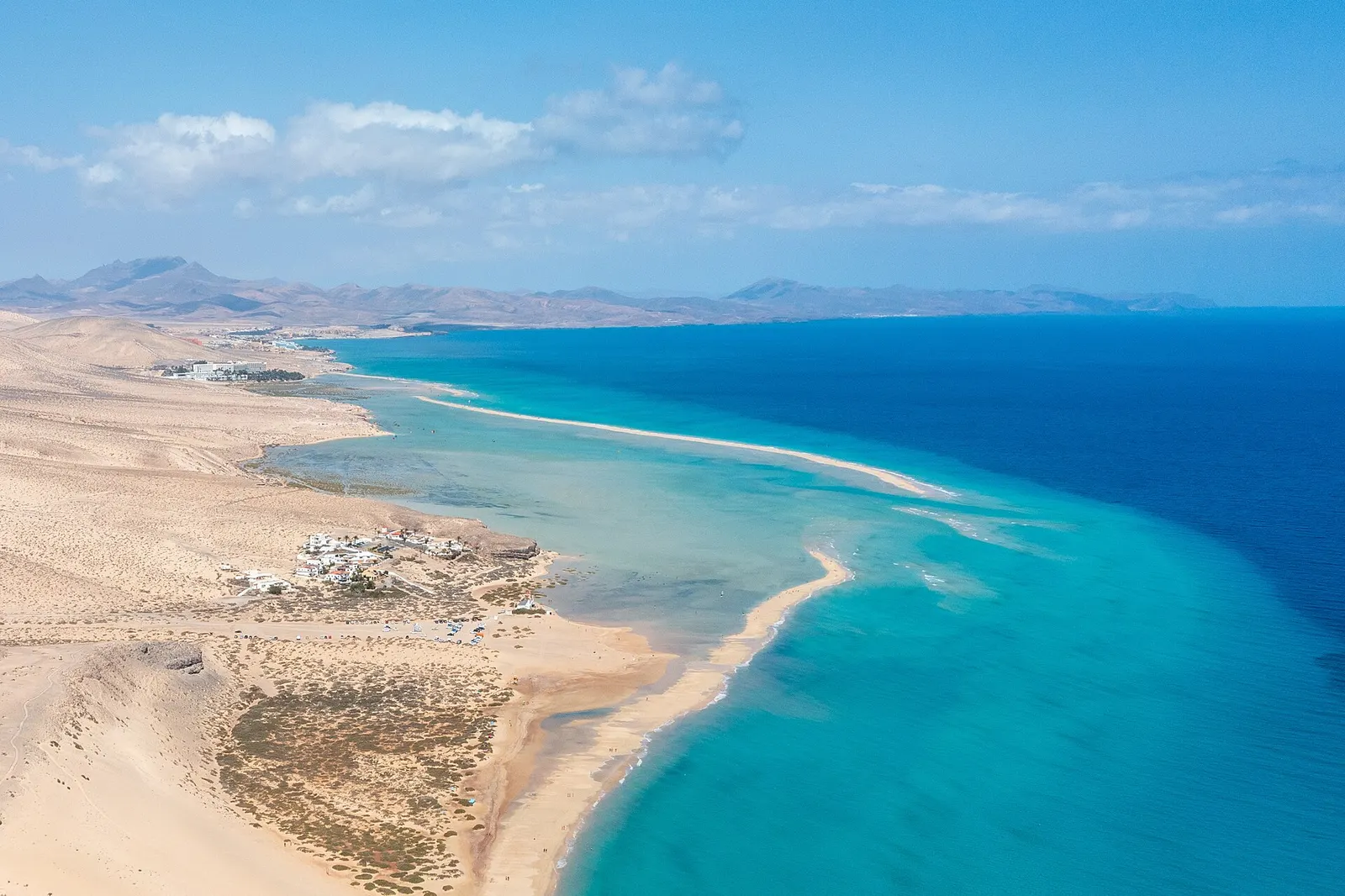
On the south-east coast of the Jandía peninsula, the westerly wind passes over the mountain and leaves the sea quieter. Hence the name of the place, Costa Calma, and hence its best-known beach: Sotavento, or Playa Barca, in the municipality of Pájara. What sets it apart is neither its length nor its sand but a lagoon that appears and disappears with the tide, separated from the ocean by a sandbar.
The paradox is that this sheltered coast is also a coast of constant wind: every summer it hosts a round of the windsurfing world tour. Learning to read both faces — the tide and the wind — is what turns a visit into a quiet day.
The essentials
- Where: Costa Calma, municipality of Pájara, on the leeward coast of the Jandía peninsula.
- The lagoon: forms behind a sandbar and changes with the tide. Check the tide table before you go.
- The wind: steady, especially in summer. Every year it hosts the PWA Windsurfing World Cup and the GWA Wingfoil World Cup.
- Safety: do not stay on the sandbar as the tide comes in and do not cross channels with a current.
- For calm: early morning, and any month other than July and August.
How the lagoon works
At high tide, the ocean flows in behind a long tongue of sand and fills a wide, shallow lagoon. As it falls, the water withdraws and reveals a second shoreline of fine sand, with rivulets and pools. The landscape changes within hours, so there is no single Sotavento: there is the morning one and the afternoon one, the high-tide one and the low-tide one.
When full, the lagoon is flat and shallow: you can wade knee-deep, swim without waves, and it is where beginners learn to sail. But the tide is in charge. As it rises, the sandbar can become surrounded by water; when it floods in or drains out hard, the channels linking lagoon and ocean carry a current. Do not stay on the sandbar with the tide rising, do not cross the channels when the water is running and do not count on lifeguards along every stretch. Tide tables are published daily: check one before you set out.
The wind that made it famous
For decades Sotavento has been one of the great stages of board sailing. Every summer it hosts the PWA Windsurfing World Cup and the GWA Wingfoil World Cup; the 2024 edition was the thirty-sixth, from 19 July to 3 August. Next to the beach is René Egli’s windsurfing school.
For spectators, competition days have their own beauty: coloured sails over turquoise water and a beach full of people who know what they are doing. For anyone in search of silence, those are the weeks to avoid.
How to enjoy it quietly
- Early. The first hours tend to bring the least wind and the fewest people. The light is low and the sand is not yet flying.
- Outside July and August. The summer wind draws the sailors and, with them, the bustle. In spring and autumn the beach is better shared.
- On foot. The beach is long: walk away from the main access points for a while and you will find stretches that are almost empty.
- With everything you need. There is little natural shade. Bring water, sun protection and a warm layer: the wind cools more than you expect.
What not to do
The beach and its surroundings are looked after: no stone shelters or walls, no taking sand or stones home, and room for the sailors when the wind is up. Dogs, drones and kites are best kept away from swimming and sailing areas.
Which suits you
- You want the wild beach on the other side of the mountain → Cofete and the Jandía peninsula, without going into the water.
- You want to keep looking at the sea from a boat → Fuerteventura from the water.
- You want to time your trip around the World Cup, or avoid it → Fuerteventura through the year.
Our view
Sotavento rewards those who arrive having checked the tide. Early in the morning, with the lagoon full and the wind still asleep, it is one of the most serene places on the island; at midday in August, with the sandbar ringed by water and the competition in full swing, it is something else. You need not choose between the two: you only need to know when to go.
Information as of October 2026, from regional press and public competition sources. Tides change every day and World Cup dates are announced each year: confirm them before you go.