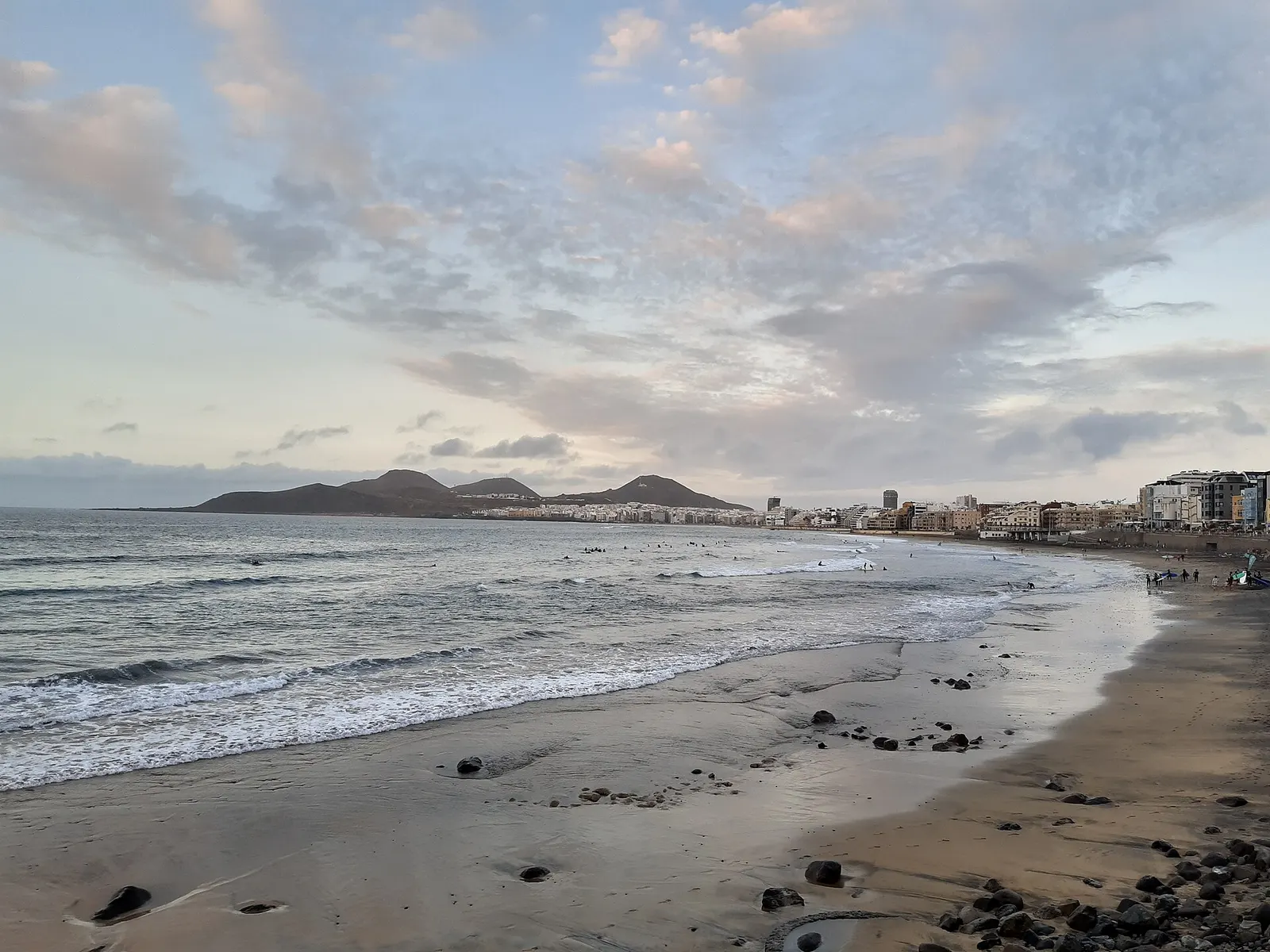
Some beaches you visit; others you live in. Las Canteras belongs to the second kind. It sits in the middle of Las Palmas de Gran Canaria, with buildings at its back and the Atlantic in front, and the city uses it like a living room: for a swim before work, a walk after lunch, a sunset on any Tuesday in January.
The essentials
- Where: on the isthmus of Las Palmas, from La Isleta in the north to near the mouth of the Tamaraceite ravine in the south.
- Length: just over 3 km of sand.
- La Barra: a sandstone reef running parallel to the shore that shelters much of the beach and calms the water.
- La Cícer: the southern end, with more swell; this is the surfers’ stretch.
- When: all year. Early in the day, ideally.
La Barra, the reef that changes everything
What makes Las Canteras different lies a few metres offshore: La Barra, a band of sandstone rock running parallel to the beach that breaks the Atlantic swell. Behind it, along much of the beach, the water stays calm, almost like a pool, and swimming becomes a daily ritual rather than an adventure.
The beach was not always called this. It used to be known as Playa del Arrecife, the reef beach, after La Barra. The current name comes from the quarries (canteras) where stone was once cut in the area, a history of hard work that is hard to picture today among the towels and parasols.
North to south, three beaches in one
The north, towards La Isleta, is the most sheltered stretch: the one chosen by those who swim every morning.
The centre is where city life happens: the busy promenade, the cafés, the city coming down to the sand at any hour.
The south, La Cícer, is something else. Here La Barra fades, the Atlantic comes in harder and the water fills with boards. It is the city’s surf beach and, as the afternoon draws in, the best place to watch the last waves being caught in the low light.
The promenade
The Paseo de Las Canteras runs the whole length of the beach on the landward side. It is flat, open and full of life: terraces, kiosks, people running, people doing nothing at all. At its southern end stands the Auditorio Alfredo Kraus, the building that closes the beach and marks the end of the walk. Walking it from end to end and back is one of the simplest and most rewarding things to do in the city.
How to enjoy it quietly
- First thing in the morning. The beach belongs to the local swimmers, the light is soft and the promenade is only half awake.
- Winter. Las Canteras has no season: in January it is still a beach for swimming and walking, without the crowds of a summer Sunday.
- Sunset, from the south. The sun goes down over the sea in front of the beach, and La Cícer is left to the last surfers.
- Respect La Barra. It is a living natural space: don’t trample the reef, don’t take anything away, and leave the sand on the beach.
Before you swim, check the sea conditions and the day’s flags: the Atlantic is in charge here too.
Our view
Las Canteras is the best proof that Gran Canaria is not just the resort south. It is a beach with a city behind it, and that makes it more interesting, not less: the calm here doesn’t come from being far from everything, but from the ritual of every day. Pair it with a morning in Vegueta, the old town, and you have both faces of Las Palmas. And if you are thinking of staying, we describe what it is like to live in Las Palmas.
Information as of October 2026.