There is a Gran Canaria that never makes it into the brochures of the south: green, damp in the mornings, with pine forests above and terraces of fruit trees falling to the sea. Agaete is its unofficial capital. The town looks over a narrow valley and stretches down to Puerto de las Nieves, a fishermen’s quay beneath the cliffs of the Tamadaba massif. It is a place to arrive early and be in no hurry to leave.
The essentials
- The Agaete valley grows coffee: it is presented as the only place in the European Union where coffee is grown and processed entirely on site.
- Puerto de las Nieves is a fishing harbour and also the ferry terminal for Santa Cruz de Tenerife.
- On 4 August, the Bajada de la Rama transforms the town: a Festival of National Tourist Interest since 1972.
- Information as of October 2026.
The valley
The Agaete valley climbs inland between rock walls and terraced farms. Citrus, tropical fruit and, above all, coffee grow here, and some farms grow and process it in the valley itself. A coffee plantation thriving in Europe is a rarity, explained by the mild, sheltered climate of the ravine. Farm visits, where offered, are booked directly with the farm; the full story of the island’s coffee and wine is in our piece on Gran Canaria’s coffee and wine.
The valley road is narrow and best taken slowly. That, in truth, is the whole idea.
The town and the harbour
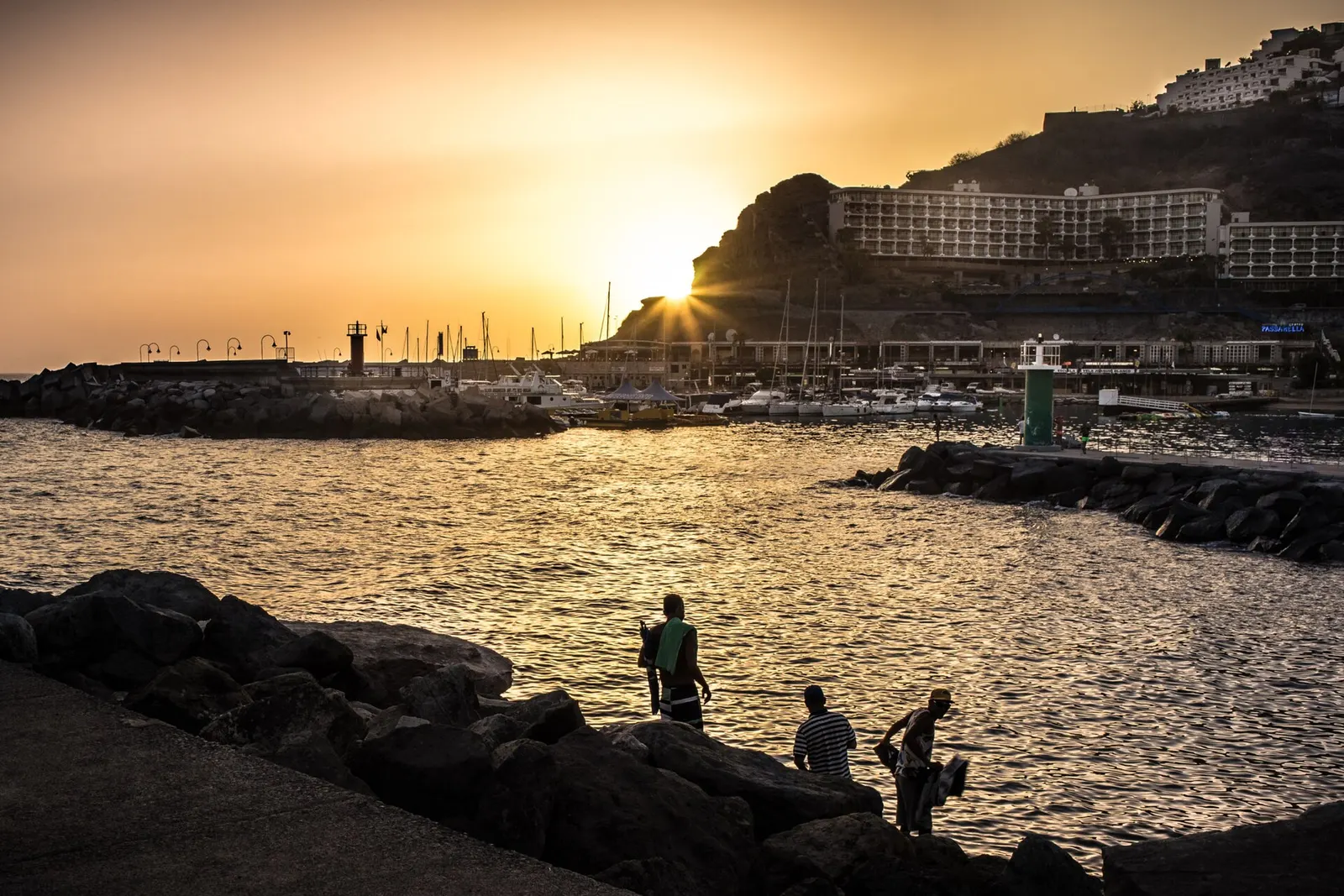
Agaete is white, with short streets and small squares. Below, Puerto de las Nieves lives from the sea and from the ferry: Fred. Olsen Express sails from its breakwater to Santa Cruz de Tenerife, a crossing of just over an hour; timetables change, so check them with the operator.
Beside the harbour stands the chapel of Nuestra Señora de las Nieves, home to a Flemish triptych attributed to Joos van Cleve — a reminder of the age when the island’s sugar was traded with Flanders. Offshore, the Dedo de Dios (“God’s Finger”), the rock that was once the harbour’s emblem, lost its upper part in Tropical Storm Delta in November 2005. What remains is still there, shorter now, with the cliffs of Tamadaba behind it.
The right hour is the last of the day: the sun sets to the west, over the sea, and on clear evenings the outline of Mount Teide can be made out on the horizon.
August and the Rama
On 4 August Agaete celebrates the Bajada de la Rama, the great festival of the north-west: locals and visitors come down into the town carrying branches brought from the pine forests above, to the sound of music, in a rite of ancient origin. It has been a Festival of National Tourist Interest since 1972, and in 2025 it drew more than 50,000 people. It is an intense and deeply local experience. It is also the opposite of calm: if you have come for something else, choose another week. You will find it in our calendar of the year in Gran Canaria.
Getting there and around
Agaete lies on the north-west coast, linked to Las Palmas by the northern coastal road. The island’s public buses — guaguas, as they are called here — serve both the town and the harbour. If you plan to continue along the coast towards La Aldea de San Nicolás, check the state of the road with the Cabildo before setting out. Everything else is in getting around Gran Canaria.
On the way, a few kilometres off, Gáldar holds one of the island’s most important Aboriginal sites: the Cueva Pintada. Together, Gáldar and Agaete make a well-rounded day.
Our approach
We do not recommend specific restaurants in this piece: we would rather the valley and the harbour be discovered at leisure. Information as of October 2026; ferry times and road conditions, always from their official source.