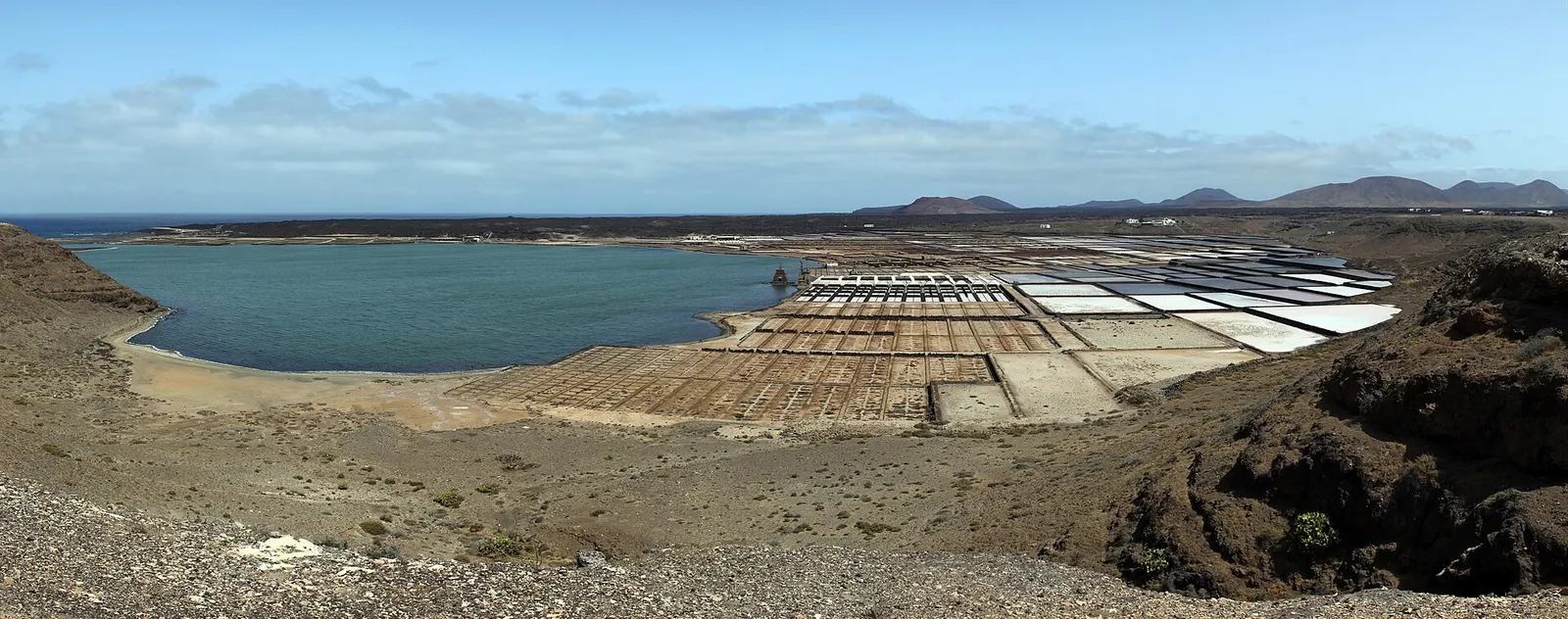
Some landscapes are for looking at; others are for eating. The Salinas de Janubio, on Lanzarote’s south-west coast, are both: a patchwork of pans in ochre, pink and white at the edge of a lagoon — and the source of the salt many of the island’s cooks keep on the table.
The place
Janubio is a saltwater lagoon that was cut off from the sea by a bar of sand and rounded boulders, the callaos. On that foundation, at the end of the nineteenth century, the salt pans were built: a network of shallow basins where seawater flows in, spreads out and lies still until sun and wind have done their work. They are among the largest in the Canary Islands and still in production.
The surroundings are now a protected natural area, which explains a few simple rules: look from the paths and designated points, don’t step into the pans or onto the lagoon shore, and don’t take boulders or stones from the bar that divides the lagoon from the sea.
Why it is different
Sea salt from a traditional salt pan is not table salt by another name. It crystallises slowly, in the open air, and is raked by hand rather than refined. The most prized is flor de sal: the fine crust that forms on the surface of the water and is skimmed off with care before it sinks. It is crunchy, used at the end, on the plate, rather than in cooking.
In Lanzarote, the wind is in charge as well. It is the same trade wind that makes farmers shield every vine with a wall in La Geria, and here it works in the salt-maker’s favour, speeding evaporation in a climate that is already dry.
At the table
On an island of fishermen, salt was for centuries the way to keep fish when there was no refrigeration. Today its place is in simple food, which is where you notice it:
- Grilled fish, with a pinch of coarse salt or flor de sal just before serving.
- Papas arrugadas, Canarian potatoes boiled in very salty water until the skins wrinkle under a fine white bloom. They come with mojo.
- Tomato, avocado or local goat’s cheese, with nothing but oil and a pinch of flor de sal.
If you’d like to take some home, ask at the salt works itself: salt is the one souvenir of this landscape you can carry away without harming it.
How to see it
The salt works runs guided visits, which usually include a tasting of its salts; check the details directly with them before you go (information as of October 2026). Without a visit, it is well seen from above, from the road that drops down towards the coast.
Timing matters: in the low afternoon sun the pans change colour and the water mirrors the sky. Janubio is also the natural first stop on the west-coast drive past Los Hervideros and El Golfo: look at the salt, carry on north as the light fades and finish facing Charco de los Clicos at sunset.