You do not understand Tenerife’s cooking by reading menus; you understand it by looking at the land. A volcanic island of terraced slopes, scarce water and an ocean that does not always let the boats out learned to cook with few things and to look after them closely. What seems rustic today is, in fact, a very finely tuned larder.
This is not a list of restaurants. It is what is worth knowing to order well at any table on the island.
The essentials
- Papas antiguas: the islands’ traditional potato varieties, with a Protected Designation of Origin registered by the European Union in 2012.
- Two mojos: the red one (or picón), with chilli and garlic; the green one, with parsley or coriander.
- Gofio: flour from toasted grain, the islanders’ bread for centuries.
- Goat’s cheese: the island has small, award-winning dairies, mostly on the middle slopes.
- The catch of the day: whatever came in, not whatever sits on the menu all year.
Potatoes, which are something else here
The so-called papas antiguas de Canarias are the varieties that reached the islands centuries ago and that farmers have kept planting with seed grown in the area itself. The European Union has protected them as a Protected Designation of Origin since 2012, and the protection covers more than twenty varieties: small, with dark or reddish skins and a flesh nothing like a supermarket potato.
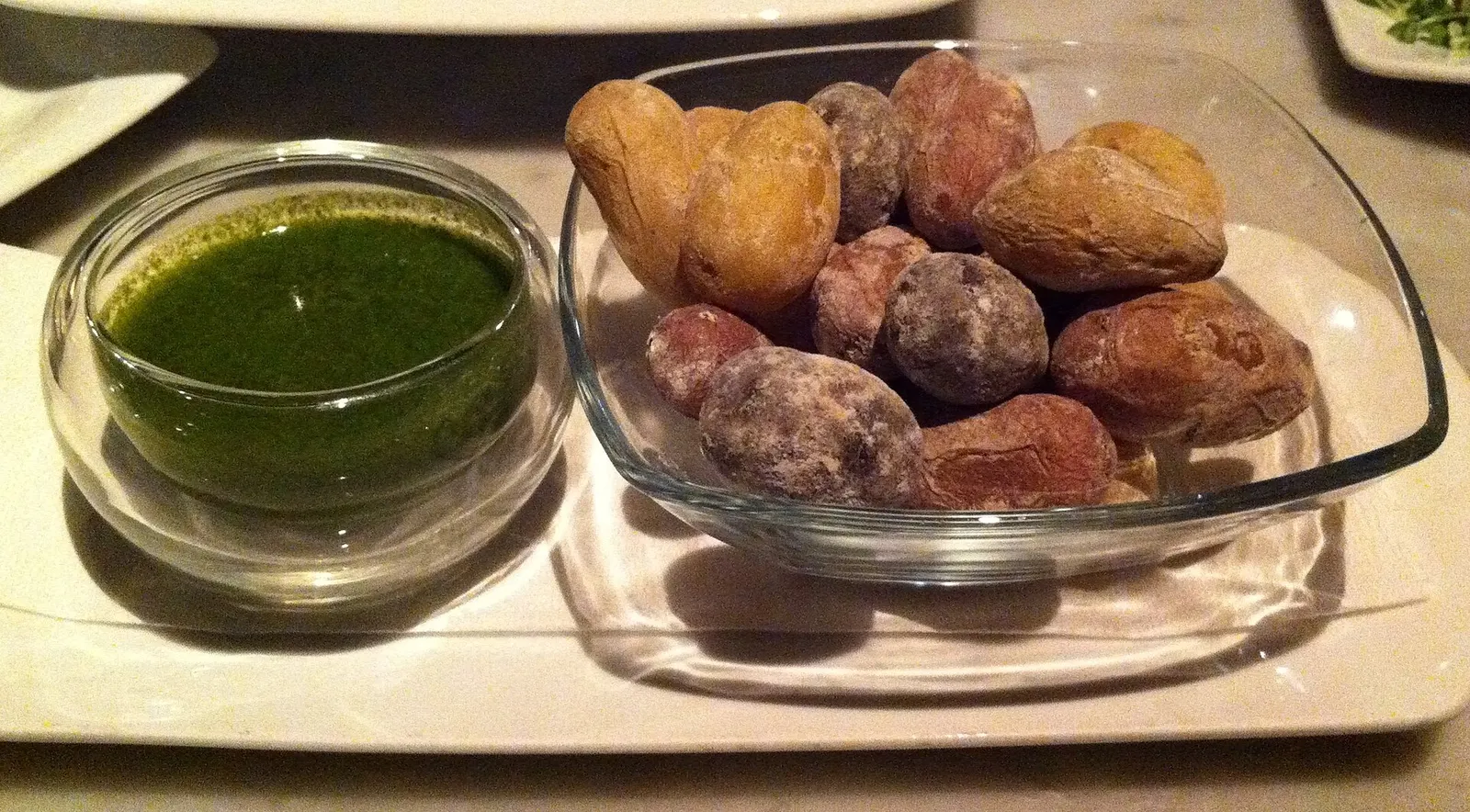
The classic way to eat them is as papas arrugadas: boiled in their skins in very salty water until the water evaporates and the skin wrinkles and turns white with salt. They are eaten whole, skin and all, dipped in mojo. If a table serves them peeled, or made with another variety, you have already learned something about the place.
The two mojos
Red mojo, or mojo picón, is made with oil, vinegar, garlic, salt and red chilli or pepper; depending on the house it is mild or properly hot. Green mojo swaps the pepper for parsley or coriander and usually goes with fish. Neither is a garnish: every family has its own proportions and defends them.
Gofio
Gofio is flour made from toasted grain (maize, wheat or a mix) and for centuries it was the basis of the islands’ diet. Today it appears in escaldón, gofio scalded with stock into a paste eaten with raw onion, and in desserts too. Order it at least once: it explains better than any museum how people ate here when there was not much of anything.
Goat’s cheese
Tenerife is goat country, with small family dairies. The island’s 2023 cheese competition drew 69 cheeses from 26 dairies, and the winner was a goat’s cheese from Benijos, in La Orotava. At the 2024 World Cheese Awards, Tenerife’s cheeses took thirteen medals. Fresh, semi-cured or smoked, they make a good start to any meal, with a little red mojo on top.
Fish
On the coast, the catch of the day rules, grilled, with papas arrugadas and green mojo. The rule is simple: ask what came in today and let yourself be guided. A place that always has the same fish, all year and in any quantity, is not looking at the sea.
Where to look
The island’s cooking is at its best in the north and on the middle slopes, rather than in the big resorts of the south. That is also where you find the guachinches, Tenerife’s most local institution, and the vineyards behind Tenerife’s wines, which go with all of the above quite naturally.
And when the island gets serious, fine dining takes up this same produce with a different technique: we cover it in Tenerife’s Michelin stars.
Our view
The luxury here is eating what the island knows how to do: a potato with a name of its own, a home-made mojo, a cheese from a dairy you could visit. Nothing more is needed. The hard part is not settling for less.