Few conversations generate as much noise as buying a house on an island. Headlines that age within a quarter, figures without dates, taxes that do not exist but circulate through forums as if they were on the statute book. This article is the opposite: a snapshot of the Menorcan market in 2026 with every figure dated and sourced, the truth about the famous “100% tax”, and the honest caveats a prudent buyer is grateful for.
One warning before we start, repeated at the end: this is not tax or legal advice. It is data journalism to help you order your thinking; decisions are made with a qualified adviser who examines your specific case.
The essentials
- Ciutadella, at record highs: around €4,400/m² in June 2026 (fotocasa index); the agents’ association (Coapi) closed 2025 at an all-time high, up 21.1% year on year.
- Maó, more contained: about €3,464/m² in June 2026 (fotocasa); its 2025 close was also a record according to Coapi (~€3,803/m²).
- Menorca remains the “human-scale” Balearic: far from Sóller (€7,761/m²), Ibiza town (€7,357/m²) or Palma (above €5,100/m² in May 2026).
- Foreign buyers weigh more than ever: they signed 31.47% of home purchases in the Balearics in Q4 2025 (Spain’s Land Registrars), the highest share of any region — though with signs of cooling: foreign purchases fell 4.4% year on year in the second half of 2025, according to the Notaries’ data.
- The “100% tax” on non-EU buyers is NOT in force. Announced in January 2025, it has never been voted on. What you do pay is the Balearic transfer tax of 8% to 13% in brackets.
How much does a square metre cost in Menorca in 2026?
It depends on who measures, and when — and that is the first lesson. The portals (fotocasa, idealista) publish asking prices almost in real time; the professional associations (Coapi) look at completed transactions. The figures do not match, and that is fine: together they draw the real range.
With that caution, the mid-2026 picture is this:
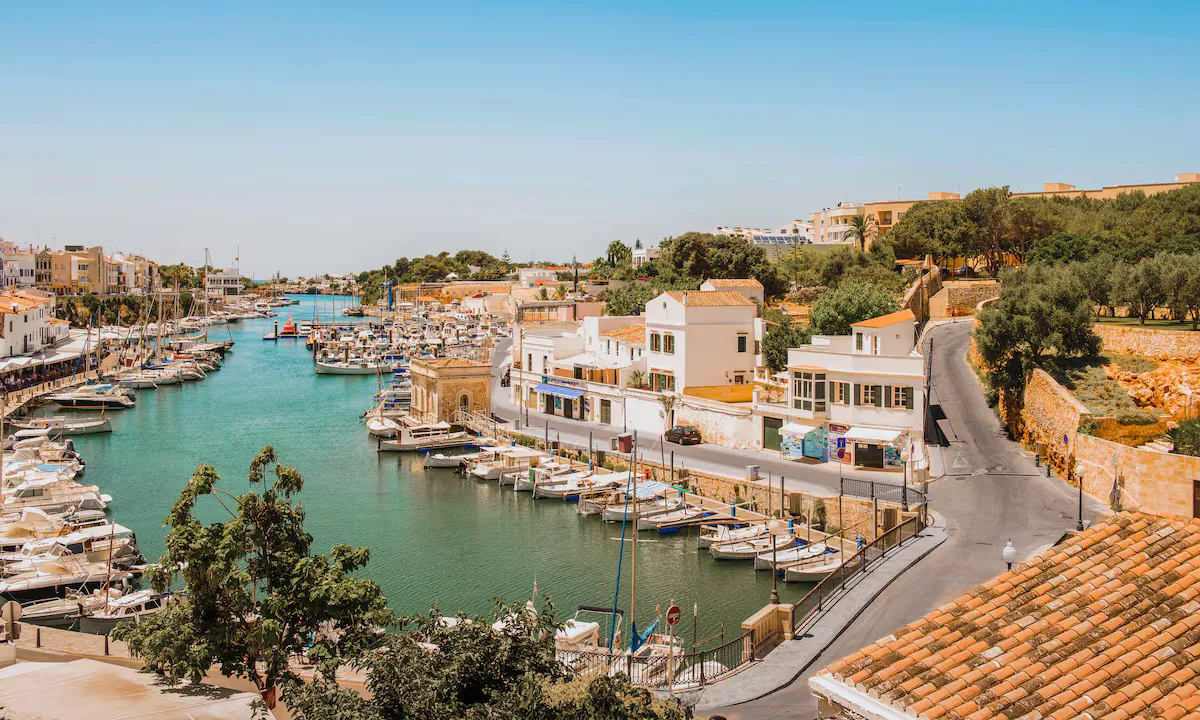
- Ciutadella: around €4,400/m² (median value: roughly €390,000) according to fotocasa’s June 2026 index. Idealista placed it at €4,069/m² in March. Coapi closed 2025 at about €4,384/m², an all-time high and 21.1% above the previous year. It is, by some distance, the island’s hottest market.
- Maó: about €3,464/m² (fotocasa, June 2026), with homes over 100 m² up 5.9% year on year. Coapi put its 2025 close at ~€3,803/m², also a record.
- Ferreries, as an inland sample: €3,522/m² (fotocasa, June 2026).
The regional context explains the pressure: the Balearics as a whole reached €5,441/m² (+7.8% year on year) and rank as Spain’s second most expensive region for rentals too; across Spain, resale housing was up 17% year on year, a record for the fotocasa index. Menorca is rising — but from further down.
Two honest limits to these numbers: they expire (treat them as a photograph of June 2026, not a settled price) and they do not cover the market in high-end country estates and llocs, whose deals close on total value, discreetly, with no reliable €/m² we could publish.
Is Menorca still cheaper than Mallorca and Ibiza?
Yes, and by a distance. The dated comparison (portal indices, spring–summer 2026) leaves little room for interpretation: Sóller, €7,761/m²; Ibiza town, €7,357/m²; Palma, above €5,100/m² and setting records. Against that, the most expensive Ciutadella in history sits around €4,400/m².
The editorial reading the data supports: Menorca remains the last Balearic island at human scale — the one where you can still buy in a living historic city without paying the prices of a consolidated international hotspot. That relative discount, combined with Ciutadella’s double-digit rise, explains the investor interest. If you read us, you know our position: the best purchase is decided not by price but by the life of all 365 days.
Who is buying the island? The foreign buyer’s record share
The year’s most quotable figure came from Spain’s Land Registrars: in the fourth quarter of 2025, foreigners signed 31.47% of home purchases in the Balearics — nearly one in three, and the highest share of any Spanish region. The Balearics are also the region with the most foreign purchases in the over-€500,000 bracket, and Germans are the leading buyer nationality, with a weight analysts describe as unique in Spain.
Two nuances so the headline does not run away with you:
- The wave is cooling. According to the Notaries’ data, foreign home buying fell 4.4% year on year in the second half of 2025 across Spain. A record share and a cooling volume can coexist; it pays to know both.
- There is no reliable island-level breakdown. The registrars publish by region and province: the 31.47% is for the Balearics as a whole, not for Menorca. Anyone selling you “Menorca’s percentage” is estimating.
The “100% tax”: what is true and what is noise
Few things have caused more confusion in international buyers’ forums. The facts, with dates:
- On 13 January 2025, the Spanish government announced its intention to tax home purchases by non-resident, non-EU buyers at up to 100%.
- On 22 May 2025, the bill was presented to Parliament.
- Since then, it has never been voted on or passed. It was also left out of the January 2026 housing package.
- As of July 2026, no special tax or ban on purchases by foreigners or non-residents exists in Spain. In the Balearics, limits on non-resident buyers have been studied — but none has been implemented.
Put precisely: it is a political announcement, not a law. And with the same precision: it is a live political issue — if you are reading this months later, verify its status before deciding, because it can change.
What you actually pay today: the real tax bill, without smoke
While the phantom tax hogs the headlines, the real tax rarely gets any. On resale homes in the Balearics you pay the transfer tax (ITP) in brackets, in force since 2023: from 8% (up to €400,000) to 13% (above €2 million), through 9%, 10% and 12% in the intermediate brackets. In practice, a high-end buyer pays between 10% and 13% on the bulk of the value. On new builds there is no ITP but 10% VAT plus stamp duty (AJD) — check the current AJD rate with the Balearic tax agency.
If one day you sell as a non-resident, the general framework is: the capital gain is taxed at 19% (non-resident income tax), the buyer must withhold and pay in 3% of the price (form 211), and municipal capital-gains tax applies. And here comes the disclaimer, as important as the numbers: none of this is tax advice; rates change, your case is unique, and the final figure must be confirmed by a qualified adviser. The full mental checklist for the purchase is in our guide to buying a home in Menorca.
The tourist-rental moratorium, in broad strokes
Anyone buying with holiday lets in mind should know about Decree-Law 4/2025 (published in the official gazette of the Balearics on 15 April 2025). In broad strokes: new tourist-rental registrations remain suspended in Menorca until the island council approves its carrying-capacity study within its territorial plan; new registrations are banned outright in flats and multi-family buildings; inactive licences will be purged from the register; Menorca stays out of the licence-exchange pools; and illegal supply faces heavy penalties, with platforms required to display registration numbers.
The practical translation is simple: buying a house in Menorca today does not carry the right to rent it to tourists. If that income is part of your plan, verify it before signing — the full text is in the official gazette, and the detail is worth reviewing with an adviser, because the island’s territorial plan is still under revision.
Why supply will stay short: the 66% that is protected
Behind all these numbers lies a structural constant that explains the Menorcan market better than any quarterly trend: 66.1% of the island’s territory is protected (46,417 hectares, according to the island council’s official figures). Two out of every three hectares will not be built on; rural land is agricultural by law, and building a new home in the countryside requires enormous plots while allowing very little construction.
For the buyer, that restraint is the other face of the prices: supply cannot grow much, and the landscape you pay for will still be there. It is the underlying argument we develop in buying a home in Menorca, and the reason this market resembles no ordinary one: here scarcity is not a cycle — it is the island’s choice.
Our view
The 2026 data tell a coherent story: an island at record prices, international buyers at a record share, structurally short supply, and a regulatory framework that protects the landscape and limits the tourist exploitation of housing. None of that is a headline bubble: those are the rules of a place that decided not to sell itself whole.
Our standing advice: date every figure you read (ours included), distrust forum taxes and agency urgency, and decide by how you want to live all 365 days — not by extrapolating a price rise. And before signing anything, an independent tax adviser and lawyer. Calm is also a buying strategy; in Menorca, probably the best one. As for what daily life costs once you have the keys, we cover that in the real cost of living in Menorca.
In Menorca, scarcity is not a market cycle: it is the island’s decision. Understand that, and you understand the price.