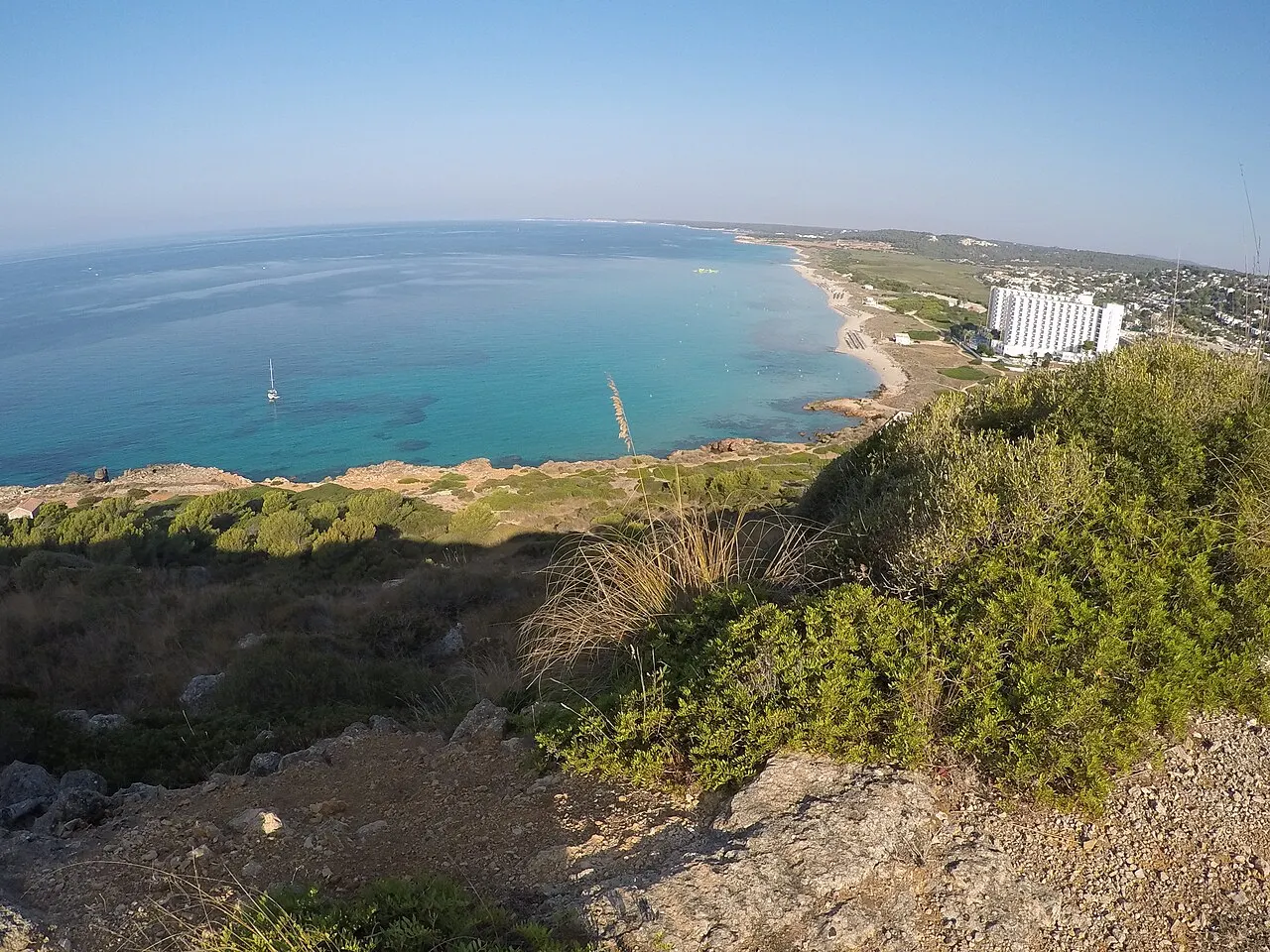
Some beaches you understand at a glance; others you have to walk from end to end to grasp. Son Bou, on the southern coast of the municipality of Alaior, belongs to the second group. At around 2,400 metres of sand —almost two and a half kilometres— it is the longest beach in Menorca, and that length is no idle tourist statistic: it is what allows the beach to be two things at once. In its central section, a full-service beach, with hotels, a lifeguard and the convenience of parking right by the sand. At its far ends, something much quieter and far older.
That dual nature is precisely what makes Son Bou interesting for anyone after judgement rather than just a postcard. Here you can start the day grabbing something at a beach bar with the family and end it walking west, leaving the parasols behind until the sand turns to dunes, the water is left to itself and, at the far end, the remains of a 5th-century basilica come into view. It is a beach that rewards the walker.
The essentials
- Where: the south coast of Menorca, municipality of Alaior. The central section sits next to the Son Bou hotel zone.
- Size: around 2,400 m (≈2.4 km), the longest beach on the island. It is not a cove but a continuous stretch of sand.
- Access in summer: you arrive by car and there is parking next to the hotel zone; cars are allowed. There is no driving restriction, but the car park fills up in August, so it pays to arrive early.
- Services: the central section is very touristy and well equipped —hotels, beach bars and a lifeguard. The ends, by contrast, have nothing at all.
- Two souls: a built-up, family-friendly centre; an untouched, naturist western end, with the small cove of Atalis and the low cliffs.
- Heritage: at the eastern end stand the remains of a 5th-century early-Christian basilica.
Getting there and parking
Son Bou is one of the large southern beaches with the best road access, and that shapes its character. From Alaior, a road drops straight down to the hotel zone, where there is parking beside the beach. Unlike many of the island’s coves —which force you to leave the car far off and walk— here you arrive practically at the edge of the sand in the central section.
The trade-off is the predictable one: in July and, above all, in August, the car park fills up early. The rule is the usual one in Menorca: arrive early or arrive late. First thing, you will find a space and the sand still calm; in the late afternoon, when many leave, you reclaim space and gain one of the best lights of the day. If you would rather not depend on the car or on luck with the parking, a private transfer sorts the day out with no stress.
When to go
Thanks to its size, Son Bou copes with the crowds better than almost any other beach in Menorca: even when the central section gets busy, there is always sand off to the sides. Even so, May, June and September are the ideal months —the water already mild, the light clean and the atmosphere uncrowded.
In the height of August, the trick is to play with the hours and the space. Early morning is for anyone who wants the beach serene; the middle of the day concentrates most people on the hotel stretch; and the afternoon, as people thin out, brings back the calm. And there is always the option of walking: the further you get from the centre towards the west, the more deserted the beach you find, in any month of the year.
What you’ll find: one beach, two worlds
The charm of Son Bou is walking it from end to end. The centre is comfortable, family Menorca: wide sand, shallow water that comes in slowly, beach bars, sun loungers and a lifeguard. Ideal for going with children or for an easy day.
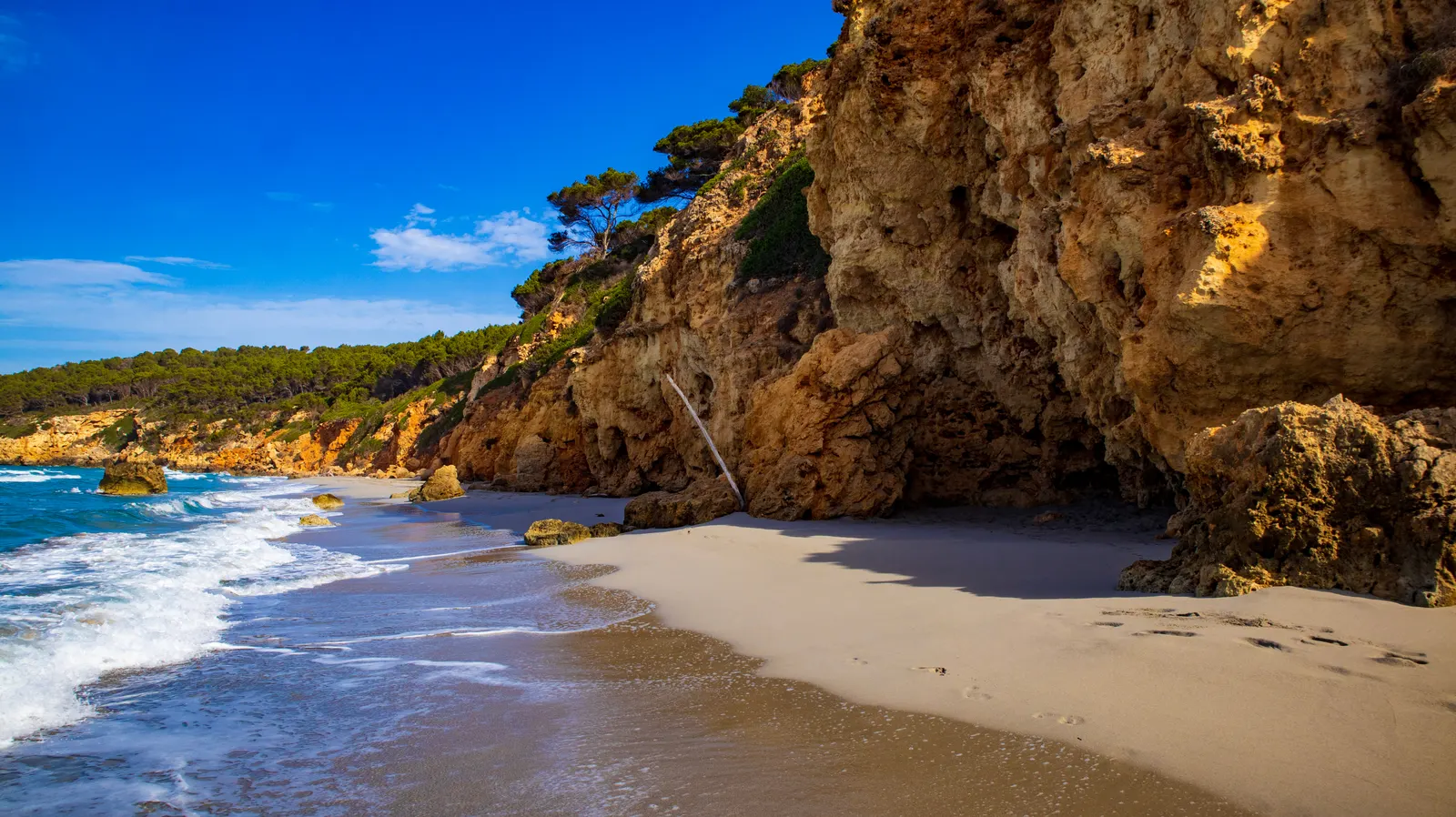
Towards the west, everything changes. The resort falls away, and dunes, low cliffs and an established naturist stretch appear, with the small cove of Atalis as the most sheltered nook. This is the untouched stretch of Son Bou, where the beach joins that of Binigaus and the landscape returns to its natural state. Just behind the dunes spreads the Prat de Son Bou, a protected wetland of some 80 hectares —reed beds, birds and fresh water— that is best admired from a distance and respected: it is one of the most valuable wetlands on the south of the island.
At the eastern end the historical surprise awaits: the remains of a 5th-century early-Christian basilica, with its three naves and a necropolis cut into the rock. It is not a Talayotic monument —that is another, far older layer of the island— but a testimony to early Christianity in Menorca, right by the beach and open to the sea. Seeing it at the end of a walk along the sand, with the Mediterranean behind it, is one of those scenes that make walking a whole beach worthwhile.
How to look after it
The fact that Son Bou is accessible and well served by amenities does not make it any less fragile. On the contrary: the pressure of visitors on a space that includes dunes, a protected wetland and an archaeological site demands care. The Prat de Son Bou is a delicate ecosystem; the dunes that separate the beach from the wetland hold the sand in place and are a habitat for wildlife, so it is best to walk along the marked paths and not cut across the vegetation.
At the basilica, the same applies: it is heritage, not a backdrop. And across the whole beach, the island’s golden rule —whatever comes in, leaves with you. Here, precisely because this is a beach with amenities, it is easy to relax and assume someone will clean up; but respect is proved exactly where it is most tempting to do without it.
How it fits into your island route
Son Bou works very well as one piece of a tour around the centre-south. Its municipality, Alaior, is worth a stop in its own right: it is the home of Mahón-Menorca DOP cheese and has a long shoemaking tradition, which we tell in Alaior, cheese and shoes. Very close by lies Es Migjorn Gran, the quietest village in the south and the gateway to ravines and untouched coves, as we cover in Es Migjorn Gran.
And if Son Bou has left you wanting more sand, it is worth putting it in context: it is the longest, but not the most hidden. To choose between beaches with amenities and coves you have to earn on foot, our guide to the best calas in Menorca helps you decide according to the day and how much you fancy walking.
Our take
Son Bou is the beach that best shows that in Menorca you don’t have to choose between comfort and authenticity: both fit on the same stretch of sand, separated by a walk. If you are going with children or want an easy day, stay in the centre and make the most of the amenities without a second thought. But don’t leave without walking: the real Son Bou is at its ends, where the 5th-century basilica looks out to sea in the east and the Binigaus dunes restore the silence in the west.
Our advice is simple: arrive early, set up base in the centre and save one of the two walks —to the naturist end and the dunes, or to the basilica— for the hours of best light. A beach almost two and a half kilometres long isn’t enjoyed lying down in the first gap you find; it’s enjoyed by walking it.