Few places in the Mediterranean pack so much prehistory per square kilometre as Menorca. The island is, in large part, an open-air museum: you walk between dry-stone walls, round a bend, and a tower raised three thousand years ago appears, planted in the landscape as if time had stopped. There are no theatrical fences and no queues. There is silence, wind and stone.
That Talayotic culture —which developed over more than a millennium during the Bronze and Iron Ages— has been a UNESCO World Heritage Site since September 2023, under the name Talayotic Menorca. This is no decorative title: it recognises a density and a state of preservation of megalithic monuments that is hard to match on such a small island.
Visiting it well is not a matter of seeing one site and leaving. It means understanding a way of inhabiting the land, reading a landscape and giving it the time it asks for. This is the Menorca the quick guide never tells you about: the one you walk slowly.
Key facts
- What it is: the megalithic remains of Menorca’s prehistoric communities, from the Bronze and Iron Ages.
- Recognition: a UNESCO World Heritage Site since 2023, as Talayotic Menorca.
- Three key structures: the navete (funerary), the talaiot (tower) and the taula (T-shaped sanctuary).
- The taula is unique in the world: nothing like it exists outside Menorca.
- Access: many sites are open-air; several are free or inexpensive to enter.
- Best time: early morning or sunset, with warm light and fewer people.
What exactly is the Talayotic culture?
We are talking about the societies that inhabited Menorca throughout recent prehistory, from the second millennium before our era until the arrival of Rome. The stage that gives the whole its name —the Talayotic period proper— is associated with the appearance of the talaiots, the great stone towers dotted across the island.
What is extraordinary is not only the age, but the density and variety. Within a few kilometres you find settlements, ritual enclosures, watchtowers and funerary monuments side by side. All of it built with the dry-stone technique, without mortar, fitting enormous blocks together with a precision that still surprises today.
The three structures to understand
Before setting off to see them, it helps to be clear about the difference between the three elements you will encounter most:
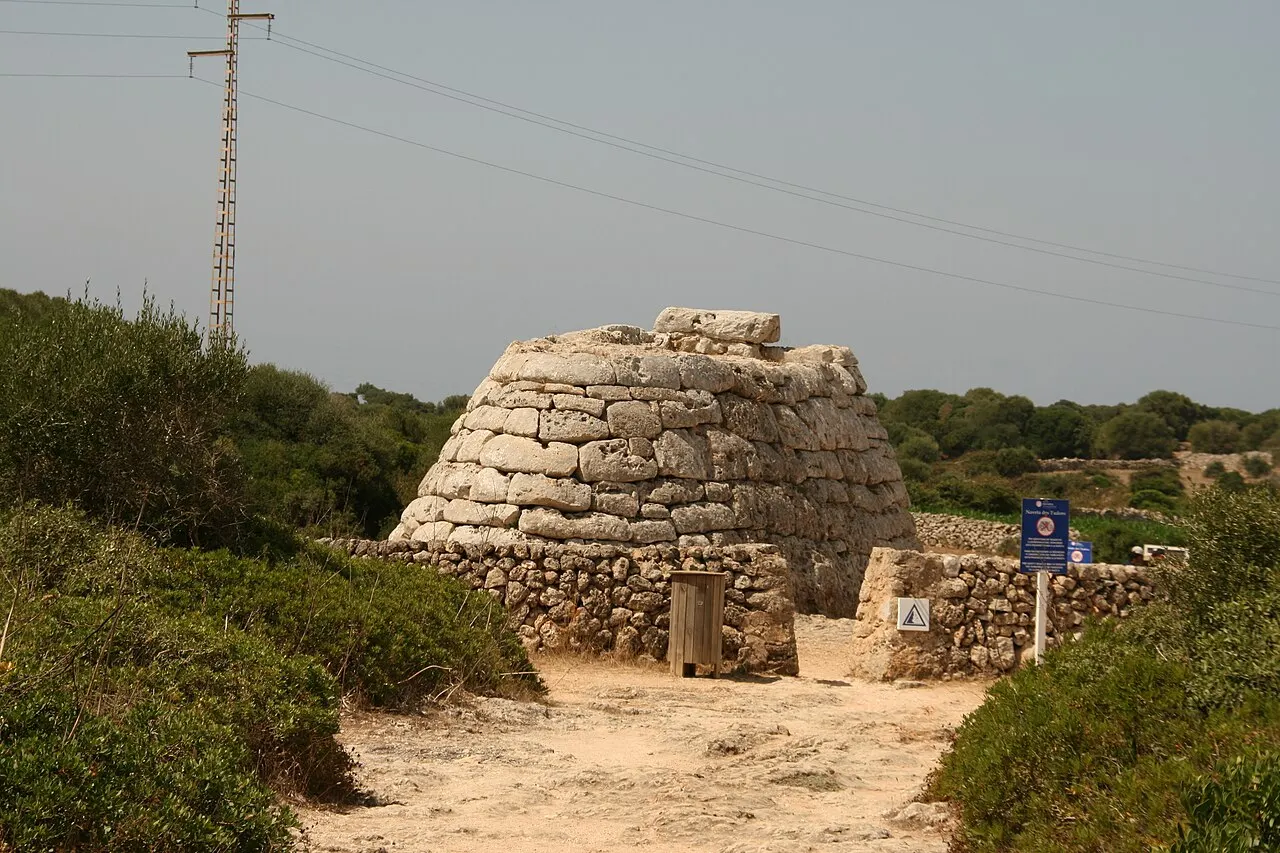
- Navetes: funerary monuments shaped like an upturned boat, where the remains of the community were laid. The Naveta des Tudons is the most famous and best preserved.
- Talaiots: truncated-cone stone towers that give the culture its name. Their exact function is debated —watching, gathering, a symbol of the community’s power— but they presided over the settlements.
- Taules: the most enigmatic. Two great stones forming a T, within an enclosure, unique in the world. Everything points to a ritual or religious use. No one knows for certain what was celebrated there, and that mystery is part of their power.
The Naveta des Tudons, the emblematic monument
If you can see only one thing, make it the Naveta des Tudons, near Ciutadella. It is one of the oldest megalithic monuments in Europe still standing, and is considered the most perfect of its kind on the island.
Its elongated form, like an overturned boat, leaves no one indifferent. It served as a collective ossuary: inside, the remains of dozens of people were found alongside their grave goods. It is fenced for protection, but you can walk around it in a few minutes. A local legend wraps it in charm —two giants in love with the same woman— which adds magic without taking anything away from what you see.
Which other sites deserve a stop
Beyond the navete, three groupings help tie it all together:
- Torre d’en Galmés: the largest Talayotic settlement on the island, in the south. Talaiots, a taula, dwellings and an ingenious water-collection system. Ideal for grasping how people lived.
- Trepucó: near Maó, with one of the largest and most photogenic taules, easy to combine with the city.
- Torralba d’en Salord: renowned for its imposing taula and enclosure, with good interpretive context.
To these you can add dozens of navetes, caves and smaller remains scattered across the territory, many beside footpaths or rural tracks, which appear almost by surprise.
When and how to visit
The secret lies in the light and the calm. Going at sunset or first thing makes the visit memorable: golden stone, long shadows and almost no one around. At the height of a summer midday the sun is punishing and the experience suffers.
A few practical suggestions:
- Closed footwear: the ground is uneven, with loose stone and low vegetation.
- Water and a hat: there is barely any shade at the open sites.
- Absolute respect: do not climb or move stones; these monuments have stood for millennia and must remain so.
- Times and tickets: some sites have opening hours and a ticket desk; check the latest information before you go, especially out of season.
How it fits into a trip of several days
The Talayotic combines beautifully with the rest of the island. A morning of sites calls afterwards for a quiet cove, an unhurried lunch or a stretch of the Camí de Cavalls, the coastal path of around 185 kilometres that rings Menorca. Prehistory and the sea are never far apart.
It also gains much when read alongside the island’s living culture: the Mahón-Menorca cheese with its PDO, Xoriguer gin and its pomada, the artisan trades. All part of one and the same story: a land that has known how to keep its identity.
Our take
Talayotic Menorca is not something you “see” — it is something you walk and listen to. Against the temptation to tick off four sites in a day, we prefer the opposite: choose two, go slowly, sit down, look at the landscape those communities chose, and let the place speak.
Begin with the Naveta des Tudons and a settlement such as Torre d’en Galmés, save sunset for whichever moved you most, and leave the rest for another trip. That is the quiet luxury of Menorca: having three thousand years of history all to yourself, in silence, with no one to hurry you.