Search for “things to do in Menorca” and you will find the same list a hundred times over: the three most photographed coves, a boat trip and little else. It is not untrue, but it is an island told in a hurry. The Menorca that deserves the journey — a Biosphere Reserve since 1993, living at a gentler pace than its Mediterranean neighbours — reveals itself when you change the question: not what must be seen, but how to live it slowly.
This guide is our answer. Twelve plans chosen with judgement, each with its why, its when and its how, written for the traveller who prefers space to crowds and time to a checklist. None demands showy luxury; most ask for precisely the opposite: rising early, walking a little, staying a while longer. That is the art of calm this magazine stands for.
All twelve work in 2026 and most of them work all 365 days of the year. Where an access is regulated in summer or an opening time shifts with the season, we say so. No filler: behind every plan sits a full guide of ours, linked for when you want to go deeper.
The essentials, at a glance
- The whole island is a Biosphere Reserve since 1993: protected landscape, an unhurried pace and plans for every month.
- Best season for almost everything: June and September; the month-by-month detail is in our guide on when to visit Menorca.
- The golden rule against the crowds: rise early (before 10 am) and choose, each day, the coast sheltered from the wind.
- On foot: the Camí de Cavalls (GR-223) rings the island: some 185 km in 20 stages, free and open to all.
- Culture: Talayotic Menorca has been a UNESCO World Heritage Site since 2023; many sites are open-air, free or inexpensive to enter.
- Practical note: several accesses (the southern coves, Favàritx…) are regulated in high season; check current information before you go.
1. Walk a stretch of the Camí de Cavalls
The Camí de Cavalls (GR-223) is the best way to understand Menorca: some 185 kilometres of historic path hugging the entire coastline, divided into 20 waymarked stages. There is no need to walk it all — hardly anyone does: a single half-day stretch is enough to discover the island you cannot see from the road. To begin, the walk from Cala Galdana towards Macarella and Macarelleta is one of the most beautiful coastal paths in the Mediterranean; the north, rougher-edged, rewards you with solitude and an almost lunar landscape. Spring and autumn are its finest seasons, and the path is public and free.
2. Choose your cove by the wind, and arrive early
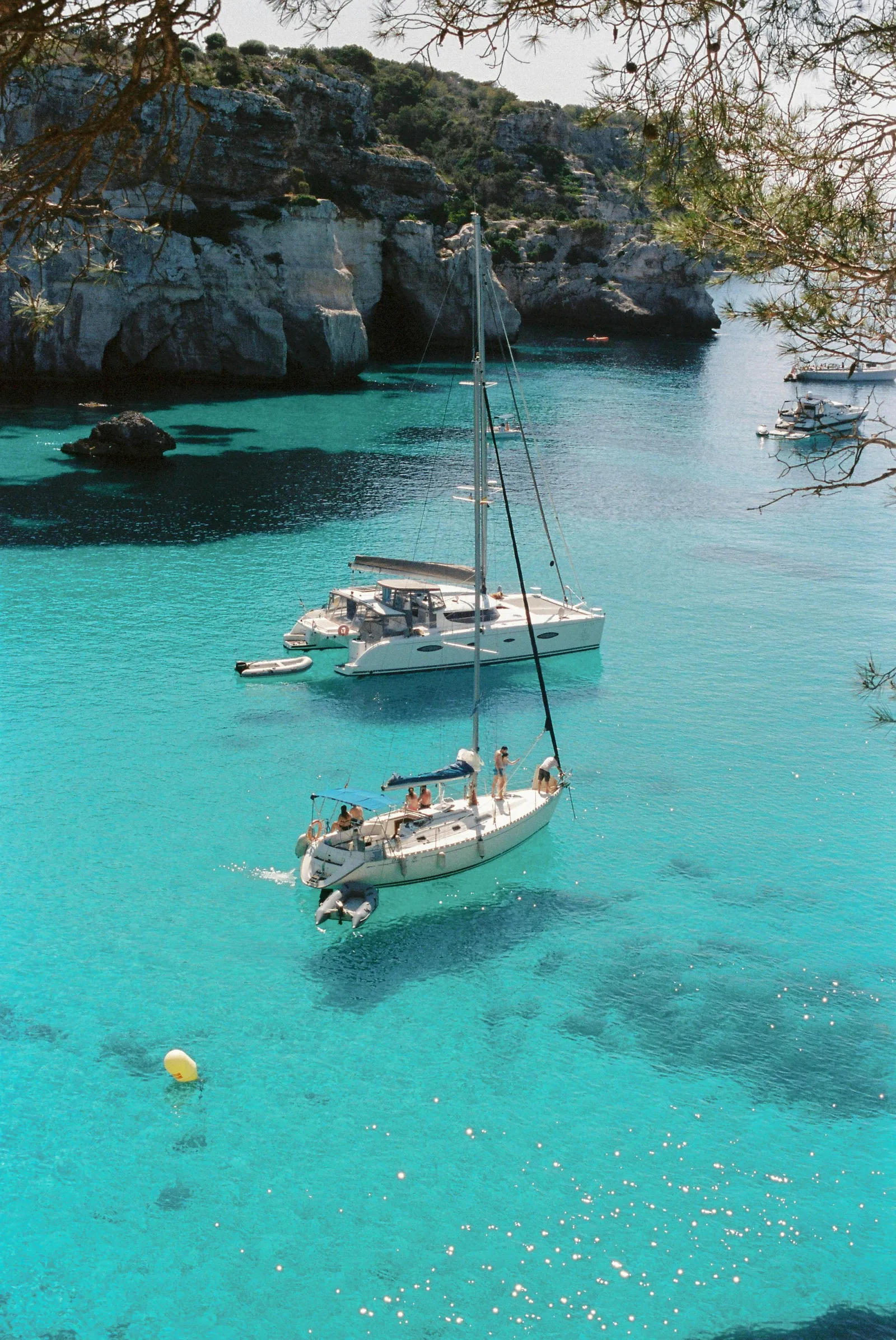
Menorca’s coves are the reason many people come, and the difference between savouring them and enduring them is method. First, the hour: before 10 am the sand is clear and the light is soft. Second, the wind: with the tramuntana, the south (Galdana, Macarella, Turqueta, Mitjana) lies calm while the north turns rough; with a southerly, it reverses. Reading the forecast and picking your coast is the trick that sets apart those who know the island; we have turned it into a daily tool: where the sea is calm. And in high summer, remember: several car accesses are restricted to protect the landscape.
3. See dawn at s’Albufera des Grau
The Parc Natural de s’Albufera des Grau is the core of the Biosphere Reserve: a brackish lagoon ringed by marshes, islets and pinewood in the island’s north-east. You do not come here to do anything spectacular; you come to walk slowly along signposted trails, to watch birds — the wetland is a refuge for resident and migratory species — and to listen to a Menorca in a low voice that hardly anyone knows. The first hour of the morning, with the light filtered and the park nearly empty, is its great moment. Check the visitor centre’s opening times, which vary with the season.
4. Go to where the island ends: the lighthouses
Menorca ends at its lighthouses, and visiting them is a way of touring the island by its extremes. The essential ones are five — Favàritx, Cap de Cavalleria, Punta Nati, Cap d’Artrutx and Illa de l’Aire — each with its own character: the black-slate, lunar-looking landscape of Favàritx, the vastness of the island’s northernmost cape, the bare stone of Punta Nati. You cannot enter the towers (they are still in service); what you visit is the very edge: wind, rock and horizon. Go at dawn or dusk, and in high season expect some accesses to be regulated. The full route is in our guide to the lighthouses of Menorca.
5. Touch four thousand years: Talayotic Menorca
Few places in the Mediterranean pack so much prehistory into each square kilometre. Talayotic Menorca has been a UNESCO World Heritage Site since 2023, and it is visited without queues or stagecraft: funerary navetas, talaiots and the enigmatic taules, unique in the world. If you can see only one thing, make it the Naveta des Tudons, near Ciutadella: one of the oldest megalithic monuments in Europe still standing. Many sites are open-air, free or inexpensive to enter, and they are at their best in the early morning or at dusk, when the stone glows and the sun no longer presses.
6. Descend into Líthica, the stone cathedral
A couple of kilometres from Ciutadella, the Pedreres de s’Hostal are former quarries of marès — the golden sandstone half the island was built with — rescued as a cultural space by the Líthica foundation since 1994. Two landscapes live inside: the gentle labyrinth of the hand-cut quarry, now threaded with gardens, and the sheer vertical pits of the machine era, as overwhelming as an inverted cathedral. There is a botanical garden, a maze and, in summer, concerts in the deepest quarry. Allow at least an hour and a half, and check current prices and opening times before you go.
7. Give a day to each capital: Ciutadella and Maó
They are different beauties, 45 minutes apart, and the island asks you to see them both. Ciutadella, the capital until the eighteenth century, keeps one of the loveliest historic centres in the Mediterranean: stately palaces, a Gothic cathedral and a harbour that turns honey-coloured by mid-afternoon. Maó unfolds its great natural harbour and the British air of the upper town. In both, the secret is the same: the first hour of the morning for the streets, the last of the evening for the harbour, and no hurry in between.
8. Binibèca Vell at first light
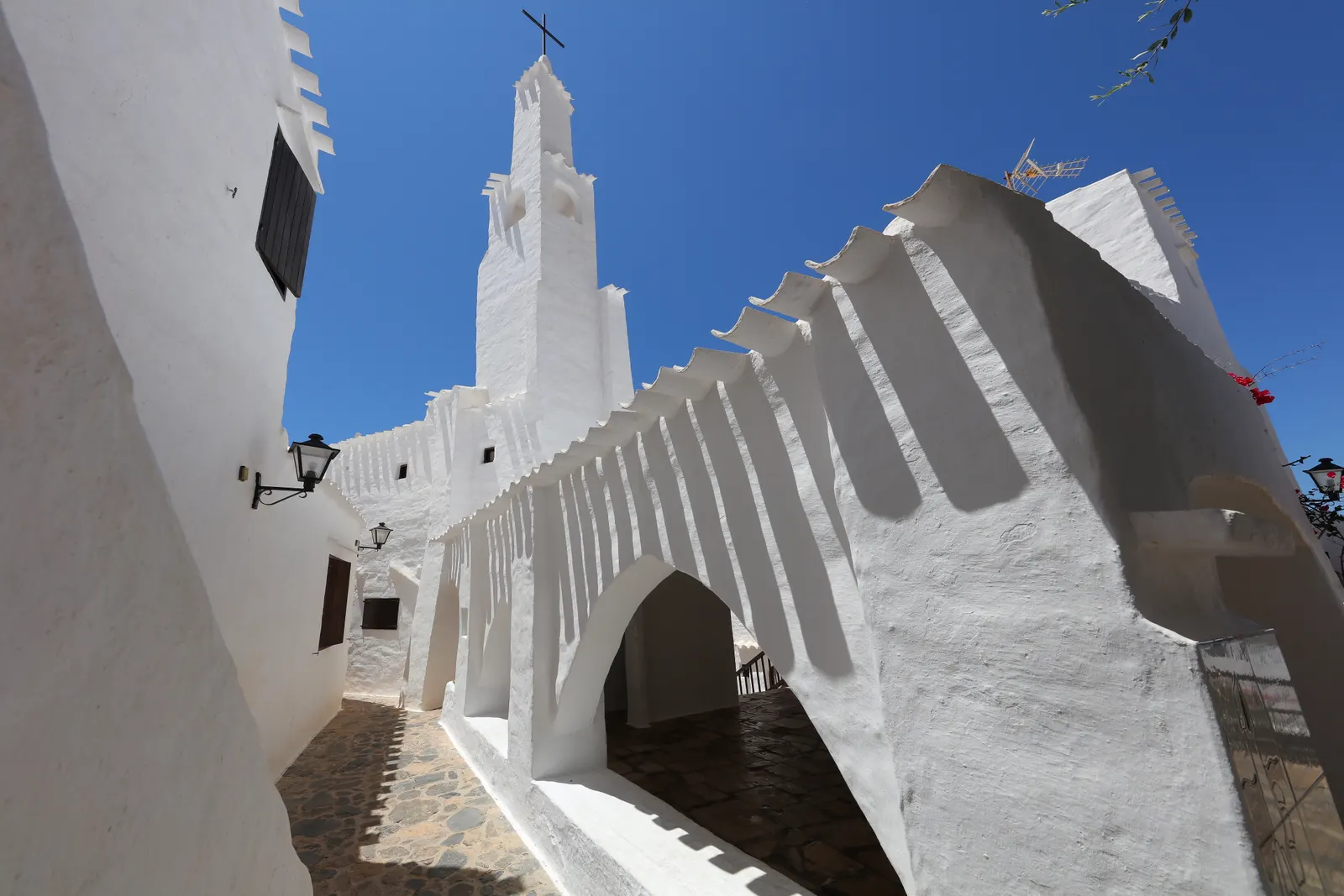
Binibèca Vell is not the old fishing village it appears to be: it is a development from around 1972 that recreates, with remarkable craft, Menorca’s white vernacular architecture. Knowing that takes nothing away, and visiting it well demands one thing only: the right hour. At dawn the maze of whitewash and shade is empty and the only sound is your own footsteps; between 11 am and 6 pm, above all in high summer, it fills up. It is a lived-in place — in 2024 residents asked for visiting hours to be limited — so walk quietly and respect courtyards and windows. An unhurried 45-60 minutes is enough.
9. Fornells: the sheltered bay and its lobster stew
On the north coast, Fornells is the seafaring Menorca that still smells of salt and slow cooking: white houses facing a sheltered bay more than three kilometres long, perfect for swimming in calm water or trying sailing, kayaking and paddleboarding. Above the village, the defence tower the British built in 1801-1802 watches over the mouth of the bay. And at the table, the reason for the pilgrimage: the lobster stew, considered the best on the island. In season, book well ahead; in spring and autumn, the village is serenity itself.
10. Taste Mahón-Menorca cheese where it is born
If Menorca had a flavour, it would be its Mahón-Menorca cheese, protected by a Denominación de Origen. You know it at a glance: a square shape with rounded corners — the legacy of the fogasser, the knotted cloth it is pressed in — and an orange rind, rubbed with oil and paprika. From young to aged, every maturity tells the same landscape: green pastures, dry-stone walls and a saline note gifted by the sea. Look for the “Artesano” mark if you want raw milk and traditional craft, and visit Alaior, its cheese capital, to understand it fully.
11. A sunset with no intermediaries on the west coast
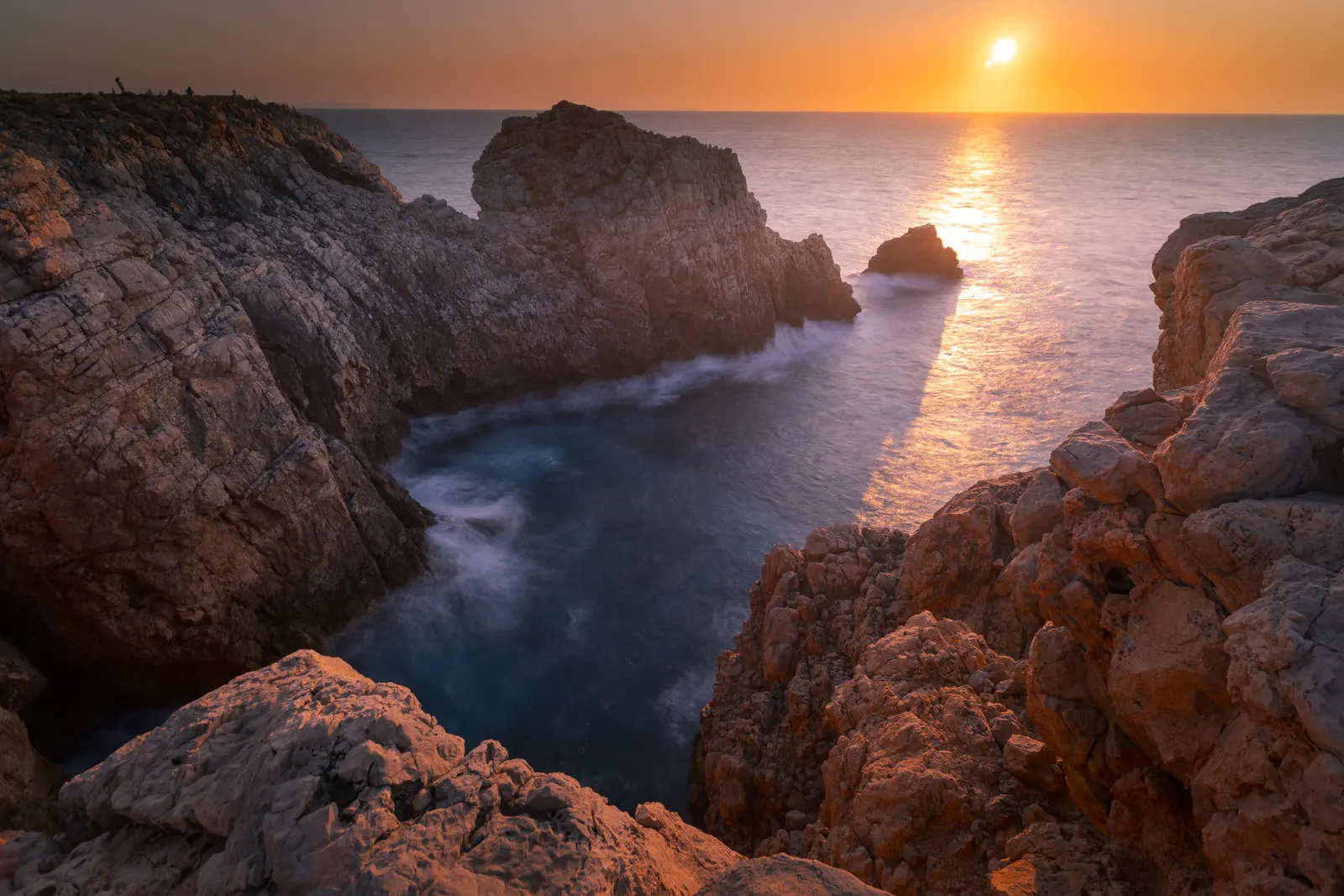
The island’s westernmost tip faces the setting sun head-on, with no land in between, which is why the Ciutadella area offers the cleanest sunsets: Punta Nati, austere and mineral; the Cap d’Artrutx lighthouse, with the disc dropping straight onto the water. Method matters: arrive 30-45 minutes before sundown and do not leave the moment the sun disappears — the blue hour that follows is often the most beautiful part. Our guide to Menorca’s sunsets walks through every viewpoint, and if you want to close the day with a quiet drink, we have mapped the places in sunsets and drinks.
12. The Cova d’en Xoroi, inside the cliff
To finish, the island’s most iconic sundowner. The Cova d’en Xoroi is a natural cave opening in the cliff face of Cala’n Porter, turned into a venue in 1964: a café with views by day, a bar and club by night, with terraces and lookouts at several heights leaning over the drop. You are not looking at the cliff: you are inside it, the sea beneath your feet and the sun going down straight ahead. On very clear days you can make out the silhouette of Mallorca on the horizon. It is a private venue with paid entry and seasonal hours; check prices and times before heading down.
How do you fit it all in without rushing?
Do not attempt all twelve in a week: choose. A good trip to Menorca combines a stretch of the Camí, two or three well-chosen coves, one capital, one dose of culture and one table worth remembering. If you want a proven structure, our guide to Menorca in 5 days orders the island without haste; if you would rather have a plan of your own, the trip planner builds one with you, around your days and your pace. And to know what is on while you are here — festivals, markets, concerts — the what’s on guide is always up to date.
Menorca’s luxury cannot be bought: it is the space, the time and the silence the island still grants to those who arrive calmly. If that is your way of travelling, join the Society: one serene letter, no noise, with what genuinely matters on the island.