Some places on Fuerteventura can be summed up in a word. The Barranco de las Peñitas is not one of them. It is a short walk, yes, but those couple of hours hold a dam that no longer holds water, a ravine of polished rock and the island’s deepest devotion.
Where it begins
In Vega de Río Palmas, a hamlet in the municipality of Betancuria, a few minutes’ drive from the old capital. The valley has more palms and more green than you would expect on Fuerteventura, because this is where the water from the hills runs down — when it rains.
The village is home to the sanctuary of the Virgen de la Peña, patron saint of Fuerteventura, built in the early 18th century. It is worth stepping inside before or after the walk: the gorge and the sanctuary tell the same story from two ends.
The dam that filled with earth
The path follows the riverbed down to the Las Peñitas dam, built to hold back the water of the island’s rare torrential rains. It did not work as planned: over the years, flash floods filled it with sediment, and today it is practically empty of water. What remains is a strange and beautiful image — a dam wall with a flat expanse of earth behind it, sometimes with a little vegetation, in the middle of an island that lives in constant anticipation of rain.
The ravine and the chapel
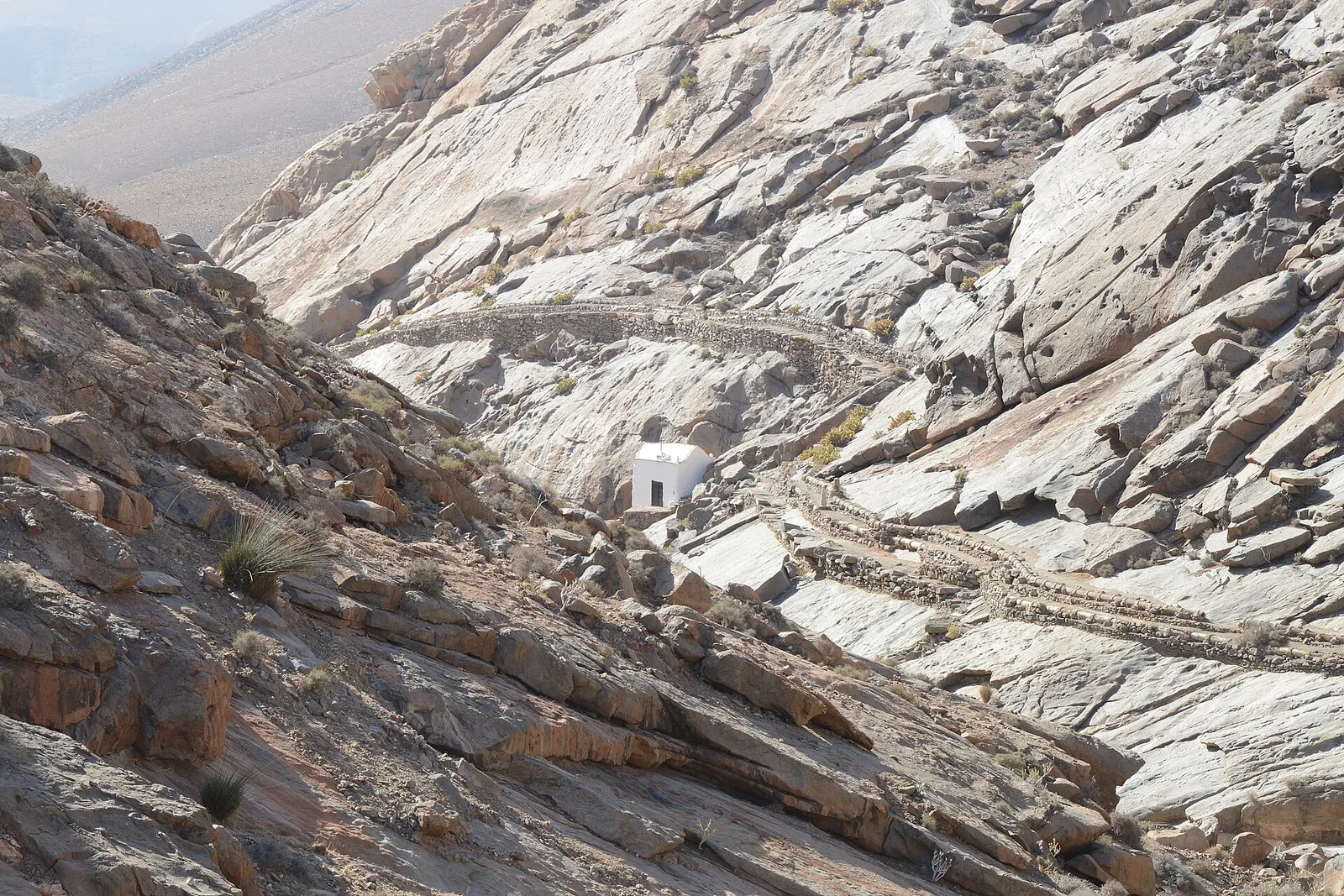
Beyond the dam, the gorge narrows between walls of rock. It is the most beautiful stretch and the most delicate: smooth stone polished by water, and steps where you need to watch your footing. Tucked against the rock stands the small chapel linked to the Virgen de la Peña, white and tiny against the face of the ravine. Tradition places the apparition of the image here, in this gorge.
If the chapel is open, go in quietly. It is a place of worship, not a backdrop.
The Virgen de la Peña and her pilgrimage
Every September, the island’s patron saint draws thousands of people to Vega de Río Palmas. Her romería-ofrenda — a pilgrimage with offerings — is one of the most deeply rooted dates in the local calendar, and many people arrive on foot from across the island. If you happen to be here then, the valley is transformed: more life, more people, a different rhythm. If you want the gorge in peace, avoid those days; if you want to see the island as it really is, come precisely then, respectfully. The Cabildo publishes the programme each year: check it beforehand.
The practical part, plainly
- Distance and time. Sources disagree on the distance, depending on where they start counting. Allow a couple of hours there and back without hurrying.
- Difficulty. Easy to moderate, with slippery sections on polished rock. Wear shoes with a good grip.
- No shade, no water. Neither along the entire route. Set off early or late in the afternoon, carry more water than you think you need, and skip it on very hot days or when the calima — the dust-laden wind from Africa — sets in.
- Within a protected area. The gorge is part of the Betancuria Rural Park: stay on the path, do not build stone cairns, do not fly drones and do not take rocks away.
Information as of October 2026. Trail conditions change after rain: if there are closure or rockfall notices, respect them.
Our view
Las Peñitas is a small walk with a great deal behind it. Go early, before the sun reaches into the ravine, and on the way back give yourself time to sit in the village sanctuary. If you stay the night nearby, the island’s interior is also one of the best places to look up at the sky. And if you carry on to the coast, Ajuy is just a few kilometres away.