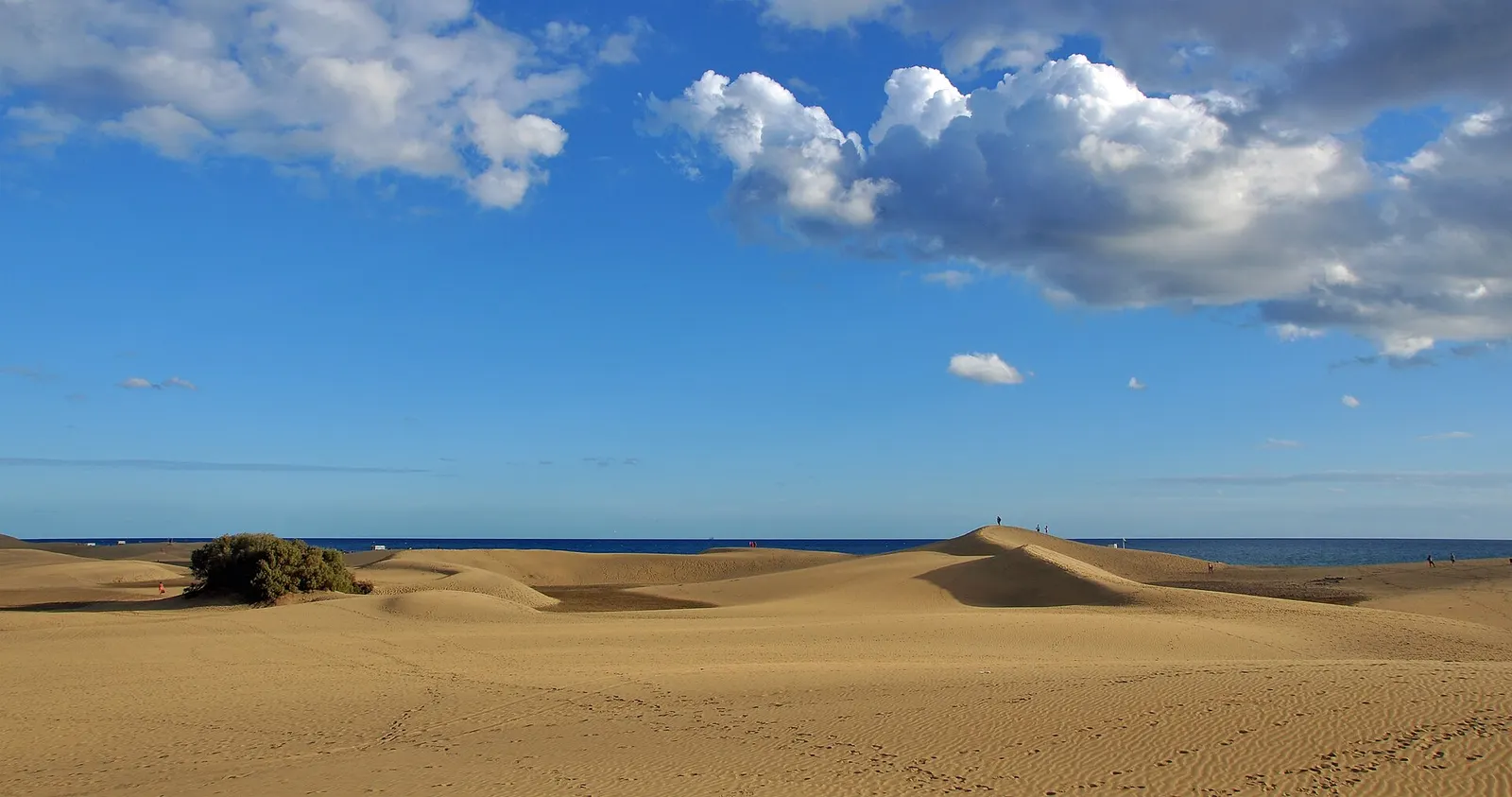
From the air they look like a small desert dropped at the edge of the Atlantic. From inside, early in the morning, they are something else: a landscape that moves, remade by the wind every night, holding a lagoon, a palm grove and a colony of birds a short walk from the hotels of the south. The Maspalomas dunes are Gran Canaria’s most reproduced postcard. They are also one of its most fragile places.
The essentials
- The dunes are a Special Nature Reserve. They may be walked only on the waymarked trails: around 8 km lined with wooden bollards.
- Do not enter fenced or restricted areas, do not build stone windbreaks or shelters, do not take sand away and do not fly drones.
- The right hour is sunrise: low light, cool sand and almost no one about.
- Information as of October 2026; the rules of use are set by the Cabildo de Gran Canaria.
A landscape in motion
The dune field occupies the southern tip of the island, between Playa del Inglés and the Maspalomas lighthouse. The sand advances with the wind and the ridges change shape from one week to the next. On its western edge, the Charca de Maspalomas — a small lagoon beside the palm grove — is a refuge for migrating birds.
What visitors see as scenery is in fact a living, vulnerable system: thousands of people stepping off the paths break the plants that hold the sand in place and disturb the way it moves. That is why the reserve has for years been managed under a master plan, with marked trails and patrols.
The marked path
The public trails — around 8 km — are marked by some 1,500 wooden bollards. Beyond them lie the restricted areas, some fenced off so that the vegetation and the dunes themselves can recover. Leaving the trail is not a minor slip: it is prohibited, and in 2026 the Cabildo stepped up patrols with environmental officers, supported by the police and the Guardia Civil.
Three habits best left at home:
- Stone windbreaks and shelters. Piling up stones against the wind looks harmless; it is prohibited and damages the ground.
- Cutting across the dunes. The photograph from an untouched ridge leaves footprints the wind does not always erase in time, and the roots that hold the sand give way.
- Taking sand home as a souvenir.
The right hour
At sunrise the dunes have the colour of damp sand, the wind is still asleep and the silence is almost complete. This is when the place makes sense: long shadows, crisp ridges, tracks of small animals that no one has yet trodden over. The last hour of the afternoon brings similar light, with more people.
At midday, by contrast, the sand burns, the light flattens everything and the glare tires the eyes. Bring water, shoes that do not mind sand, and sun protection even under cloud: the sand throws the sun back at you.
Understanding them better
The Cabildo periodically runs interpreted walks on the reserve’s geology and wildlife; there is no fixed calendar, so check its official channels before you go. A slow stroll afterwards along the edge of the Charca, binoculars in hand, rounds off the morning without setting foot where you should not.
Who it is for
For anyone staying in the south who wants to see the place before it fills up: all it takes is an early start. If you are looking for somewhere calm to stay nearby, see our selection of luxury hotels in Gran Canaria. For the southern coast from another angle, Gran Canaria from the water; and for other images of the island without the crowds, our postcards without people. In winter, when the light softens, the dunes change again: we cover that in Gran Canaria in winter.
Our approach
We recommend this visit only within the reserve’s rules. Access information as of October 2026; before you go, check the current guidance from the Cabildo de Gran Canaria.