Mallorca’s famous places are famous for a reason, and it is not marketing: they really are extraordinary. The problem is not the place. It is the time of day.
The shuttle bus up to the Formentor lighthouse made 398,859 trips between May and October 2025, a record for the service. At the Caló des Moro, a cove with around twenty metres of sand, the local press has counted up to 4,000 people a day in high season. The cathedral passed 1.2 million visitors in 2025. None of those numbers is there at eight in the morning.
Each of these postcard views has its key: an hour, a day of the year or a door almost nobody uses. Here they are, with access checked for 2026.
The essentials
- Formentor: the road closes to private cars from 10am to 10pm, 15 May to 18 October. Before 10am, you can drive up.
- Caló des Moro: first thing in the morning, or outside July and August.
- Es Trenc: first thing; failing that, Es Caragol, on foot from the ses Salines lighthouse.
- The cathedral: on 11 November, at 8am, the rose window traces its figure of eight in light.
- Caves of Drach: the first tour of the day.
- Mondragó: out of season, with free parking.
Formentor: the road closes at ten
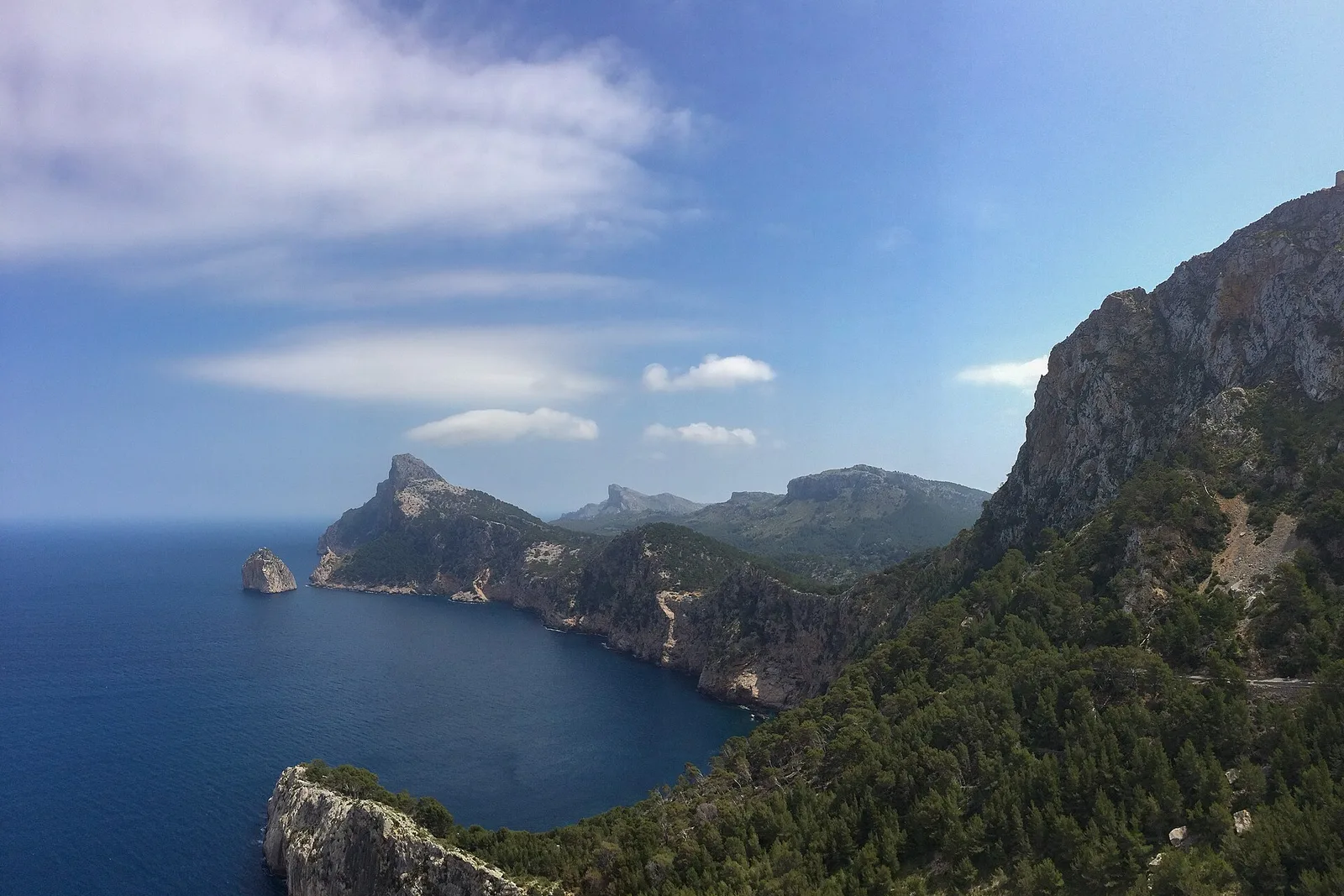
The far end of the Serra de Tramuntana is a twenty-kilometre peninsula hanging over the sea, and its road —with the mirador des Colomer, the beach and the lighthouse at the far end— is one of the most photographed on the island. That is why it has opening hours.
In 2026, according to the DGT, private-car access is closed from 15 May to 18 October, 10am to 10pm. During those hours, only the TIB shuttle bus (line 334, which stops at the viewpoint, the beach and the lighthouse), bicycles, vehicles for people with reduced mobility and emergency services get through. Taxis and private hire cars can enter, but only as far as Formentor beach, not the lighthouse. Last summer, 2,314 fines were issued to those who tried anyway.
The key is simple: before 10am there is no restriction. Driving up to Cap de Formentor at eight, with the low light raking across the cliffs and the road to yourself, is a different trip altogether. From 19 October it is open all day again.

Caló des Moro: the cove social media filled
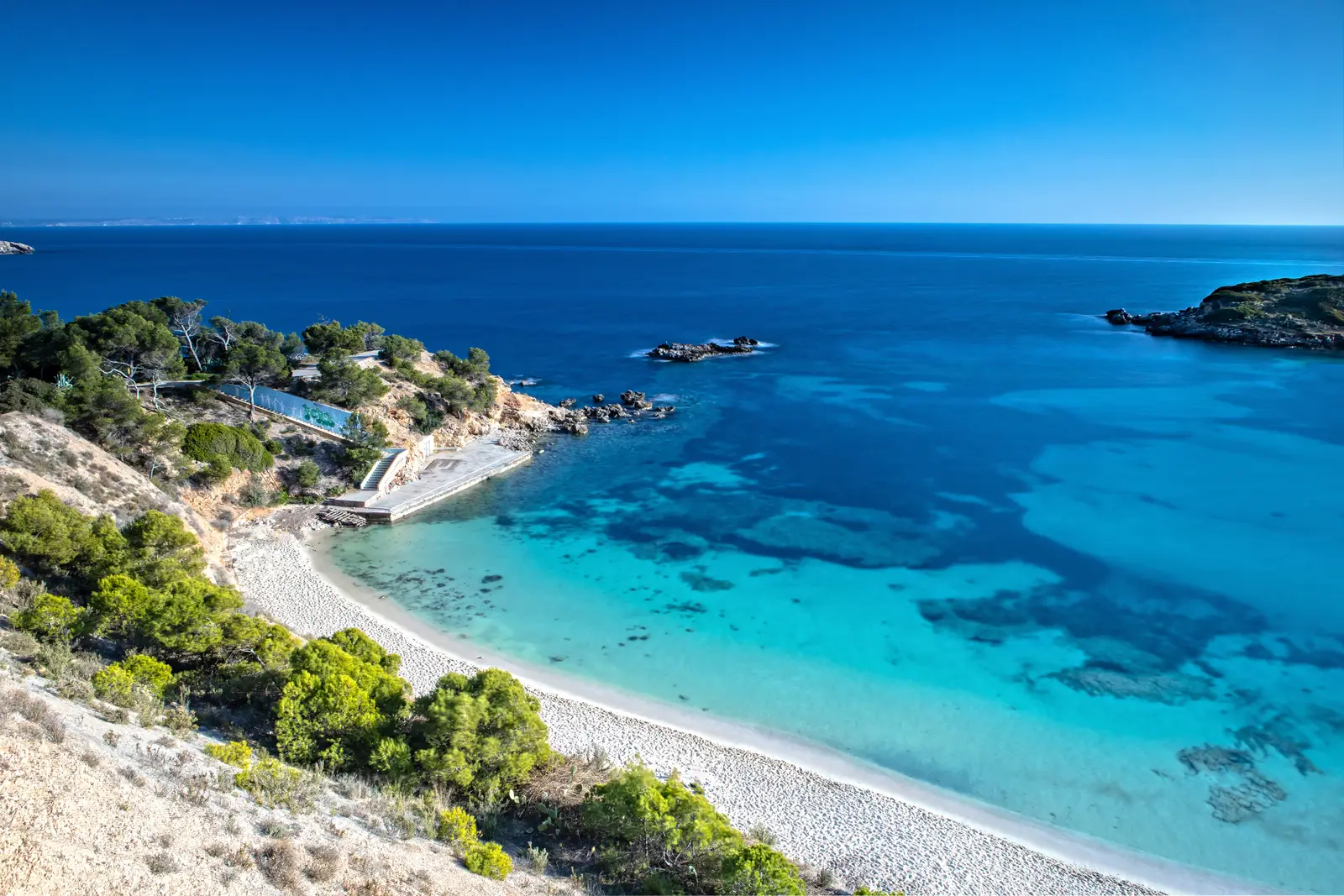
It is a narrow inlet of turquoise water between walls of rock and pine, on the Santanyí coast, and probably the most photographed cove on Mallorca. The local press has published figures this year that explain the rest: up to 4,000 people a day in high season and around 70 kilos of sand lost every day. That sand, quite simply, leaves stuck to people.
There is no official capacity limit —the figure of “a hundred people” doing the rounds is a press estimate, not a rule— so the only way to see it as in the photo above is to arrive first thing or go outside July and August. You park in Es Llombards and walk down.

Let’s be honest: in August there is no on-foot “same cove with fewer people” nearby. What there is, is the sea. From a boat, the Santanyí coast can be explored without parking and without climbing down steps, and the Caló des Moro is seen from the water — the angle almost nobody gets.
Es Trenc: the park that fills up by its car park
Es Trenc is the long beach of the south: kilometres of pale sand with no buildings behind it, protected as the Es Trenc-Salobrar de Campos Maritime-Terrestrial Nature Park. Precisely because it has no road in front, it fills from behind: its na Tirapel and sa Barralina car parks charge a fee in season and, since summer 2025, have sensors that announce on display boards when they are full.
First thing, then. And if not, the alternative is Es Caragol: a beach with no road, by the Cap de ses Salines, about two kilometres on foot from the lighthouse. It has no facilities or shade, and that filters out a lot of people. Water, proper footwear, and the day is yours.
Cala Mondragó: the nature park out of season
The Mondragó nature park has protected two pale-sand coves with pine woods down to the water since 1992. In summer, its two public car parks —Ses Fonts de n’Alis and s’Amarador— have seasonal management; out of season they are free, and the park is a different place. Inside, drones are banned and dogs must be kept on a lead and off the beaches.
The cathedral: the figure of eight in light on 11 November
The Mallorca cathedral, known locally as La Seu, keeps one of the loveliest dates on the Balearic calendar, and it is free. Two mornings a year, on 2 February and 11 November, the sun enters through the great rose window —11.85 metres across, with 1,115 pieces of glass— and casts its light exactly beneath the rose window of the inner façade. The two circles overlap: it is the “vuit de la Seu”, the figure of eight in light.
On those days the cathedral opens its doors at 8am. The next date is Wednesday 11 November 2026. There is no better way to walk into the island’s most visited monument: first thing, in silence, and to see something that happens only twice a year.

Caves of Drach: the first tour of the day
The Caves of Drach, in Porto Cristo, end their 1,200-metre route beside Lake Martel, 117 metres long, where a classical music concert has been held on the water since 1935. Tickets are for a set time and booked online: the first tour of the morning has the fewest people around it.
When calm is something you buy
What all these keys have in common is that they require being nearby at the right hour. And that is decided when you choose where to sleep:
- The north (Port de Pollença and Alcúdia), for driving up to Formentor before ten.
- The southeast (Santanyí, Ses Salines, Colònia de Sant Jordi), for the Caló des Moro, Mondragó and Es Trenc first thing.
- The Serra, for the viewpoints at sunset: see Serra de Tramuntana in a day.
The houses worth the trip in each area are in our guide to quiet luxury hotels in Mallorca. If you’re arriving by plane and want to start the trip without a car, from Palma airport to your hotel covers every transfer option. And if you prefer the sea, the coves you can only reach by boat are the other way to avoid the queue.
If what you’re after is not the famous view but what almost nobody sees, carry on to three nights in Mallorca almost nobody knows you can book.
Our view
None of these places needs us to discover it: everybody already knows them. What is worth telling is that the same postcard view changes completely depending on the hour. At eight, Formentor is an empty road above the sea; at midday, a queue. The Caló des Moro of the cover photograph exists, but it lasts about an hour.
Luxury, here, is not an exclusive place. It is arriving first.
Access details and dates checked on 22 September 2026 with the DGT, the Govern balear, Palma Cathedral’s website and the local press. Restrictions change every season: check them before you go.