Tenerife has two calendars. One is the tourist season, which barely changes all year because neither does the weather. The other is its festivals, and that is the one that truly marks the passing months for those who live here. Attending one is the most direct way to see the island from the inside.
This is not a listings page with fixed dates. It is the calendar that repeats year after year, with what you need to know to arrive at the right moment and behave as a guest.
The essentials
- February or March: the Santa Cruz Carnival, the capital’s great festival.
- Between late May and late June: the Corpus Christi carpets in La Orotava.
- July: the Romería de San Benito Abad, in La Laguna.
- 14 and 15 August: the pilgrimage and feast of the patron saint of the Canaries, in Candelaria.
- All year round: patron saint festivities in every town, almost always with mass, procession, an open-air dance and, in many, a romería.
The Santa Cruz Carnival
It is the island’s best-known festival and one of the best known in Spain: it has been a Festival of International Tourist Interest since 1980. For days the capital fills with murgas, comparsas, contests and street dancing. Because it depends on Lent, the date changes every year: it usually falls in February or early March. Carnival Tuesday is a local holiday and the day of the Coso, the great parade.
It is not a quiet festival, and we do not pretend otherwise. If it appeals, book accommodation well ahead and choose your days: the contests and galas are better seen than the street at midnight.
The carpets of La Orotava
The opposite of Carnival: silence, patience and craftsmanship. For the Infraoctava of Corpus Christi, the town of La Orotava covers its streets with flower carpets and its Plaza del Ayuntamiento with a great tapestry of volcanic sands from Teide, which the procession walks over. It is a movable feast and usually falls between late May and late June. The town’s patron saint festivities also include a romería and a baile de magos. We tell the full story in the carpets of La Orotava.
The Romería de San Benito Abad
In La Laguna, the Romería Regional de San Benito Abad is usually held on the second Sunday of July. It is regarded as the only regional romería in the Canaries, and in 2026 it reached its eightieth edition. Dozens of decorated carts accompany the saint through the streets of this World Heritage town, with traditional music groups and thousands of people dressed as magos, in Canarian peasant costume.
The San Benito festivities also include the Baile de Magos, a vast open-air dance in traditional dress. To understand the town where it all happens, start with La Laguna, the city without walls.
The pilgrimage to Candelaria
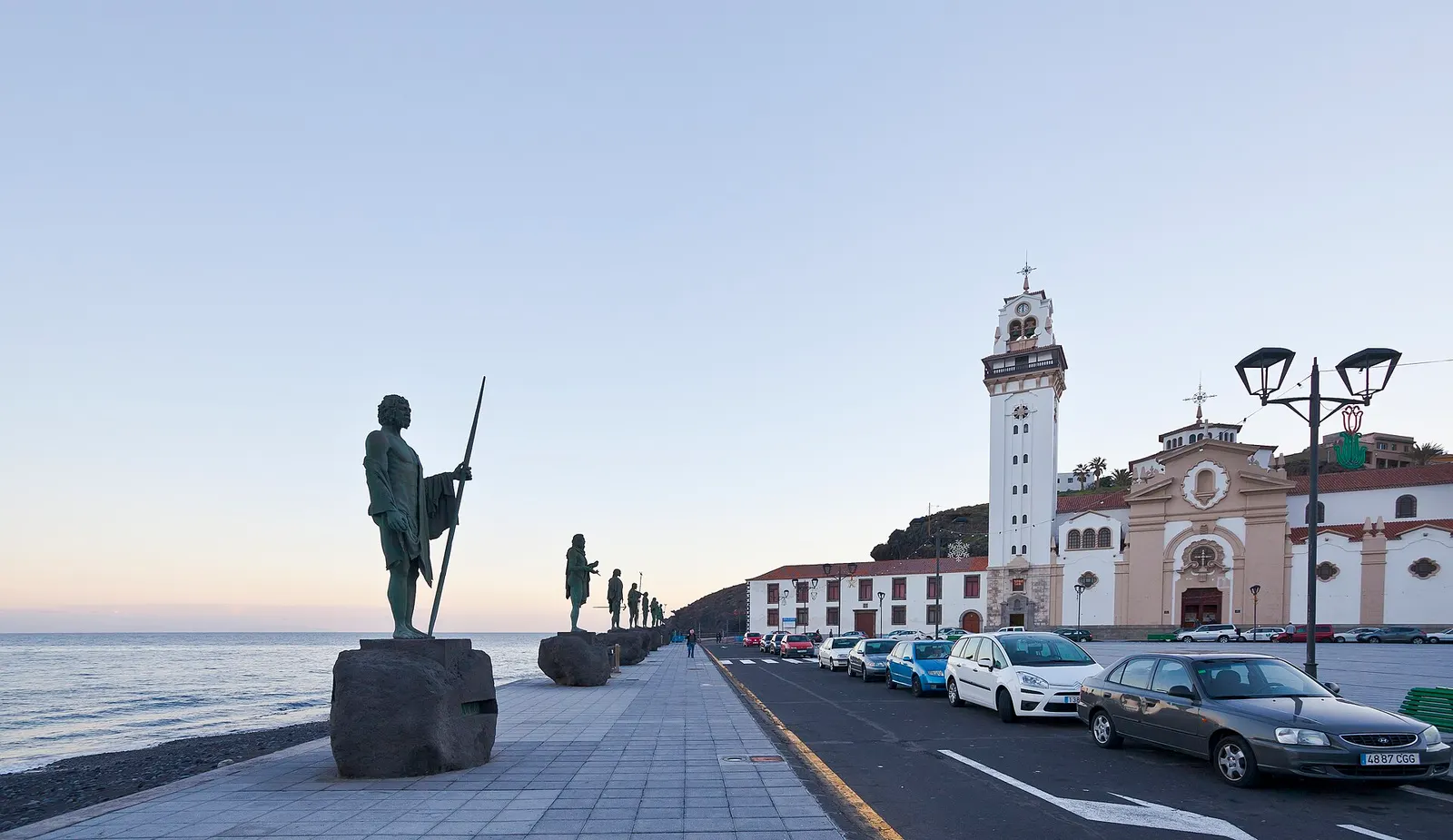
On the night of 14 to 15 August, thousands of people walk from every corner of Tenerife to the basilica of Candelaria, where the patron saint of the Canary Islands is venerated. It is the island’s largest expression of faith. On 2 February the feast of Candelaria is also celebrated. Outside those dates, the square of the menceyes is one of the most serene places on the island: we describe it in Candelaria, facing the nine menceyes.
How to attend as a guest
- The festivals belong to the locals. You go to watch, to accompany and, if invited, to dance. Not to take over.
- The mago costume is not fancy dress. If you want to wear it, do it properly or borrow it from someone who knows how; otherwise, simple clothes.
- At processions and masses, silence and distance. Photographs without flash and without blocking the way.
- What is offered from the carts is hospitality, not a service: be grateful and do not take advantage.
- Use public transport or leave the car well away. Road closures are common and parking nearby is almost impossible.
How the buses and tram work, in getting around Tenerife.
Our approach
We give the calendar that repeats according to tradition or the liturgical year, not the dates of a specific edition, because they change every year. Before travelling, check the official programme of each town hall (information as of October 2026).