Most of what is told about Tenerife begins in 1496, when the Castilian conquest ended. Candelaria is one of the few places on the island where the story begins earlier, and where its two halves — the Guanche one and the one that came after — share the same square.
The patron saint of the Canary Islands
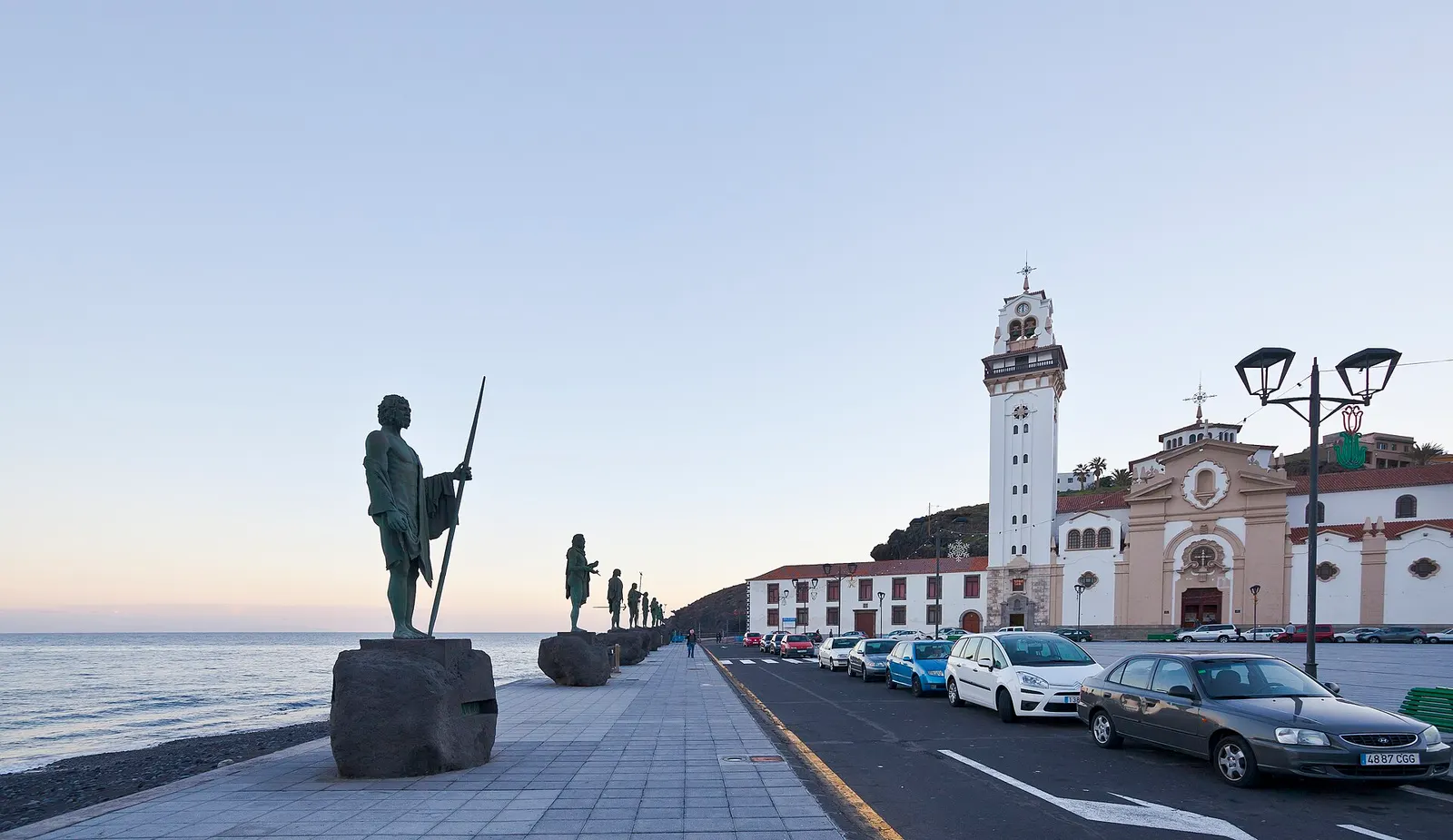
In Candelaria, on the island’s east coast south of Santa Cruz, stands the Basilica of Nuestra Señora de la Candelaria, the Virgin who is patron saint of the Canary Islands. It is the archipelago’s principal place of worship and one of the most visited sites on Tenerife.
According to tradition, the image was found by two Guanche shepherds before the Castilians arrived. Sources disagree on the year, so we do not give one; what matters is what the story says: that Marian devotion in the Canaries has an origin that islanders themselves place in the aboriginal world, not in that of the conquerors. It is a traditional account, not a documented fact, and it is best read that way.
The present basilica is modern: building began in 1949 and was completed at the end of the 1950s. What makes it special is not the architecture but what it means to those who walk in.
The square and the nine menceyes
In front of the basilica opens the Plaza de la Patrona de Canarias, inaugurated in 1959, wide and open to the sea. Along the promenade stand nine bronze statues: the menceyes, kings of the nine menceyatos into which Tenerife was divided when the Castilians arrived.
The current sculptures are by José Abad and were unveiled in 1993. They replaced earlier figures carved in volcanic stone, which were moved to another avenue in town. The ensemble speaks for itself: it is a tribute to those who ruled the island before 1496, set in the same space as the devotion that came with the conquest.
Standing before them with the sea to one side, on a morning with no one around, is one of the most serene ways to understand Tenerife.
When to go
There are two great dates. 2 February, Candlemas, and above all 15 August, the great feast of the patron saint. On the eve, the night of 14 to 15 August, thousands of people walk to the basilica from all over the island. It is one of the most deeply rooted traditions in the Canaries and part of Tenerife’s festivals worth knowing, but it is not a time for calm: it is a time of crowds and devotion.
To see Candelaria as we describe it here, come on any other day, ideally midweek and early. The square is then almost silent, with the sound of the sea and little else.
Visiting respectfully
The basilica is a working church: there are masses and people at prayer. Enter quietly, dress appropriately and avoid taking photographs during services. Opening hours may change, so check before you go (information as of October 2026).
Getting there
Candelaria is on the east coast, a short drive from Santa Cruz along the southern motorway. A car is easiest; TITSA buses also run here, and their timetables are worth checking on their website or app.
Further reading
The Tenerife that came after the menceyes makes sense on a walk through La Laguna, the city without walls, founded after the conquest. And to see how the island has lived with its own geography, Garachico, the port the volcano took.
Our approach
The dates of the basilica, the square and the sculptures come from public sources and the island’s official tourism guides. The date of the image’s discovery varies between sources and belongs to tradition, so we do not present it as fact.