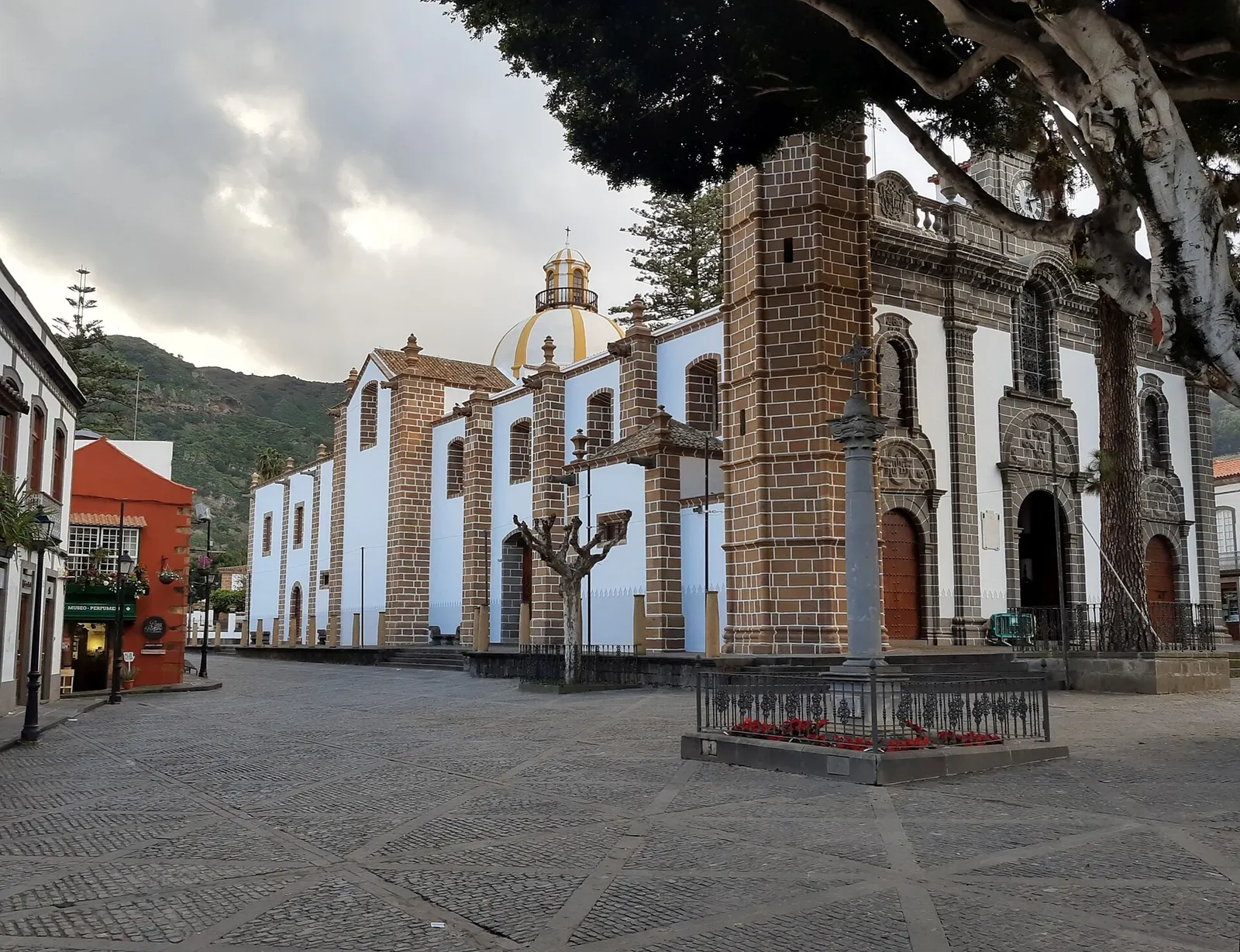
Some towns you visit; others you go to. Teror is one of the latter. For more than five centuries, the people of Gran Canaria have travelled up to this town in the northern midlands to see their patron saint, the Virgen del Pino — the Virgin of the Pine — and that habit has left a mark you can see in every street: grand houses, carved wooden balconies and a basilica presiding over it all from the square.
Visited on an ordinary Tuesday, unhurried, it is one of the most serene places on the island.
The essentials
- The patron saint: the Virgen del Pino is patron of Gran Canaria and of the Diocese of the Canaries; tradition places her apparition in 1481, on a pine tree.
- The basilica: a church from the second half of the 18th century, with an older tower showing Gothic and Renaissance features; declared a historic-artistic monument in 1976, today a Bien de Interés Cultural, Spain’s highest heritage protection.
- The old town: declared a historic-artistic ensemble in 1979.
- The balconies: manor houses, some from the 16th century, with carved wood and stone balconies on the square and Calle Real.
- The festival: 8 September, Gran Canaria’s main festival, of National Tourist Interest; on the eve, the 7th, the pilgrimage and offering.
Calle Real and its balconies
Teror makes sense on foot. Calle Real climbs towards the basilica between manor houses, many with their Canarian balcony: a carved wooden gallery projecting from the façade, designed for seeing without being seen and for shading the house. Some of these houses date from the 16th century; others from the centuries after, but all keep the same proportions, which is what makes the whole so coherent.
Look up: the best details are in the brackets, the turned balusters and the latticework. And look at the stone too, the dressed masonry framing doors and windows.
The Basilica del Pino
The Basílica de Nuestra Señora del Pino dates from the second half of the 18th century, but its tower is older and keeps Gothic and Renaissance features from the earlier church. It was declared a national historic-artistic monument in 1976 and is today a Bien de Interés Cultural.
Inside is the image of the Virgin, the centre of everything. Enter quietly, as in any working place of worship, and respect mass times. Outside, the square is the place to sit and watch the town go by.
8 September
Once a year, Teror stops being a quiet town. The Fiestas del Pino are Gran Canaria’s main festival and are declared of National Tourist Interest. The great day is 8 September, and on the eve, the 7th, comes the romería-ofrenda, the pilgrimage and offering to the Virgin.
It is worth seeing once, but it is not a quiet day: crowds, closed streets and a town given over to its festival. If you are looking for serene Teror, come another day. If you want to understand what this Virgin means to the island, come then.
How to plan the visit
- Come on a weekday morning. The town takes a couple of hours on foot, and morning light suits the façades.
- In September, check first. There are road closures during the festival; see Teror town council’s programme.
- Dress respectfully if you go into the basilica.
- Stay for lunch in the town or the northern midlands: what is cooked here is in eating in Gran Canaria, and the cheese from the neighbouring district in Flor de Guía cheese.
Our view
Teror is proof that in Gran Canaria calm is not only found by the sea. It is in a street in the midlands, in the shade of a wooden balcony, on an ordinary day when the town belongs only to those who live there.