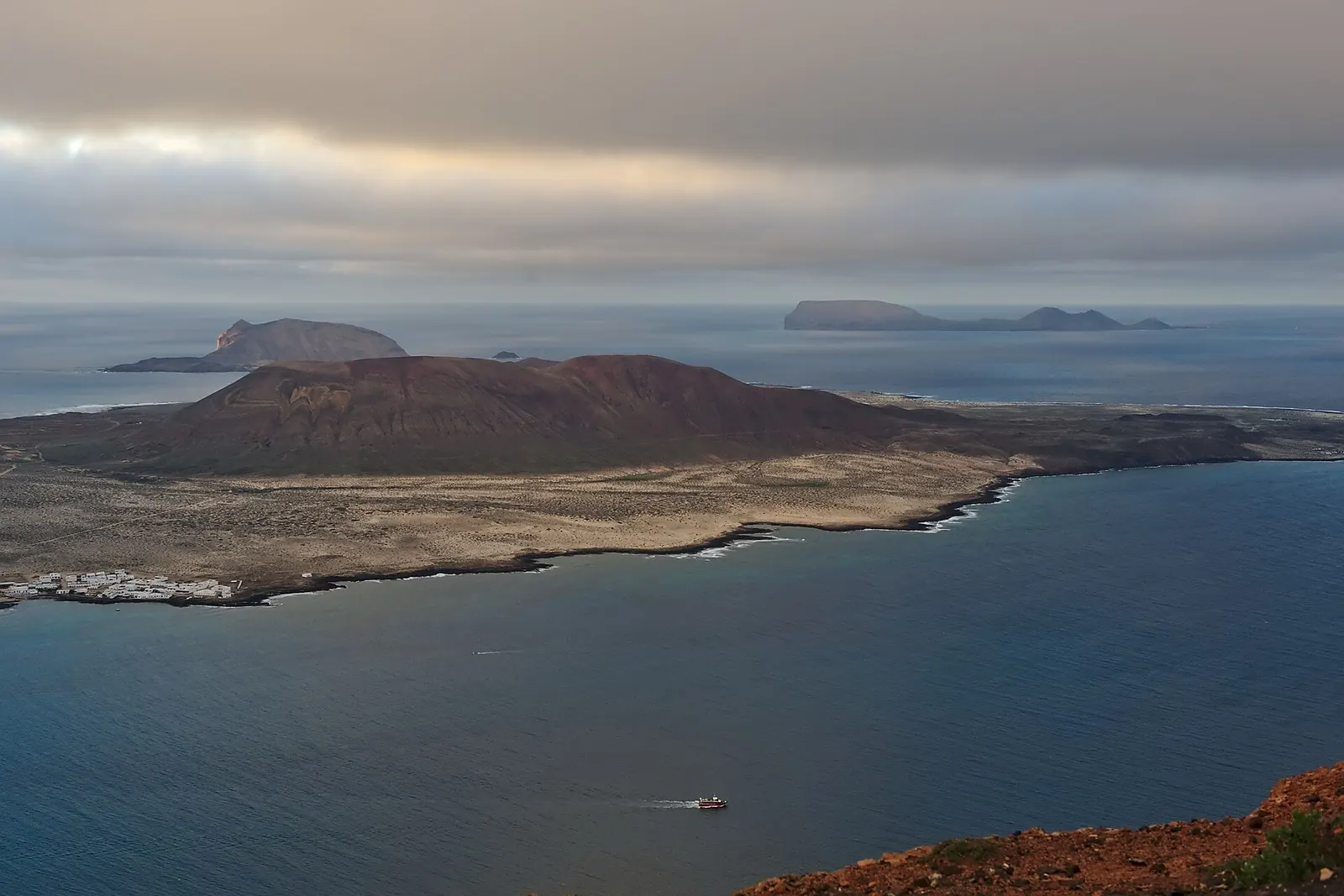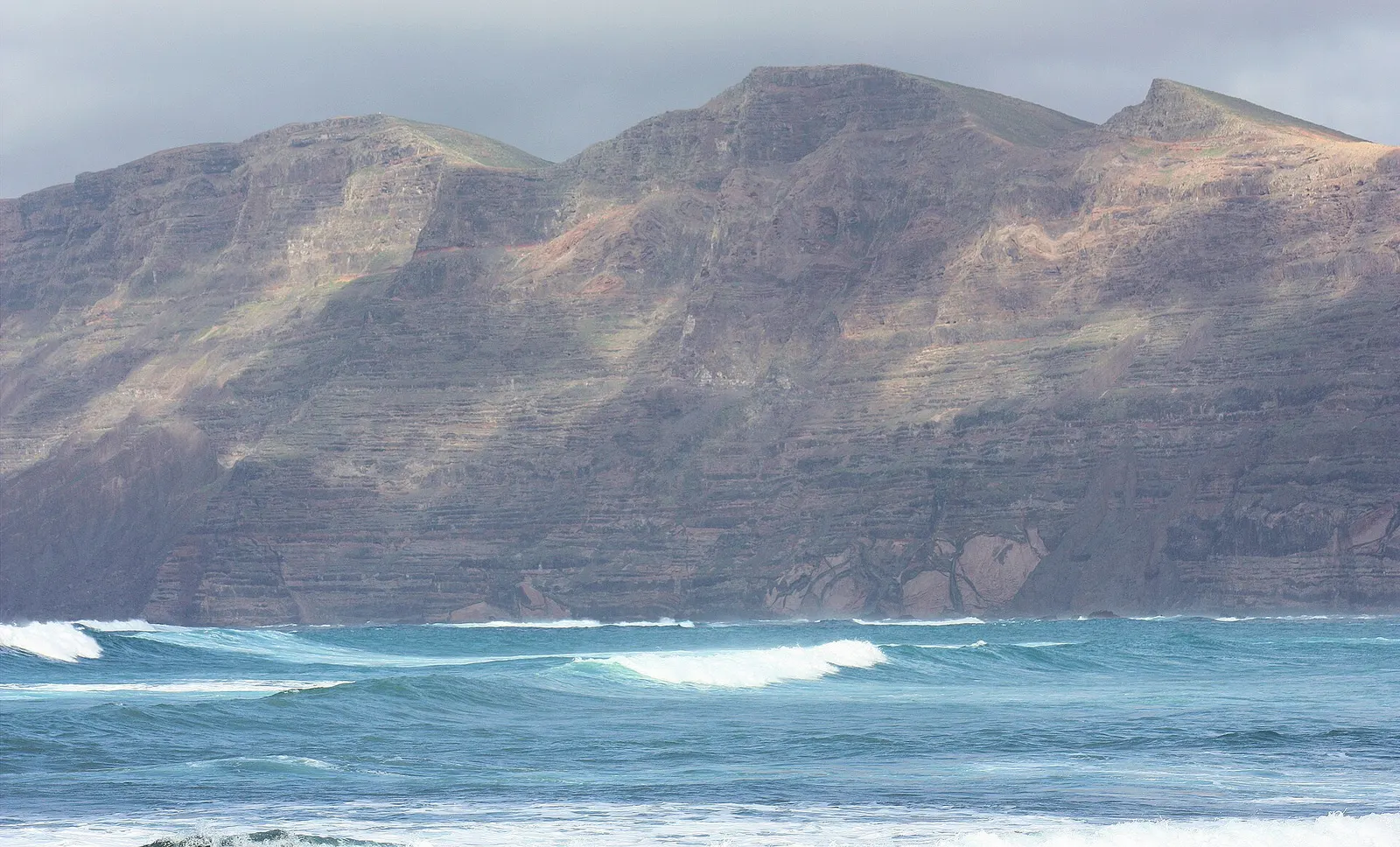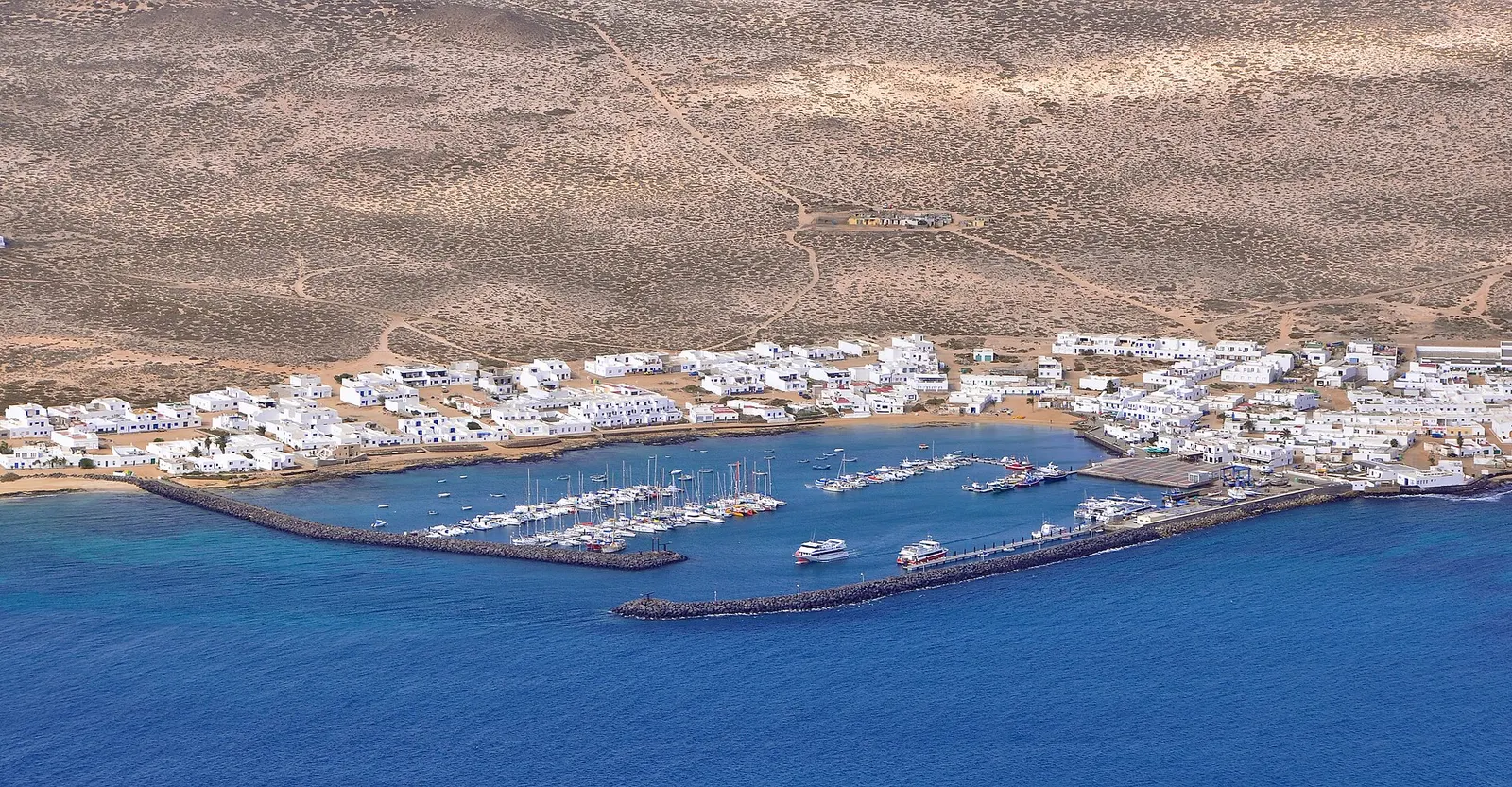
Some islands are remembered for a landscape, others for a sound. La Graciosa is remembered for the absence of one: the engine. In Caleta de Sebo, its main village, the streets have no tarmac. They are sand, and you can walk them barefoot if you like. There are no private cars, because none can be brought over. What there is: a harbour of small boats, low white houses, the Famara cliffs across the strait and a sense of time measured by the boats that come and go.
Since 2018 the Statute of Autonomy of the Canary Islands has named it an island rather than an islet: its article 4 lists the seven islands with their own administration and, alongside them, “the island of La Graciosa”, which is administratively attached to Lanzarote.
The essentials
- You arrive by boat from Órzola, in the north of Lanzarote, on a short crossing. The car stays behind. The details are in getting to La Graciosa.
- Caleta de Sebo holds the harbour, the houses, the shops and the bicycle hire. Pedro Barba, to the east, is a small hamlet with hardly any services.
- You get around on foot, by bicycle or by four-wheel-drive taxi, along dirt tracks.
- The whole island lies within the marine reserve of La Graciosa and the northern Lanzarote islets, and inside the Chinijo Archipelago Natural Park.
The beaches, one by one
Playa Francesa lies about three kilometres west of Caleta de Sebo, facing Lanzarote, with water that is usually more sheltered. A little further on, beneath Montaña Amarilla, the coast turns ochre; you reach it along the track, by bicycle or by taxi.
To the north is Playa de las Conchas, the one in every photograph, with Montaña Clara opposite. It is also the most treacherous: the swell and currents are strong and the red flag is common. Come here to look and to walk the shoreline; swim only if the sea genuinely allows it.
From Las Conchas, a classic loop follows the north coast to Pedro Barba and returns along the shore to Caleta de Sebo. It is a full day by bicycle, with your own water and shade, because outside the village there is nowhere to buy either.
Getting around
In Caleta de Sebo there is bicycle hire near the harbour; electric bikes sell out in season, so book ahead. The tracks have loose sand and the odd climb. For those who would rather not pedal, the village’s four-wheel-drive taxis run transfers to the beaches and tours of the island; there are few of them, so book in advance. Neither the bikes nor the taxis publish fixed fares: ask when you book.
Staying the night
La Graciosa in the morning and La Graciosa in the evening are two different islands. Mid-morning the boats arrive with day-trippers; late in the afternoon they leave. Whoever sleeps in Caleta de Sebo has a calm harbour, low light over Famara and the village to themselves. It is the best advice in this guide: do not come to La Graciosa for a few hours.
If you are thinking of camping, the rule is clear: only in the designated area at Bahía del Salado and with prior authorisation. Almost the whole island, apart from the villages of Caleta de Sebo and Pedro Barba, is state-owned land inside a protected area. Outside that zone, there is no camping.
The marine reserve, taken seriously
La Graciosa lies within the La Graciosa and Northern Lanzarote Islets Marine Reserve. For visitors that means three things: no shellfish gathering, no spearfishing, and diving only in the marked zones and with authorisation. Recreational fishing from a boat requires authorisation from the Government of the Canary Islands. Nor do stones, shells or sand go home as souvenirs: the island’s landscape is what remains when nobody takes it away.
To see the reserve from its best angle, the water, continue with Lanzarote from the water: sailing the Chinijo Archipelago. And to look at La Graciosa from above, the other side of the strait is Famara. The Mirador del Río, which looks down on it from the clifftop, is covered in northern Lanzarote.
Our view
The luxury of La Graciosa cannot be bought: it is earned by staying. One night in Caleta de Sebo, a bicycle, water in your bag and the tide as your only timetable. It is the smallest island we cover around Lanzarote, and the one that gives back the most time.
Facts checked on 20 October 2026 with the BOE (Spain’s official gazette), the Ministry of Agriculture, Fisheries and Food and information from the La Graciosa centre of the National Parks Autonomous Agency. Access information as of October 2026: confirm timetables, bookings and conditions before you go.