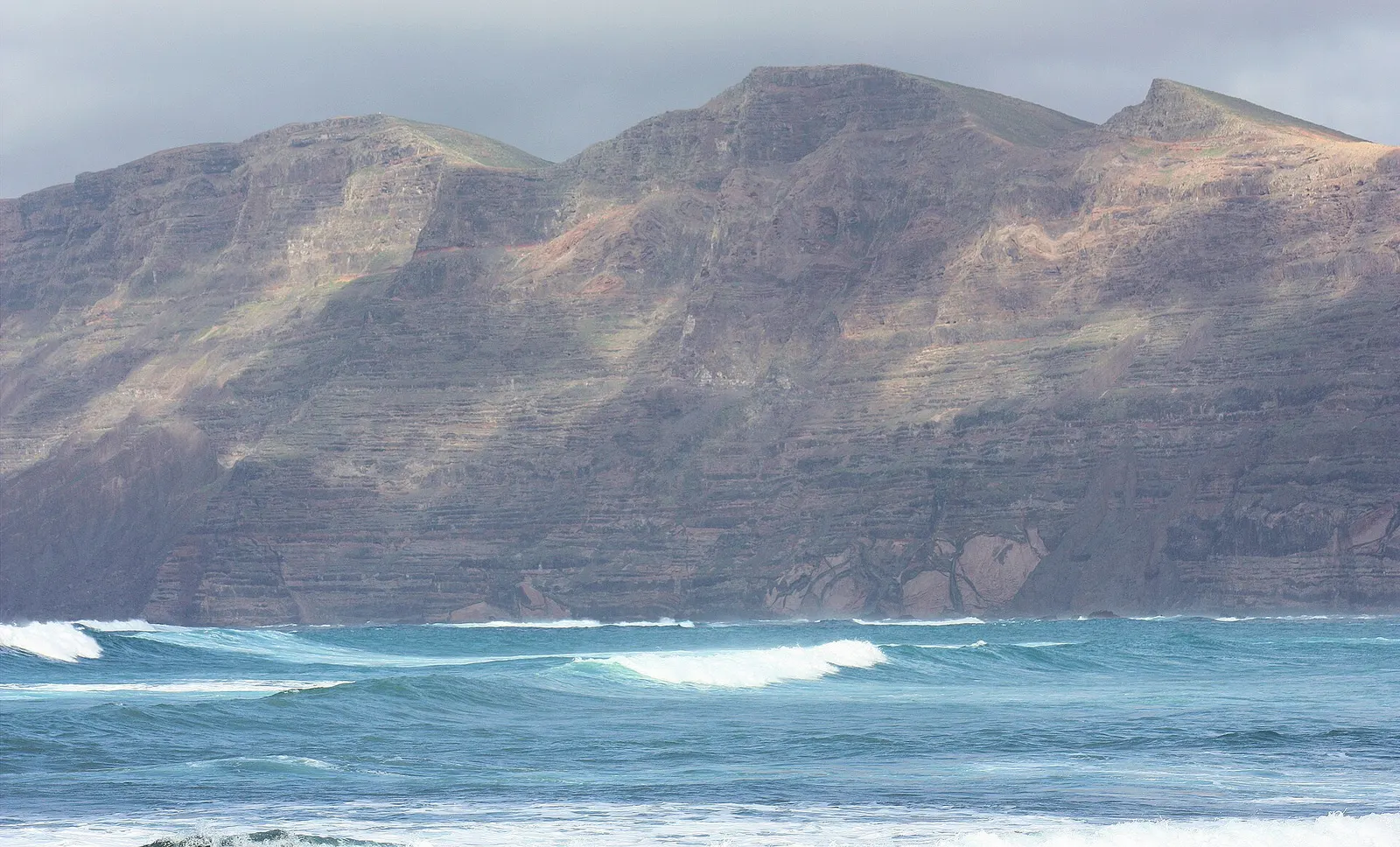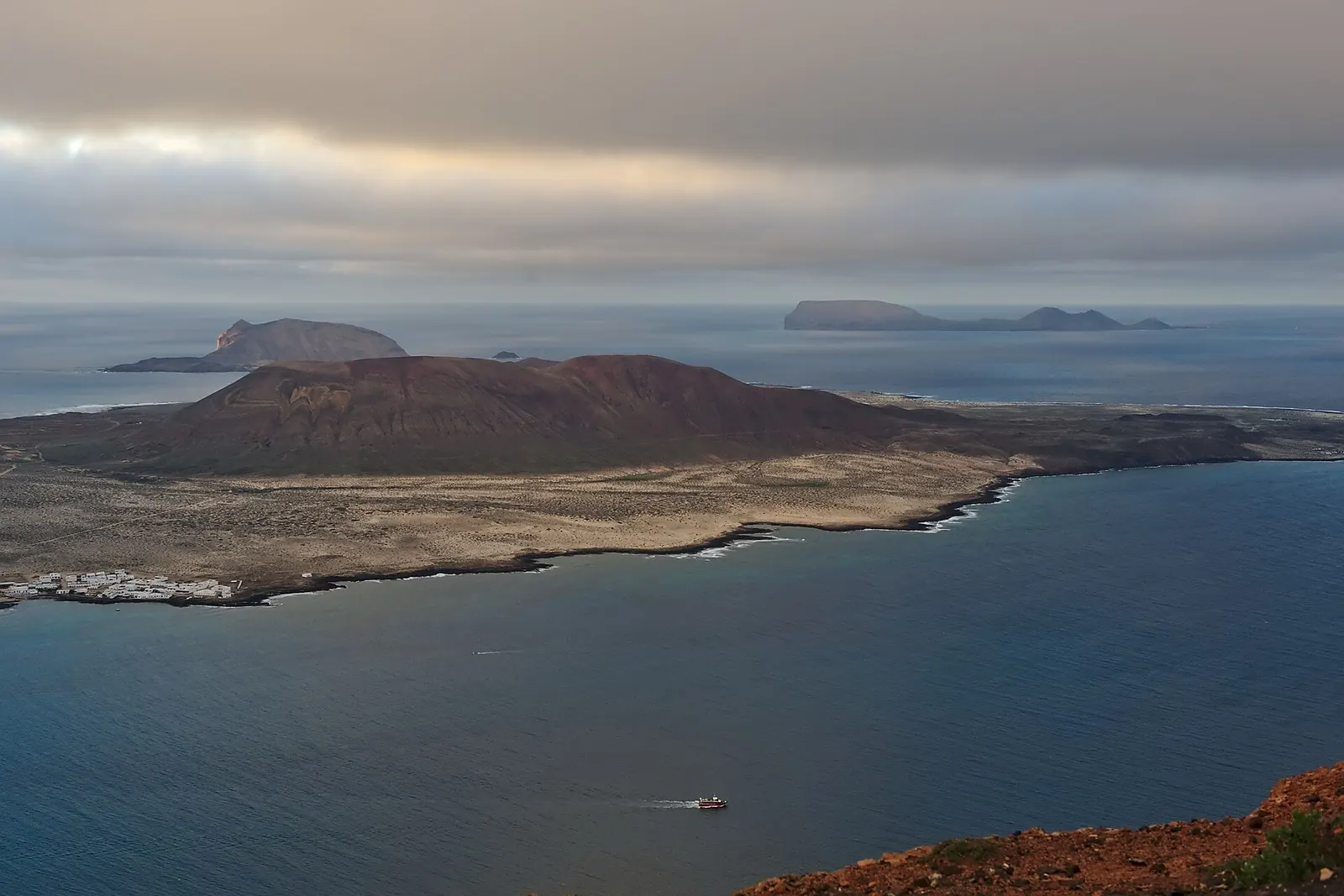
From land, the north of Lanzarote is a wall: the Famara cliffs, hundreds of metres of rock dropping into the sea. From the water, that wall becomes a balcony, and in front of it appears what the island keeps hidden: La Graciosa, across the strait known as El Río, and beyond it, in a line to the north, Montaña Clara, Alegranza and the Roque del Este and Roque del Oeste. This is the Chinijo Archipelago — chinijo being Lanzarote’s word for something small — and it is better understood from a boat than from any viewpoint.
The essentials
- All of this sea is a marine reserve. The La Graciosa and Northern Lanzarote Islets Marine Reserve covers the north of Lanzarote, La Graciosa and the islets.
- No shellfish gathering and no spearfishing. Diving only in marked zones and with authorisation.
- Recreational fishing from a boat requires authorisation from the Government of the Canary Islands.
- The islets are seen from the water. They hold protected seabird colonies; this guide does not suggest landing on them.
- The sensible way is with a skipper, who knows the wind and the local rules.
What you see from the boat
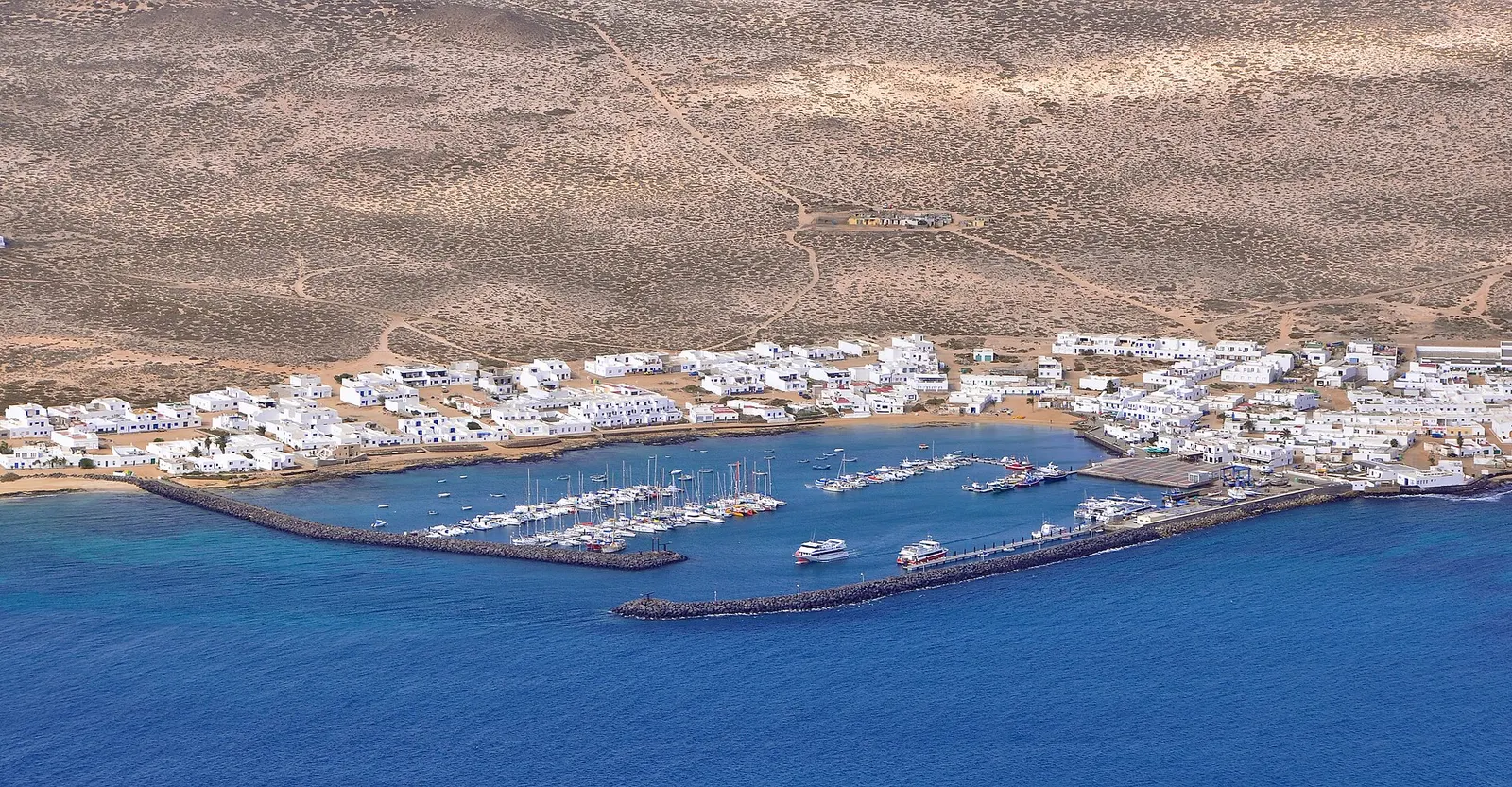
Sailing between Lanzarote and La Graciosa, the Famara cliffs rise on one side, and high up you can make out the Mirador del Río, built into the clifftop to look at exactly this. On the other side is Caleta de Sebo, its white houses at water level, and the beaches of La Graciosa: Playa Francesa, the ochre slope of Montaña Amarilla and, to the north, Las Conchas, facing Montaña Clara.
Further out lies Alegranza. It is the northernmost islet and one of the Canary Islands’ important places for seabirds: species such as Cory’s shearwater and Bulwer’s petrel nest there. That is why the area is a Special Protection Area for birds. The right approach is the one ornithologists themselves ask for: distance, low engine and no approaching the colonies.
Lanzarote and the Chinijo Archipelago are also a UNESCO Global Geopark: the volcanic geology you read in the cliffs and in the cones of La Graciosa is part of what is protected.
The rules of the water
A marine reserve is not a backdrop: it is a set of rules. For anyone sailing here, they come down to this:
- No shellfish gathering and no spearfishing. Not an octopus, not a limpet.
- Diving only in marked zones and with authorisation. If you want to dive, go with a centre that holds the permits.
- Recreational fishing from a boat, only with authorisation from the Government of the Canary Islands, applied for through its online office.
- Nothing goes home as a souvenir: no volcanic stones, no shells, no sand.
And on land, on La Graciosa, camping is only allowed in the designated area at Bahía del Salado and with prior authorisation.
With a skipper, and with the wind
Lanzarote is ruled by the trade winds, the north-easterly that cools the island much of the year. In the north, that wind and the Atlantic swell can change the day quickly. So the sensible choice here is not to hire a boat and head out alone, but to go with a professional skipper and a company that operates with every authorisation in place. Before booking, ask whether the trip enters the marine reserve and what permits it holds; a serious company will explain without hesitation.
If what you want is to set foot on La Graciosa, you do not need a private boat: the scheduled boat leaves from Órzola. We explain it in getting to La Graciosa.
Further reading
- The island, on foot and without tarmac → La Graciosa: the island where the streets are sand.
- The cliffs seen from below → Famara: the cliff, the long beach and the sand village.
- The Mirador del Río and Haría, from land → northern Lanzarote.
- Lanzarote’s other sea, underwater → Museo Atlántico.
Our view
The Chinijo Archipelago is not something to collect: it is something to contemplate. A good day on the water here is slow, with the engine idling off Famara, Alegranza on the horizon and nothing on deck that was not brought aboard in the morning.
Facts checked on 20 October 2026 with the Ministry of Agriculture, Fisheries and Food, the Government of the Canary Islands’ online office, the National Parks Autonomous Agency and SEO/BirdLife. Access information as of October 2026: the rules of the reserve and the park can change, so confirm them before setting out.