There’s a traveller the ‘airport to hotel’ guides can’t help: the one who isn’t going to a hotel. Their destination is a specific pontoon at a specific marina — the chartered yacht casting off tomorrow, their own boat back from a winter ashore, the yacht where the crew is already waiting. In Mallorca that traveller has plenty to choose from: the bay of Palma alone holds half a dozen marinas, and the journey from the plane to the water can take, at times, ten minutes; at others, an hour and a quarter.
This guide covers the ports and marinas that really matter to anyone arriving at a boat — Palma and its bay, the western marinas of Portals and Port Adriano, Andratx, Sóller, the north around Alcúdia and Pollença, and the east — with what counts on arrival: how long it takes, which marina is which, and what’s worth settling before you leave home. Everything verified as of September 2026. Palma is in the middle of a concessions reshuffle: some names will change from one season to the next.
The essentials
- Airport: Palma (PMI). By car without traffic: Real Club Náutico and Moll Vell ~15 min, Club de Mar ~20 min, Puerto Portals ~25 min, Port Adriano and Port d’Andratx ~40 min, Port de Sóller ~40 min, Alcúdia ~50-55 min, Pollença and Cala d’Or ~55-60 min, Cala Rajada ~1 h 15.
- ‘Palma’ isn’t an address: the bay stretches from Can Pastilla to Porto Pí. Confirm the marina and pontoon number before booking the transfer.
- Uber operates in Mallorca; Cabify and Bolt, unconfirmed as of September 2026. Metered taxi, bus or a booked transfer.
- The ferries don’t dock in the centre: in Palma they arrive at the Paraires and Poniente terminals, next to Porto Pí.
- Charter only with a contract, and with an operator in order: the Govern inspects the ports every season.
Before you leave home: three details that change everything
- The exact marina and pontoon. ‘My boat’s in Palma’ can mean the Club de Mar, to the west, the Real Club Náutico beside the cathedral, or a club at Can Pastilla, five minutes from the airport. Ask your base, your skipper or your captain for the name of the marina and the berth number: it’s the difference between being dropped at the gate and hauling kit bags across half the bay.
- The real boarding time. For charters, each operator sets its own; there’s no standard published time. Arrange the transfer around that figure, not your flight schedule, and leave margin for summer traffic.
- The luggage decides. Soft bags, a cool box, the crew’s shopping: the volume of an embarkation doesn’t fit just any car. Choose the vehicle by its boot, not by the fare.
Palma: one bay, five different ports
The port of Palma is run by the Balearic Port Authority, which describes it as the largest of its five ports and puts it at 10 km from the airport. Very different worlds fit inside it, and it’s worth knowing which one your boat is in.
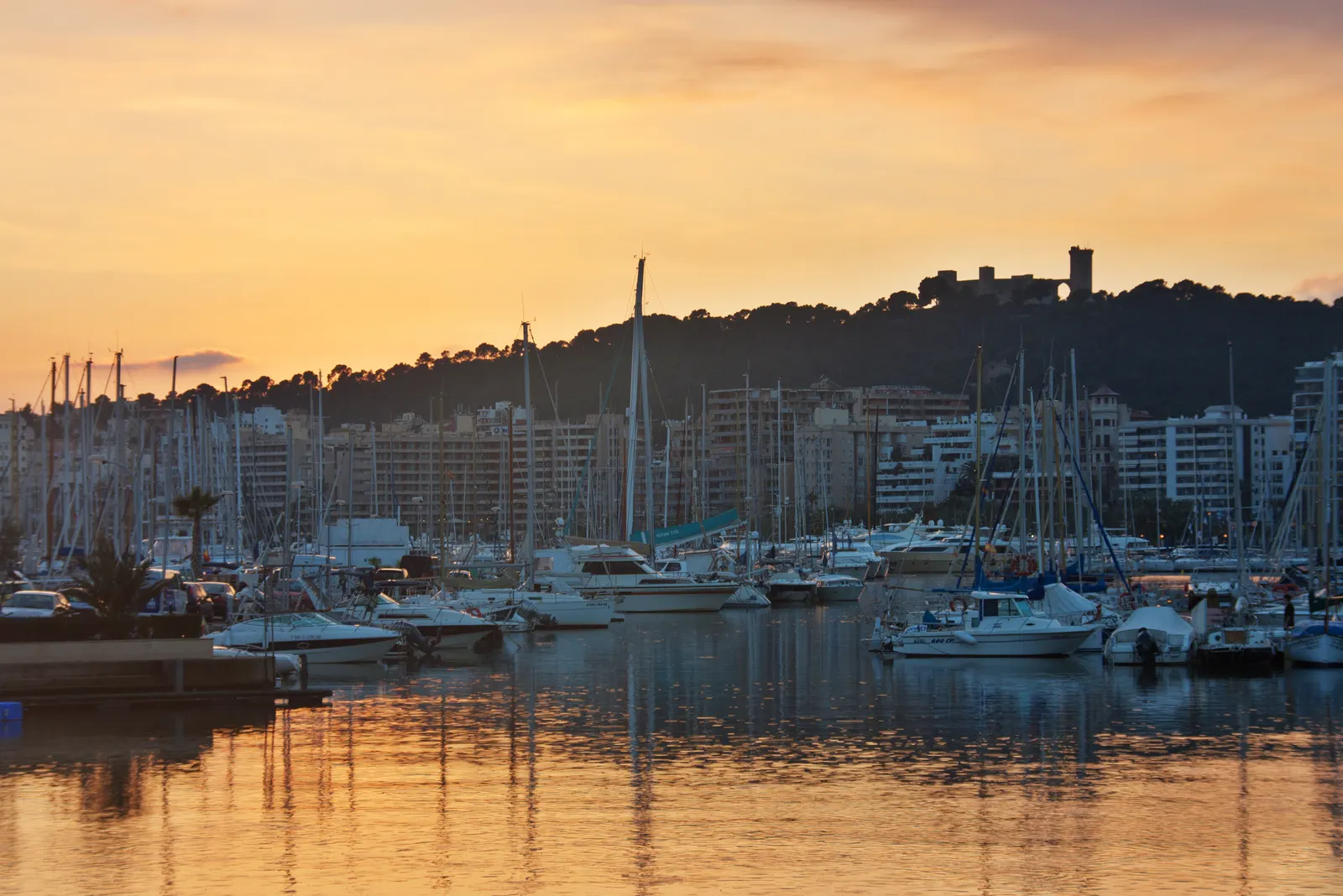
Club de Mar, in the west, opposite Porto Pí, is the marina for the big boats: more than 500 berths and, according to the club itself, room for boats up to 170 metres. About 20 minutes from the airport. It’s also the end of the port where the ferry terminals are.
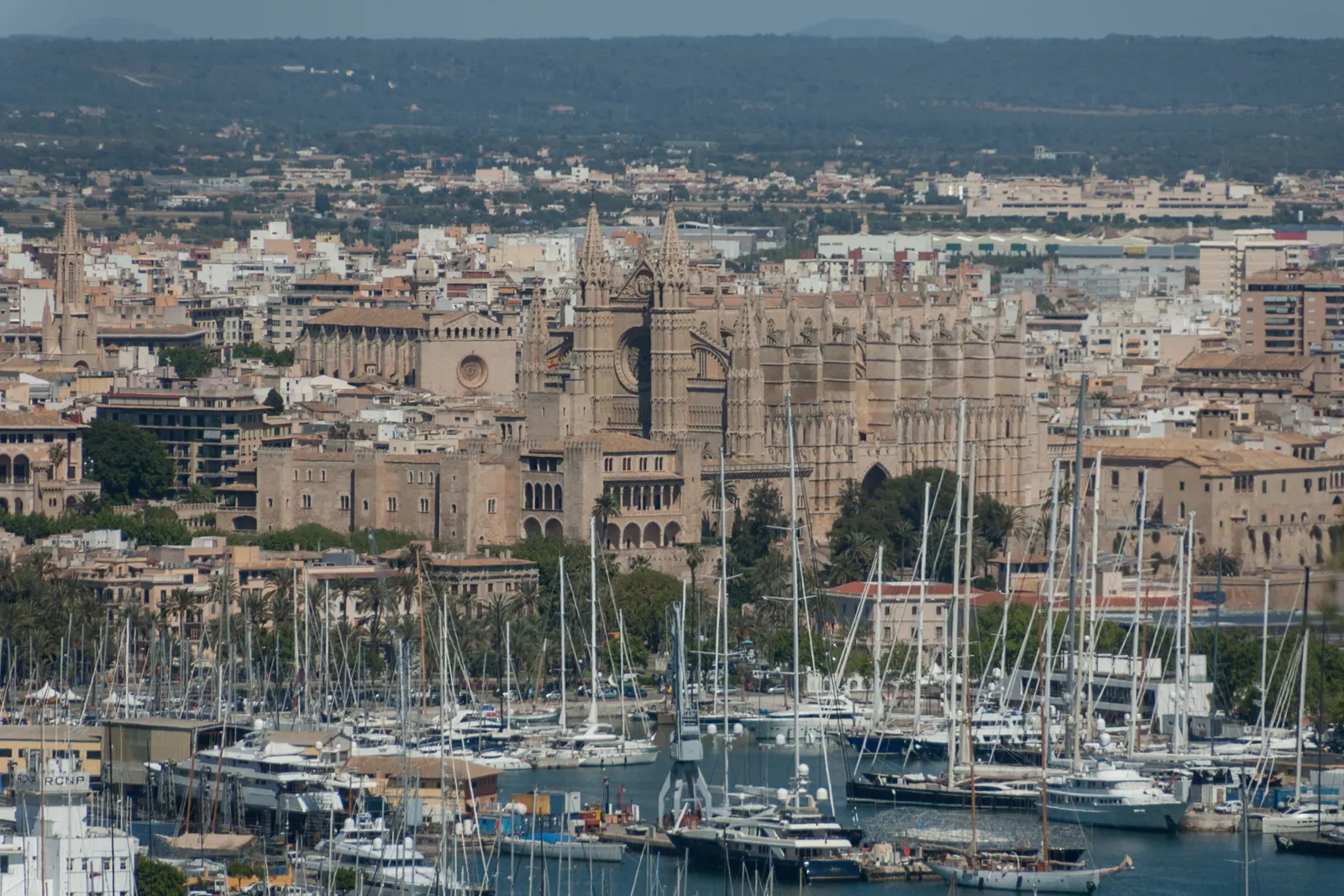
Real Club Náutico de Palma, in the Sant Pere basin, next to the Moll Vell and at the foot of the cathedral, has 1,019 berths. Right beside it, the Moll Vell offers 26 berths from 15 to 40 metres a hundred metres from the cathedral, with parking for its clients. Both are about 15 minutes from the airport. Opposite the Hotel Victoria, on the Paseo Marítimo, Marina Port de Mallorca has 200 berths for boats up to 50 metres.
To the east, Portitxol and the sailing clubs of Can Pastilla are the closest ports to the airport: between 10 and 15 minutes. And anyone who comes to Palma for the boat rather than the holiday — an owner checking on a refit — has their place at STP, the port’s large shipyard, which takes boats up to 120 metres.
A note for 2026: the charter berths on the Paseo Marítimo and other parts of the port are in the middle of the concession-awarding process. If your charter leaves ‘from the Paseo Marítimo’, confirm the exact pontoon with your operator the week before you fly.
And a second note, for anyone arriving by ferry: the shipping lines dock at the ferry terminals of Paraires and Poniente quays, at the western end, not in the centre. Check the terminal on your ticket: with luggage, count on a taxi or a transfer, not a stroll.
The west: Puerto Portals, Port Adriano and Andratx
West of Palma, in Calvià, are the two big superyacht marinas outside the city. Puerto Portals, in Portals Nous, has 701 berths from 8 to 60 metres, with shops and restaurants right on the quay; about 25 minutes from the airport. Port Adriano, in El Toro, brings together 487 berths from 6 to 80 metres — in summer it takes boats up to 100 — and has private parking; allow 35 to 40 minutes. The corridor is served by the TIB’s Aerotib A11 line, which runs from the airport to Palmanova, Magaluf, Santa Ponça and Peguera, but doesn’t drop you on the pontoon.
Further on, Port d’Andratx, about 40 minutes away, belongs to Ports IB and got a new operator for its sailing facilities in 2026; the part run directly by the Govern offers transit berths bookable online. It’s also a port with stepped-up charter enforcement: in July 2026 the Govern carried out an operation there against illegal chartering.
The Tramuntana: Port de Sóller
The only major port on the north-west coast is Port de Sóller, run directly by Ports IB: 465 berths, 164 of them for transit, with an office on the commercial quay. About 40 minutes from the airport through the Sóller tunnel, free to use since 2017. There’s no direct bus: you change at the Estació Intermodal in Palma, so with boat luggage a booked transfer is the sensible choice. It’s the natural base for sailing the coast of the Serra, which we cover in Mallorca from the water.
The north: Alcúdia and Pollença
The bay of Alcúdia is the island’s other great sailing hub. Alcudiamar, under concession from the Port Authority, has 745 berths; the APB puts the port of Alcúdia at about 50 km from the airport, between 50 and 55 minutes. The port also has a ferry terminal, with the line to Ciutadella de Menorca: if you’re island-hopping, this is your gateway. The Aerotib A32 connects the airport with Inca, Alcúdia, Platja de Muro and Can Picafort.
Port de Pollença, about 55-60 minutes away, combines the part run directly by Ports IB with the Reial Club Nàutic Port de Pollença, under concession. It’s the natural gateway to Formentor by sea, where Ports IB has one of its fields of eco-friendly buoys.
The east and south: Cala d’Or, Cala Rajada and la Colònia
In the south-east, Marina de Cala d’Or has 499 berths and is about 55-60 minutes from the airport. Further north, Portocolom and Porto Cristo combine publicly run areas with a sailing club, about an hour away; the Aerotib A42 runs as far as Manacor, Cala Millor and Cala Bona. Cala Rajada, at the north-eastern tip, is 1 h 15 away: Ports IB manages 85 berths and the sailing club another 130. And in the south, Colònia de Sant Jordi has 315 berths, 37 for transit, about 45-50 minutes away; the Aerotib A51 runs from the airport to S’Arenal, Llucmajor and Campos.
From the airport to the pontoon: the real options
- Bus. The EMT A1 runs into central Palma (€5.00 for the airport ticket, in cash or by tapping a bank card) and the TIB’s Aerotib A11, A32, A42 and A51 run direct to coastal areas. None drops you at your pontoon; for Sóller, Andratx or Pollença you have to change.
- Taxi. Metered, with the official Mallorca fare (Decree 20/2025): a €2.50 flag-drop fee, €1.20 per kilometre by day and a €4.65 airport surcharge. The minimum fare from the airport is €16.95. At summer peak times, the rank queue shows it.
- VTC. Uber operates in Mallorca and has bays in the airport’s arrivals area. Other apps aren’t confirmed on the island.
- Booked transfer. Price and time fixed from home, a vehicle chosen for the luggage and, above all, a driver who already knows which marina you’re headed to. For a charter group — six or eight people with kit bags and shopping — a minibus settles it in a single trip. If your final destination is a hotel, you’re better served by the guide from Palma Airport to your hotel.
Once aboard: two rules that protect your week
Charter with a contract. The Govern goes after illegal chartering: in 2026, up to September, more than 1,350 inspections across the islands and dozens of case files opened. A boat in order carries its identifier and hands you a contract; that’s what protects you if something goes wrong.
Never anchor on posidonia. It’s banned across the Balearics under Decree 25/2018. Ports IB has fields of buoys bookable online in Mallorca — Cap Blanc–Cala Blava, Formentor and Sant Elm — and the Govern offers an anchoring viewer and apps such as Posidonia Maps to show where to drop anchor without damaging the meadow. Mooring without touching the seabed is the quietest form of luxury we know.
Depending on who you are
- You’re a crew arriving for a charter: look for genuine space. A minibus settles luggage and crew in a single trip, and a driver who knows the marina saves you a lap of the bay.
- You’re expected on board (a guest on a yacht): the transfer is part of the experience; the car should match the boat, and the driver should know the pontoon before you do.
- You keep a berth on the island: yours are the journeys of the season — airport, shipyard, provisioning. And if you’re coming to check on a refit, the airport is twenty minutes from STP.
- You’re island-hopping: the ferry to Ciutadella leaves from Alcúdia. Our guide to getting to your boat in Menorca covers the other side.
Our take
The classic mistake of anyone arriving at a boat in Mallorca is thinking ‘the port of Palma’ is one place. It’s five, spread across an entire bay, and there’s another dozen marinas around the island besides. Our advice fits in three lines: confirm the marina and the pontoon, book the transfer around the real boarding time and choose the vehicle by its boot. The sea imposes its own calm the moment you cast off; don’t let logistics steal the day before from you.