Menorca is probably the easiest island in the Mediterranean for a family holiday, and not for what it has but for what it doesn’t need. There’s no need for water slides when there are calm coves where the water barely covers your ankles for the first few metres; no need for endless transfers when the island can be crossed end to end in under an hour; and no need for kids’ clubs when, in summer, children play in the village square until dinner time.
This guide is for families who travel the way we do: no water parks, no all-inclusive wristbands, nap times built in, and the appetite to see more than the pool. We’ve checked everything against official 2026 sources — Turismo de Menorca’s beach services table, the Consell’s opening times and prices, and each town council’s festival programme — and what we couldn’t confirm, we haven’t claimed.
The essentials
- The beaches for young children are the ones with calm water, a gentle entry and a lifeguard: Es Grau, Cala Galdana, Sant Tomàs, Cala en Porter, Santandria and Sa Platja Gran; in the north, the Arenal d’en Castell.
- Lifeguards: 26 supervised beaches in 2026. Each town council sets its own season, starting in May; Es Castell has none.
- The wind decides the day: with a tramontana, head south; with a south wind, head north. Our tool where the sea is calm tells you every morning.
- Culture without overspending: at the Consell’s archaeological sites, free for under-8s always, and for everyone on Mondays.
- Festivals: yes to the children’s programme; no pushchairs at the jaleo, as the town councils themselves ask.
- Where to stay: by area, depending on what you want on your doorstep. We don’t publish hotel lists.
What makes a beach good for children
It’s not about the photo. With young children, a beach works when it ticks off most of this: a gentle slope into the water, shelter from the swell, a lifeguard in season, shade (pines or parasols), parking close by and toilets and something to eat within reach. The unspoilt coves that fill every postcard usually miss three or four of those points, which is why we leave them for when the children can walk on their own (we tell you which ones at the end of this section).
The beach services table published by Turismo de Menorca, updated on 21 May 2026, is the best source for checking this: it gives the walking time from the car park, the facilities and the bus route for every beach.
The calm-water beaches, by area
In the south: for tramontana days
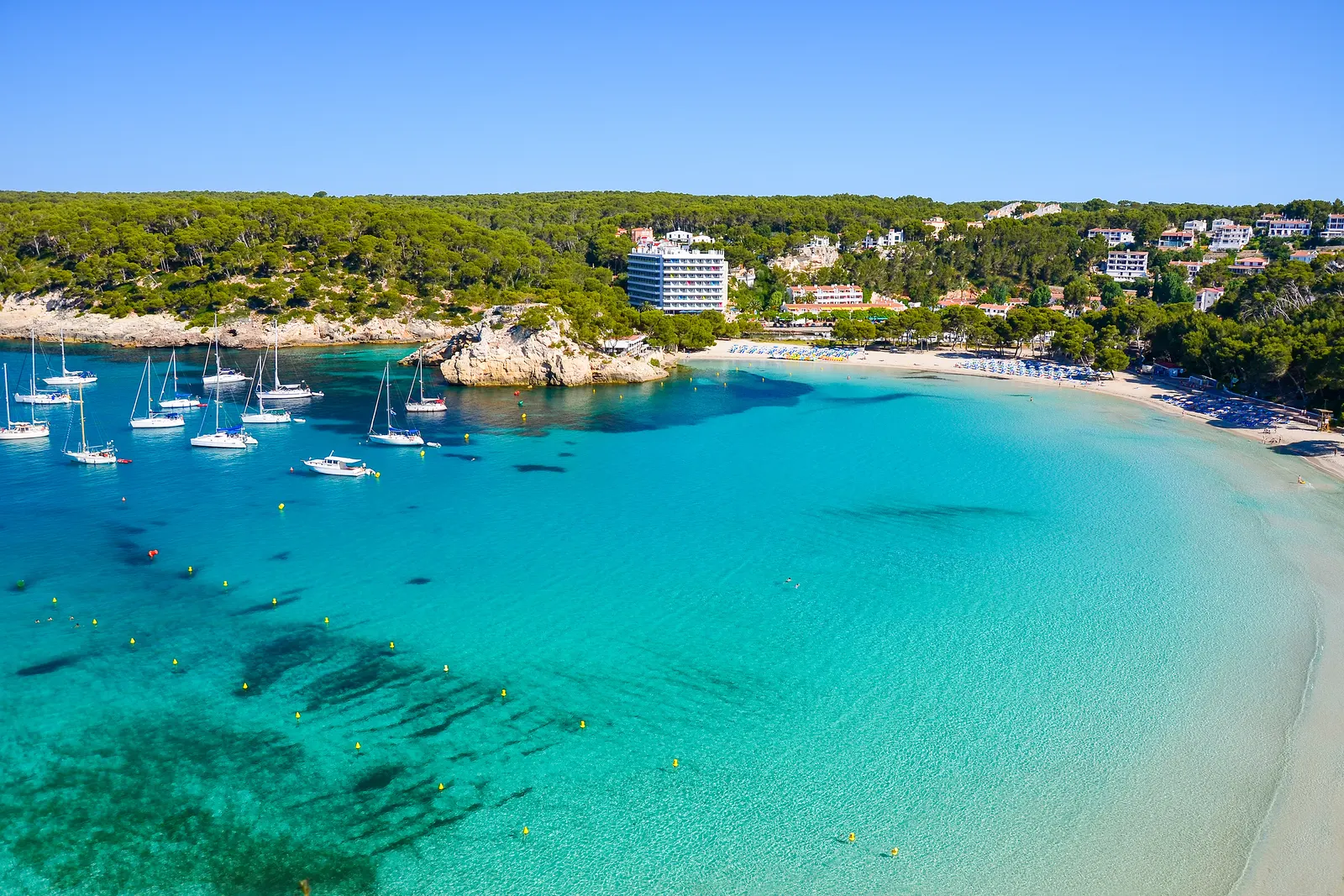
Cala Galdana (Ferreries). The textbook family beach. Its cliffs, according to Turismo de Menorca, “keep the swell out”, the sand slopes gently into the water, and the surrounding pine wood is made for eating or resting in the shade. It has sunloungers, toilets, restaurants, a picnic area and an accessible point, plus four lifeguards from 1 May to 31 October. The car park is close to the sand, but it fills up early in July and August; with a south wind, it loses some of its calm.
Sant Tomàs (Es Migjorn Gran). White sand, shallow water and a pine wood that runs right down to the front row. Its great asset is the promenade: just over a kilometre, flat, closed to cars and shaded by pines, with a playground, picnic tables and wooden walkways down to the sand. Lifeguards are on duty from 1 May. With a south or south-westerly wind, the water loses its calm.
Cala en Porter (Alaior). Turismo de Menorca describes it as a “natural pool surrounded by cliffs that shield it from the swell”, with shallow water and a playground right on the sand. The car park is next to it. It’s one of four beaches on Menorca with a Blue Flag in 2026 and has two lifeguards (three at the height of the season). At sunset, Cova d’en Xoroi sits on top of the same cliff.
Son Bou (Alaior). Menorca’s longest beach, 2.4 km according to the official listing, with a gentle slope and every facility, lifeguards and a Blue Flag. One nuance worth knowing: it’s a bay open to the sea, and the emergency services classify it as the island’s only high-risk beach. On a calm day it’s a pleasure; with a south wind, real waves. That’s when the lifeguard’s flag has the final word. We cover it all in our guide to Son Bou.
Son Saura (Ciutadella). For when the children can already manage a ten-minute walk: it’s reached on foot from the car park in 5 minutes (Es Banyul) or 10 (Bellavista), and in return it offers what almost no other beach has, a leafy pine wood that gives shade right down to the water’s edge, and very shallow water. There are lifeguards and a picnic area, but no bar or sunloungers: bring everything. The car park has controlled capacity from 1 May to 15 October, and the number 66 bus runs there in summer. It’s exposed to the south and west.
Near Ciutadella
Cala Santandria. Small, “well sheltered” except from the west wind, with a gentle slope, sunloungers, toilets, a restaurant and step-free access. In 2026 it had a bathing assistance service for people with reduced mobility from 13 July to 30 September.
Sa Platja Gran (Es Degollador). Ciutadella’s town beach, a ten-minute walk from Plaça de l’Ajuntament: a narrow inlet of calm water whose depth “decreases gradually towards the shore”. It has a seafront promenade, facilities, a lifeguard and the same bathing assistance service as Santandria.
Cala en Blanes. Very sheltered from southerly winds, with a palm grove used as a picnic spot, and a lifeguard in season.
In the east and north
Es Grau (Maó). Turismo de Menorca calls it “the family option par excellence”, and rightly so: it sits inside a bay sheltered by the Illa d’en Colom, there are no waves and the water is shallow. It has ample free parking, a bar, toilets and two lifeguards from 11 May to 11 October (11am to 8pm at the height of summer). And just steps away starts the pushchair-friendly walk we’ve actually checked ourselves (more on that below).
Punta Prima (Sant Lluís). Very gentle slope, a playground on the promenade, every facility, a Blue Flag and three lifeguards from mid-May. It’s exposed to the south-east: with wind from that direction, there’s some swell. Very close by, Binibèquer Nou, also Blue Flag, has fine sand and a pine wood with picnic tables behind it.
Arenal d’en Castell (Es Mercadal). An almost circular bay of very calm, shallow water, with sunloungers, toilets, restaurants, an accessible point and lifeguards in season (in 2026, until 15 October). Two things to know: it has almost no natural shade, and with a tramontana it stops being a swimming pool.
The ones best left for when they’re older
They’re beautiful, but they demand legs, proper shoes and constant supervision. With young children:
- Macarelleta: 15 minutes from Macarella along a clifftop path with some tricky sections, and no facilities.
- Macarella: the water isn’t the problem; the logistics are. In summer it’s reachable only by bus, on foot or by bike, and it fills up.
- Cala del Pilar: about 50 minutes on foot, uphill on the way back, with no shade or facilities.
- Pregonda: 35 minutes from Binimel·là along stony, clay paths.
- Trebalúger and Escorxada: between 45 minutes and over an hour’s walk, with some climbing.
- Tortuga and Presili: 35 and 20 minutes on foot, without a scrap of shade or a single facility.
Several of them feature in our guide to Menorca’s unspoilt coves, for the day the children are the ones leading you there.
The wind decides the day
The rule Menorcans live by fits in one line: with a tramontana (north wind), head south; with a south wind, head north. The official listings confirm it beach by beach: Son Bou, Sant Tomàs, Son Saura and Cala en Porter are exposed to southerly winds, while Arenal d’en Castell, Cala Tirant and Binimel·là take the brunt of the tramontana’s swell. With young children, a day of rough sea on the wrong coast is a day lost.
There’s no need to guess. Our tool where the sea is calm cross-checks the AEMET forecast against each cove’s orientation every morning and tells you which coast is sheltered.
Away from the water: plans that work with children
Talayotic settlements, in the open air
Talayotic Menorca is a World Heritage Site and, with children, a stone playground where you wander among talayots, taulas and prehistoric houses. At the sites managed by the Consell, under-8s go free, always, and everyone goes free on Mondays (2026 prices). Naveta des Tudons (€2) is a 400-metre walk from the car park; Torre d’en Galmés (€3) has picnic areas and an interpretation centre with audiovisual displays. Talatí de Dalt, privately run, is free for under-12s. One tip you won’t find in any brochure: there’s no shade in summer, so go early morning or late afternoon.
Líthica, the stone quarries
At Líthica, near Ciutadella, the former marès sandstone quarries form a maze of open-air chambers and gardens. Under-15s go free if travelling with family, always with an adult: there are some level changes. In the morning, tickets must be bought online in advance. More on this in our guide to Líthica.
The sea, from a boat
- The seabed of Maó harbour: the glass-bottomed catamarans of Yellow Catamarans tour the harbour from April to October in 60–70 minutes, for €18 for adults and €9 for ages 3 to 12; under-3s go free.
- A llaüt around the coves: the llaüt trips run by Mar en Calma from Cala Galdana have no minimum age and last about three and a half hours, with a Menorcan snack included.
- By kayak, with the older ones: there are guided cave routes from Cala Galdana, and beginner-level kayak-and-snorkel trips in the Fornells marine reserve. Neither operator publishes a minimum age: ask when you book.
Horses, farms and cheese
- The Menorcan horse, black and the star of every festival: at Son Martorellet (Ferreries), it’s a free, self-guided hour-long visit around the stables and paddocks, from May to October.
- On horseback: the Cavalls Son Àngel trails accept children from age 6; at Son Bou, the one-hour ride is from age 5 (the two-hour ride asks for age 7 with experience, or 12 for first-timers).
- Inside a cheese dairy: Subaida runs a guided family visit, and at Binillubet children get to be “cheesemakers for a day”. Book ahead for both. Everything on the island’s cheese is in our guide to Mahón-Menorca cheese.
- The farm: Lloc de Menorca, in Alaior, is a small zoo and educational farm open from April to October.
One pushchair-friendly walk and two short hikes
- Sa Gola, in s’Albufera des Grau: the pushchair walk we’ve actually put to the test. It’s 1.7 km, flat, about 45 minutes, shaded by pines and mostly accessible; it starts from the car park by Es Grau’s football pitch. The climb to the viewpoint is short, steep and optional.
- Sant Tomàs–Son Bou along the Camí de Cavalls: 6.4 km, low difficulty and mostly flat, between two beaches with facilities. For children who already walk well.
- A word of warning on the Sa Mesquida–Es Grau stretch: it’s often sold as family-friendly, but it has a steep climb and medium difficulty. No pushchairs, and only with children who walk well.
The lighthouses, hand in hand
Favàritx lighthouse, in its moonscape of slate, is only reachable in summer on the L43 bus from Maó (from 15 May in 2026; €3.65 each way). At Cap de Cavalleria and Punta Nati, the path runs right along the cliff edge: hold hands, always. We cover them all in the lighthouses of Menorca.
Plan B: if it rains or the tramontana blows
If it rains, the best option is underground: Cova de s’Aigua, in Cala Blanca (Ciutadella), is a cave with an underground lake, visited with a guide in a small group over 45 minutes. Under-8s go free (€5 for ages 8 to 15, €10 for over-15s), and it’s worth booking ahead. After that:
- Can Saura, the Museu de Ciutadella: free for under-18s; Tuesday to Saturday, morning and afternoon.
- The Museu de Menorca, in Maó: has a children’s space, the Petit Museu, with a simulated archaeological dig. As of September 2026 the first floor, where it’s located, was still closed due to a fault (in the meantime, entry is free): call ahead on 971 350 955.
- The Museu Militar in Es Castell, with its air-raid shelters: free, Wednesday to Friday and the last Saturday of each month, in the morning.
- The Torre de Fornells: open daily, 10am to 4pm, free for under-8s.
- The cheese dairies that offer tours, by booking.
There are more ideas, without children in mind, in what to do in Menorca when it rains. The talayotic settlements, Líthica, the lighthouses and the Camí de Cavalls are all outdoors: save them for when it clears up.
If the tramontana is blowing, the problem isn’t the sky but the sea in the north. On that day, forget boat and kayak trips from Fornells and the northern lighthouses, and head south and inland instead: Galdana, Sant Tomàs or Cala en Porter for swimming, and the Naveta, Torre d’en Galmés or Líthica for the rest of the day. Always check with the operator that a trip is still running.
The festivals: which ones work and which don’t
From June to September, every town celebrates its patron saint with horses: the caixers ride into the square, the horse rears up on its hind legs among the crowd, and the jaleo begins. It’s the most Menorcan thing you’ll see, and with children it calls for judgement. Almost every town council warns about it in writing: “Do not go through the Jaleo with a pushchair” (Sant Lluís, 2026); “It is dangerous to move around with pushchairs” (Maó, 2026). And almost all of them ask for closed shoes: no flip-flops.
| Festival | When | With young children |
|---|---|---|
| Sant Joan, Ciutadella | 23 and 24 June | Best avoided: the Caragol des Born, the hazelnut-throwing, the corregudes, the Jocs des Pla and the fireworks, which the municipal bylaw rates as high risk. Under-14s can’t enter the cordoned-off areas unaccompanied. |
| Sant Martí, Es Mercadal | Third weekend of July | Yes: the children’s Monday, with a foam party for over-7s, accompanied by an adult. |
| Sant Jaume, Es Castell | 24 and 25 July | Yes to the workshops, and on the 26th to the children’s watersports activities at Cales Fonts. The 25th’s corregudes, the town council itself warns, carry high risk. |
| Sant Cristòfol, Es Migjorn Gran | Fifth weekend of July, or the first of August | Yes: it’s the smallest jaleo (46 caixers in 2026), and the Monday is for the children, with games and a tongue-in-cheek donkey jaleo. |
| Sant Bartomeu, Ferreries | 23 and 24 August | Yes, especially the day after: in 2026, the 25th brought a donkey jaleo, a foam party and children’s entertainment. |
| Sant Lluís | Last weekend of August | Yes: the most complete family programme; in 2026, with a children’s pregó and child caixers. |
| Gràcia, Maó | 7 and 8 September | Yes to the family area at Parc des Freginal; in 2026 the fair opened its first evenings without music or lights, designed with autistic children in mind. |
The exact dates for each year are in our festivals calendar and the what’s on listings. If you want to watch the jaleo with children, find a balcony or the edge of the square, arrive early, bring water and a hat, and don’t let them touch the horse: the official signs warn of the risk of kicks. Winter has one more date for the little ones: on 5 January, the Three Kings arrive at Maó harbour at 6pm and parade up to the town hall.
Where to eat with children
On Menorca, meals are unhurried and dinner is late, and with children, that’s solved with three approaches:
- The beach bar with facilities. Galdana, Son Bou, Punta Prima, Cala en Porter and Santandria all have a bar or restaurant, according to the official 2026 table.
- The picnic in the shade. The picnic areas under the pines at Cala Galdana, Son Saura and Binibèquer Nou, and those at the settlements of Torre d’en Galmés and Torralba d’en Salort, are the most Menorcan dining room there is. Fill the basket at the Claustre del Carme market in Maó or the Ciutadella market.
- The night market. In summer, the one in Es Mercadal (Thursdays, June to September, 7pm to 11.30pm) and the one at Cales Fonts, in Es Castell (every night from 15 June to 15 September), sort out dinner while the children run around the square.
For the proper tables, the ones worth a babysitter or a long, lingering meal, there’s where to eat in Menorca; and for what Menorcans actually cook at home, home cooking from Menorca.
Where to stay with children, by area
We don’t publish hotel lists. What’s useful is choosing the area, based on what you want within walking distance:
- The south of Ciutadella (Santandria, Cala Blanca, Cala en Bosch): several supervised beaches on foot and the city itself a few minutes away. In August, plenty of people.
- Cala Galdana: a sheltered bay with everything on your doorstep. In return, it’s packed at the height of the season.
- Sant Tomàs and Son Bou: the long stretches of sand in the south, with a promenade and facilities; Sant Tomàs is the smaller of the two.
- The south-east (Punta Prima, Binibèquer, Sant Lluís): Blue Flag beaches, whitewashed villages, and Maó and the airport close by.
- The north (Arenal d’en Castell, Fornells): calm-water bays, as long as the tramontana isn’t blowing.
- The interior (Alaior, Es Mercadal, Ferreries): the most central base if you’re driving; the whole island is within an hour.
If the great houses of quiet luxury appeal to you, check the age policy first: Biniarroca, Casa Ládico and Morvedra Nou are adults-only. And for getting around, getting to and around Menorca covers it all: the number 01 bus links Maó and Ciutadella in an hour.
The practical part
When to go: June and September
With children, the two months bookending summer win out for three reasons. The heat: at Menorca airport, the average maximum is 25.8°C in June and 26.2°C in September, against 28.9°C in July and 29.2°C in August, and nights above 20 degrees go from 4 in June to 20 in July (AEMET, 1981–2010 averages). The crowds: in 2025, June had 18% fewer passengers through the airport than August, and September had 24% fewer (AENA). The sea: in September it’s warmer than in early July. The trade-off is that September brings a little more rain and the odd stormy day. The full calendar is in when to visit Menorca.
The sun and the flags
Between May and August, with a clear sky, the UV index AEMET forecasts for Maó sits around 8, “very high”, and on some July days reaches 10. The Balearic emergency service 112 sums it up for young children: a hat, shade and water often, even more so with babies. The lifeguard’s four flags: green, swimming allowed; yellow, caution; red, swimming forbidden; orange, no lifeguard on duty.
If a jellyfish stings
The 112 Baleares protocol: get out of the water, don’t rub it (not with a towel, not with sand), remove any remains with tweezers or the edge of a card, rinse with seawater, never fresh water, and apply cold for 10–15 minutes, with the ice in a well-sealed bag. If nausea, dizziness or general unwellness appear, go to hospital. If you spot jellyfish, tell the lifeguard. Our tool where the sea is calm flags, cove by cove, whether the recent wind has been pushing them towards the shore; it’s a guide, not a guarantee.
Tap water
It isn’t safe to drink across the whole island. In 2025, ten supply zones in Maó, Es Castell and Ciutadella had water unfit for consumption due to nitrates (in Ciutadella, also chlorides), according to official data from the Ministry of Health; in Santandria, Sa Caleta and part of Cala Blanca, the town council declared it unfit for drinking or cooking until 15 September 2026. With children, the sensible approach is bottled water for drinking, cooking and making up bottles; tap water is fine for showering and washing.
Doctors, pharmacies and phone numbers
- 24-hour A&E: Hospital Mateu Orfila, in Maó, is the island’s public hospital and has a Paediatrics department, which also covers A&E. In Ciutadella (Canal Salat health centre) and Alaior (Es Banyer), there’s round-the-clock primary care emergency service; in Maó, the Dalt Sant Joan health centre covers it from 8am to 10pm.
- Phone numbers: 112, free, 24 hours, available in Spanish, Catalan, English and German; 061, medical emergencies.
- Duty pharmacies: on the website of the Balearic Pharmacists’ Association (cofib.es), listed by town.
- European Health Insurance Card (EHIC/GHIC): gives access to public healthcare on the same terms as a resident, but doesn’t cover private care or repatriation. Every family member should carry one, children included, and it’s worth adding travel insurance on top.
Car seats and getting around
In Spain, any child 135 cm tall or under must travel in an approved car seat or booster, matched to their height and weight, in the back seat; the DGT (Spain’s traffic authority) recommends keeping it up to 150 cm. Not using one carries a €200 fine and 4 points. The exemption that lets taxis carry children without a seat only applies to urban traffic in big cities: on Menorca’s roads, ask for the seat when you book your hire car, taxi or transfer, and confirm the model. The distances help: it’s about 12 minutes from the airport to Maó, and about 45 to Ciutadella. All the options are in Menorca airport to your hotel.
Our take
A good morning on Menorca with children looks a lot like a good morning without them: a sheltered cove early on, before the crowds arrive; a picnic under the pines; a nap when the sun gets fierce; and, as evening falls, the village square. The island doesn’t need you to turn it into a theme park: it just needs you to pick the right cove for the wind, and not ask a four-year-old for an hour-long hike.
If you’d rather have the plan done for you, the trip planner asks whether you’re travelling with children and their ages, and steers you away from the long-walk coves if you have a pushchair. And for the famous beaches, the ones everyone wants to see, the Society’s free guide Menorca’s famous beaches, and how to see them without the crowd tells you what time they stop being packed.