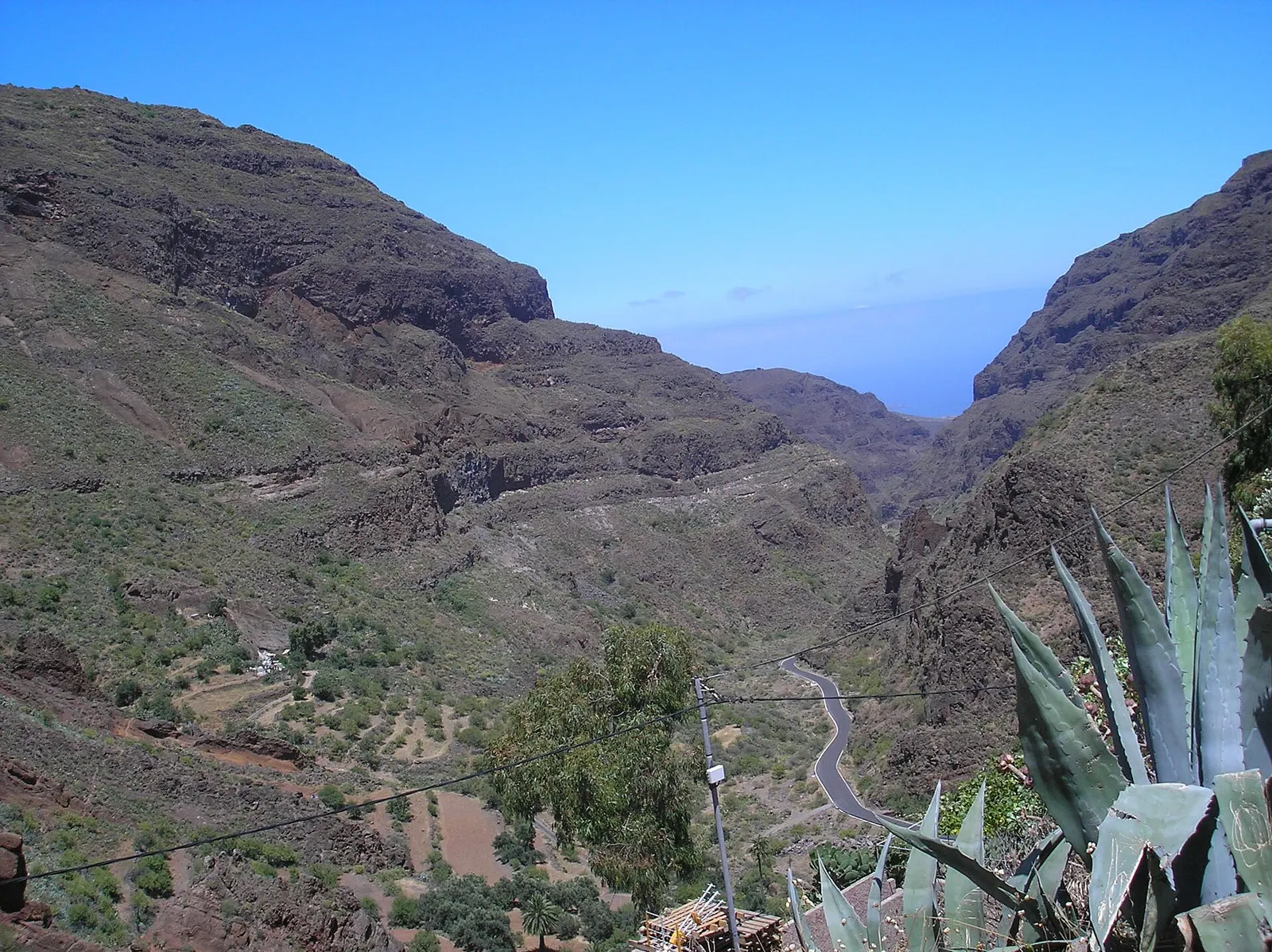
There is a Gran Canaria that never makes it into the beach brochure. It begins in the south-east, a few kilometres from the motorway, where a narrow road slips between two walls of rock and the island changes register: less sun and sand, more stone, palm trees and painted doors set into the hillside.
This is the Guayadeque ravine — the barranco de Guayadeque — the natural boundary between the municipalities of Agüimes and Ingenio. And its most remarkable feature is not the landscape but the fact that people still live inside its walls.
The essentials
- Where: between Agüimes and Ingenio, in the south-east of Gran Canaria. You drive up the GC-103, which ends at the head of the ravine.
- What to see: the interpretation centre at the entrance, the Cuevas Bermejas — cave houses that are still lived in — and the dining rooms carved into the rock at the end of the road.
- Getting there: by car or on foot is best. The bus — the guagua — runs infrequently: if you use it, check the timetable beforehand. More in getting around Gran Canaria.
- When: in the morning, to drive up slowly, and back before nightfall.
A ravine with a memory
Guayadeque was one of the great places of the ancient Canarians. Its walls are full of caves that served as homes, granaries and burial sites, and many of the Aboriginal remains now kept at El Museo Canario, in Las Palmas de Gran Canaria, came from here.
What makes it interesting is that the story never broke off. After the conquest, people went on carving into the tuff to live inside the mountain, where the temperature stays steady all year. That continuity — from Aboriginal cave to cave house with its door, its window and its flowerpot — is what makes Guayadeque more than a pleasant drive.
The interpretation centre
At the mouth of the ravine stands the Guayadeque Ravine Interpretation Centre, a building dug into the hillside using the same technique as the cave houses. It covers the ravine’s geology, its plants and wildlife, and its history from the ancient Canarians to the present. It is the best place to start: afterwards, everything you see from the road makes more sense.
Opening times and admission may change: check before you go.
The Cuevas Bermejas
At around kilometre 5 on the road you reach the Cuevas Bermejas, a hamlet carved into reddish rock that is still inhabited. There is a small cave chapel dedicated to San Bartolomé, around which the ravine holds its fiestas.
These are homes, not a museum. Look from the road and the little square, without peering through doorways or photographing the people who live there.
Lunch at the end of the road
The GC-103 ends at a small cluster of restaurants carved into the rock, serving Canarian cooking: grilled meats, papas arrugadas — wrinkled potatoes — with mojo sauce, island cheese. Eating inside the mountain, with the light of the ravine coming in through the door, is one of those simple experiences that stay with you.
We name none of them because opening hours and menus change with the day and the season: ring ahead, especially midweek and out of season. The story behind those dishes is in eating in Gran Canaria.
Walking the ravine
Guayadeque is good walking country: there are waymarked trails through the ravine and paths between the caves. If you walk, carry water and sun protection, stay on the waymarked trails and do not enter caves that are not open to the public: many are archaeological sites and others private property.
And the usual rule in a place of natural and archaeological value: do not take stones or anything else from the ravine.
Our view
Guayadeque is not an outing to rush between two beaches. It is a slow half-day: the interpretation centre in the morning, the road at an easy pace, a long lunch in a cave and the drive back in the last light, when the ravine walls take on the colour that gives the Cuevas Bermejas their name.
To understand who lived here before the conquest, the other half of the story is up on the summit: what UNESCO protects in the heart of Gran Canaria.
Information as of October 2026, checked against local guides and public information from the interpretation centre. Bus, centre and restaurant hours may change: check before you go.